For the past few years, the first of April has been a special day in my life. It was on that day in 2013 that I published the inaugural post on this blog and announced it to a select group of people. In 2014, I stated why the blog exists. There were no commemorative posts in 2015, but I made the decision to become a linchpin. While I erred in my quest afterward, let us be clear: an important decision was made, and on that day. So now in 2016, I wanted to make something happen, having remembered the anniversary only in the middle of March. Given the state of mind that I was in at the time and what I had done in previous years, I felt the urge to do something that was just as meaningful, but new and certainly different.
Different,
as in wearing a red nose during my morning commute to work.
Conveniently, I already had one, gifted to me by Corinne after
a clown
exercise that she had us do in theater class several years ago. I had
actually worn the nose since then, in 2012, but only around the block
of my
apartment building. At the time, I found the idea of doing that so daring that I labeled it an Operation Original. This "originality", I owe it to Hypnotica,
an artist of sorts who once decided to wear a dildo taped to his forehead while
walking through a shopping mall. It was his attempt to conquer his fears
of uncertainty and public ridicule, which he saw as obstacles to the
ability to think freely. I cannot sincerely say that I had the same
motives as him, but I was captivated by outrageous nature of his experiment and motivated to emulate him. Not quite with a dildo, but
with a red nose.
If truth be told, it took me four years to take the plunge. I had
imagined wearing the red nose in an everyday
situation, while going to work via subway or shopping at the supermarket, but the doing that seemed too daunting for me at the time. I just could not
will myself to do
it. The stuff that I did in my neighborhood was only a
small test, a simulation that lasted less than five minutes and had no practical objective ‒ I was not going anywhere to do anything useful. I remember having felt great nevertheless (and
relieved) when I made it back to my apartment after the test, even though nothing really had happened except some curious looks from several
passers-by and from a client seated on the terrace of a cafe. But something had happened; something within me, that is. I had
stepped out of my comfort zone. Now, four years later, I felt more
ready to go beyond the test, to "do
the real thing". The idea was at the back of my
mind, and even though I did not think about it everyday during that
entire time
span, it was never forgotten. It ended up remaining the lone social
experiment ‒ among those that I had conceived ‒ that I had not dared to
perform yet, notably because it was truly "out there". Besides, when March came by, I found
myself often down in the dumps, while at work, among
others,
or even alone. I knew more or less what I had to do to pick myself up,
and it boiled down to becoming more engaged, among other things. So I
decided to get engaged ... with myself. That is how life starts getting better, right? Given my despair, it only
seemed right to do something big. Big like red-nose big. And then, sometime later, out of the blue, I remembered it would soon be April
1st. It
would be on a Friday, a work day. I began to realize what that day had
meant to me. Memories and thoughts converged naturally to give birth to
the perfect idea albeit a
scary one. I asked myself, "Remember that young, tall, blond
lady that you saw that
morning some time ago when you were heading towards the office building
from the
RER station? Remember she was wearing a red nose, looking so casual as
she walked and talked with someone? What if ... that was you?"
The decision to strike, so to speak, was made two weeks before April
1. During those two weeks, which seemed longer than they really were, I
experienced waves of excitement and anguish. Not only was I trying at times
to
discourage myself, uttering things like "Who wears a red nose in
the metro, in the RER or even at work?" and "Do you look
like a kid?", I found myself worrying about how people would react to me, or to something so unusual. Would I get arrested? Would I get beat up? Would my phone get snatched
from me? Questions that remained without answer. However, I did find it a bit comforting that this non-stop inner monologue revealed something fundamental. The fears of public ridicule and
uncertainty, the same
ones that Hypnotica said that he was trying to overcome, I had them too.
Despite the temptation to give in to the fears, I fought to embrace the opportunity that laid before me, an opportunity that I had myself created. What's more, in the moments that I was lucid, I knew
that I
did not want to be saddled with regret on the eve of April 2. So the best that I could do was to prepare for battle.
I kept my motivation up by consuming my favorite
quotes, my favorite articles, and my favorite videos, over and over again. I even read a couple of my own blog posts, such as the love and responsibility piece, which was particularly instrumental. I also used basic visualization
techniques on a daily basis, to reinforce the belief that I could
perform on the big day. At work, with friends, in the metro, or while group
sketching in Paris, I found myself sometimes preoccupied with the task that I had set out to do. Surely, it was not something to
be shared with anyone. At least not until the task was accomplished.
At
the time of the test four years ago, I imagined some aspects of the ideal game plan. I especially had the vision of myself in the
metro wearing all black ‒ shirt, pants, socks, shoes ‒ except for this
red thing that did not fit. One of the 2016 touches to this plan was something of a security measure: "changing" into my red nose at the bus stop in my neighborhood (rather than at my place) and leaving my valuables in my apartment. In addition, I would leave for
work during rush hour, take public transportation during rush hour, and
arrive during rush hour. I would take off the nose in only
two instances: 1) once I was at my desk and 2) if I needed to
get in air without obstruction for a few seconds, after which I would
put the nose back on. Besides that, I would act like I normally did during
the commute (which was keep to myself, like most people, with something
to read if possible). In other words, nothing would change in my
behavior. And I would certainly not try to bury my face in a newspaper.
During the 45-minute trip to work, everything went according to plan. It was rush hour. I left home. I
walked to the bus stop. I changed. I walked to the metro station. I got
in the metro. I got off and walked to RER station. I got on the RER. I
got off and walked to the office building. I went inside. I took the
elevator. I got off on my floor. I arrived at my desk.
I experienced a variety of things. It all began during the night. I had immense difficulty falling asleep. After succeeding eventually, I ended up
awake on several occasions, each time earlier than the expected time. It was highly unusual, but I understood that the anxiety had taken over me. My
mind was very occupied and focused on the same thing: what I had vowed
to start at 8:55am. When I got up for good, around 7am, I had slept
little. Having no time for discouragement, I had to follow through. Around 9am, at
the bus stop, I hesitated for a moment. "Going in or not?", I asked
myself, painfully. Before I could answer, I pulled out the red plastic
from the inner pocket of my coat and rammed my nose inside it. At the same time, I made
a U-turn and headed towards the metro station. I felt a bit strange,
all the while
staying focused on my path. I got some looks, many of
which I looked out for as I passed by people or stood in a crowd. During a metro ride that included two stops, I noticed a boy glancing at me several times, always discreetly, while holding his father's hand. I saw few smiles here and there as well as some turned heads throughout my journey, though people seemed largely indifferent to my presence.
Some simply did not notice me,
and others who did ended up looking elsewhere after a couple of seconds.
Could you
blame them? After all, it was not like I was performing a clown act in attempt to retain their attention. I was either just walking by or
just standing there. The lack of a notable reaction from anyone ‒ except
from the guy
distributing free newspapers to passers-by, who made a joke that I did not hear well but that I thought was friendly ‒ made me wonder if the experiment was a bust. Maybe
I just no longer cared that much about what people thought of me? The interrogation gave me the thought of stopping to wear the nose.
But I discarded that thought almost immediately.
Upon entering
the office building, I managed to escape the sight of the people seated at the reception desk and especially that of the two security guards in front of the turnstiles leading to the elevators. I had briefly sought eye contact with the guards out of habit, unsuccessfully. While I was not trying to dodge them, I was not at the same
time trying to show up in front of them and say "Hey
look at me! I am wearing a red nose!" Oh well. In the elevator area, there was a guy who worked on my floor and with whom I had gone to speak about an issue several months before, when he was still new in the
organization. Seeing me, he looked puzzled, though he seemed more pleasantly so after I
said "Bonjour" to him (he returned the "Bonjour"). Out of the elevator
with him, I made it to my desk without seeing anyone else on the way.
The members on my team in the vicinity were busy talking and did
not notice that I had arrived. I found two options for what to do next ‒
1) take off the nose, congratulate myself, and go greet the colleagues
or 2) keep the nose, go greet the colleagues, and then return to take
the nose off. Obviously, the second option was more interesting, so I
went with it. As I appeared, I left everyone somewhat bemused, drawing more or less favorable reactions from the majority of them (about seven people). A few others remained in a mild state of
bewilderment, completely speechless even while I shook hands with them. In the midst of the commotion, someone
guessed that it was an April Fools' joke, which I neither confirmed nor denied. In
fact, I did not give much justification for my particular appearance, nor did
anyone inquire that I do so. What happened just happened, and in less
than a minute, having made the rounds, I was
back at my desk, alone. I took off the nose. Finally.
Like many other colleagues, I settled into the events of the day as usual, as if nothing had happened. From time to time though, I wondered if I really did arrive at work wearing a red nose. And each time, I accepted that I must have, otherwise I would not have asked myself such a question. So how did it feel for me being exposed in the public eye, especially before entering the office building? A little funny, a little uncomfortable, but nothing truly frightening. I did my best to walk through the crowded areas, after having consciously made the choice to appear during rush hour, but it seemed as if people were fewer than usual. And, once again, no one really seemed to care at the end of the day. What I had been fearful about turned out to be a non-event. A few looks here and there, and that was it. Nevertheless, when I put things in perspective some time later, I experienced a particular satisfaction. A kind that seemed deep and durable.
Yet,
I ought to be very disappointed. Why? Because I did only half of the job that I had imagined
for two weeks. The undone half? Just the trip back home ‒ or to
the bus stop near my place ‒
with the red nose on, starting from my desk. Essentially, the same
thing that I did in the morning. Except that around 6:15pm, when I was
getting ready to leave for the weekend, the momentum from the morning had dissipated and the old
anxieties were free again. No way was I going to let myself look silly in
front of all these familiar people that, for the most part, had no idea how I arrived at
work in the morning. So I didn't. The nose safely hidden in the
inner pocket of my coat, I got up from my seat, said my goodbyes, and left. Uncertainty
and public ridicule would remain things to fear ...
But the red nose will return.
Showing posts sorted by date for query operation. Sort by relevance Show all posts
Showing posts sorted by date for query operation. Sort by relevance Show all posts
Wednesday, April 20, 2016

Monday, August 31, 2015
exposure to annihilation
Fear.
It was what I often felt before running an operation in public. No matter how many times I had been through the very same operation in the past, under the very same conditions, those feelings of fear were always present and strong, instead of absent or at least weaker, as I had expected them to become over time. Then, one day, I stumbled upon the following words:
I had long attributed the words to Pema Chödrön, who wrote them in her book, "When Things Fall Apart". It was only a few weeks ago that I learned that she may have been quoting Karlfried Graf Dürckheim, who had included the words in his book "The Way of Transformation". So I went looking for the source and discovered the passage below. Nothing but love.
It was what I often felt before running an operation in public. No matter how many times I had been through the very same operation in the past, under the very same conditions, those feelings of fear were always present and strong, instead of absent or at least weaker, as I had expected them to become over time. Then, one day, I stumbled upon the following words:
Only to the extent that we expose ourselves over and over to annihilation can that which is indestructible be found in us.At that instant, I was in love. In love with these words. I believed that they spoke the truth, albeit in a rather poetic manner. After all, they expressed what I had experienced over and over again ‒ the fear of being exposed when I was about to launch an operation and the fear of getting annihilated afterwards, metaphorically speaking. Yet in the end, it was quite the opposite, because I usually felt empowered as a result of my actions. Sometimes, the feeling went beyond empowerment ‒ it bordered on invincibility. But only for a moment, naturally.
I had long attributed the words to Pema Chödrön, who wrote them in her book, "When Things Fall Apart". It was only a few weeks ago that I learned that she may have been quoting Karlfried Graf Dürckheim, who had included the words in his book "The Way of Transformation". So I went looking for the source and discovered the passage below. Nothing but love.
The man, who, being really on the Way, falls upon hard times in the world will not, as a consequence, turn to that friend who offers him refuge and comfort and encourages his old self to survive. Rather, he will seek out someone who will faithfully and inexorably help him to risk himself, so that he may endure the suffering and pass courageously through it, thus making of it a 'raft that leads to the far shore.' Only to the extent that man exposes himself over and over again to annihilation, can that which is indestructible arise within him. In this lies the dignity of daring.
Thursday, August 6, 2015
journée presque parfaite
I had hoped for a good day, but I was not expecting it to be that good. I mean, this is a post that was not meant to happen.
It all started on Monday morning in Paris, on my way to work. I took the metro, getting the opportunity to interact with a few commuters via Operation Metro. Albeit startled (who wouldn't be?), they smiled and returned the "Bonjour!" when I greeted them. The best part was that I had wasted no time before I got into the act. I had not asked myself whether or not to do it, if people were already watching me or were going to watch me, or how weird it was going to be. With an intense focus, I had simply jumped in and created the interactions that I had set out to create. Afterwards, I picked up where I left off in my book of the moment: "Ces impossibles Français", Chapter 5, "Au rendez-vous des libertins". I coasted for the rest of the ride. My mind was at ease.
After the morning spent at work, I got back on the metro during lunch break. I had decided to finish scouting Jardin des serres d'Auteuil, a botanical garden within a major greenhouse complex. I had visited the garden for the first time only the evening before, to determine if it was a suitable location for a future sketcher outing. Since I had to take three different metro lines to get there, I had three chances to run Operation Metro. Yay! Of course, I had my usual anxieties about deciding to stand out among passengers in the metro, but for the most part, I was looking forward to the opportunity. By the time I got out at Porte d'Auteuil, the closest station to the garden, I had scored only two out of three points for the operation. Why? Because on the second leg of the trip, I had interactions that were more involved ‒ and more interesting.
Waiting for the metro at Charles de Gaulle - Etoile to begin this remarkable second leg, I noticed a very pretty girl standing nearby. Then I noticed that the backpack that she was carrying was partially open. Which provided an opening for me to go talk to her. She was accompanied by another girl, but that was secondary. If I hesitated for a second before approaching her, it was because I was busy appreciating this unexpected opportunity to accomplish Operation Insecurity. Eventually, I went over. I said "Bonjour", and followed with "Votre sac est ouvert" ("Your bag is open"). She verified it, smiled and said "Merci", and I left to return to the spot where I was waiting before. Great. Wait, I left?
The only thing that saved me from self-torture after this "hit-and-run", as my friend Sophie would say, was another interaction that took place in the metro after it had arrived and I had entered. Mind you, I was still in Operation Insecurity mode, so I needed to approach another attractive girl to conclude. As a result, Operation Metro was no longer applicable, and it got suspended momentarily. In the metro, there was a pretty woman seated at a certain distance in front of me (I was standing). She had a small backpack on her lap on which it was written "Keziah". After the customary hesitation, I dodged a couple of passengers in order to reach her. "C'est pour Keziah Jones ce sac ?" ("Is that Keziah Jones' bag?"), I asked, referring to the Nigerian singer and guitarist who actually became well-known in France for performing in the Paris metro. "Non", she replied with a smile. "Il est à mon fils" ("It's my son's"). I developed the Keziah joke some more and a conversation ensued, about the origin of the name, French and English languages, and the like. In the process, she complimented my supposed French sans accent, whereas I did the same on her English (she was Congolese). I found it even amusing that she asked me which French words tended to reveal my accent when I said them. I admitted that some words with the "r" were problematic, and she inquired whether the "l" was also an issue. I thought about it. Indeed, my colleagues, all francophone, had once teased me during a meeting when I had said "les rules" (in a French manner), a word that had both "r" and "l" in it. But I digress. Eventually, the lady had to get off and thanked me for an enjoyable chat. What she probably did not know was that I was just as thankful, if not more.
Scouting the garden (after I had eventually made it there) was blissful, just as the day before. I took the opportunity to explore other areas and to ask the woman working at the entrance about picnic spots and restroom access. But what really gave me the thrill, just like the day before, was standing on the border of Roland Garros complex, which is literally across the street from the garden. I walked up this street on my way back to the metro station, gazing at parts of the rounded exterior of Court n° 1 that were not hidden from view by metallic bars and trees. I was particularly drawn to the surface at the top of the court, on which there was a long series of names inscribed for successive years. Names like G. Kuerten. S. Graf. M. Seles. A. Agassi. V. Williams. S. Williams. M. Navrátilová. J. Henin. R. Federer. And R. Nadal, over and over again. I imagined myself linked to these champions, appreciating the moment of being close to the history of the French Open beyond newspaper articles and television and computer screens.

I made the trip back to work via metro, bus and tram and the afternoon passed by. The next delicious moment happened on my way out of the building. When I got into the elevator to get to the ground floor, I was the only person. I wondered if the elevator would stop at an intermediate floor. And it did. And then I wondered if the person about to enter would be male or female. With a slight amount of nervousness, I hoped that the person would be not only female, but solitary as well. And the person was. She entered. I said "Bonjour", she said "Bonsoir" in response. As usual in these circumstances, I scolded myself for not using the appropriate greeting for the evening. Yet I was too focused on this rare occasion to care much about appropriate greetings. When the doors of the elevators closed, I turned to the lady and asked, "Vous venez ici souvent ?" ("Do you come here often?") She replied, in a more or less serious manner, "Mais je travaille ici" ("Well I work here"). We both stared at each other for a brief moment, her facial expression more puzzled than mine. An awkward silence set in. We still faced each other, but we no longer had eye contact. I noticed a faint smile on her face nonetheless. A guy got in at a lower floor, but that did nothing to change the vibe. On the ground floor, the woman got out of the elevator, then out of the building. I lagged behind, reflecting on what had just transpired. Needless to say, I was glad about it. A bit troubled, but glad.
Since it was rush hour, I decided to try out Operation Rush Hour before entering the metro to go home. I was already out on the street, and the lady from the elevator was nowhere to be found (even though I was not necessarily looking for her). I spotted a group of three girls coming my way. Hesitation. Then I spoke to the closest one as I passed her. "Bonjour, le mois d'août, vous passez vos vacances où en général ?" ("Hello, in August, where do you usually spend your vacation ?") "Rwanda", she said. Here was a reply, and even a reaction, that I had not expected. In fact, I was expecting a mild form of repulsion (which only goes to show my comfort level with this type of activity). But no, I was talking with a group of Rwandan girls. We (they and I) got to know a little about each other, but it did not mean much since we dispersed within the minute. Later on, I came across a woman who I found older and less attractive than the Rwandans but attractive nonetheless (call me a bit desperate), and stopped to quiz her on when the next public holiday was. The ideas that I have sometimes. But she was quite agreeable and played along. Each time (out of two) that she suggested a holiday that fell on a weekend, I contested her response, saying that it did not count. So we reached a conclusion that the next real holiday was on November 11, otherwise known as the anniversary of the signature of the armistice that ended World War I in 1918. We then separated and I completed my journey to the metro, where I did not hesitate to run Operation Metro once more. Pure joy.
Back at home, I announced an upcoming group outing to Jardin des serres d'Auteuil on the Paris Sketchers website. I also wrote a first draft of this very blog post.
And to think that these events happened because I decided at each instant to take responsibility for loving myself.
May the most of the following days be similar, or simply presque parfaites.
Sunday, July 19, 2015
adventures in queueland
One of the most remarkable sights in Paris is that of people lining up for something. And I'm not talking about lines to enter the Louvre Museum or to go up the Eiffel Tower. I am talking rather about everyday situations in which an average Parisian would find himself in a line. For example, a stop at the butcher's. A visit to the bakery. An outing at the movie theater. An evening at a concert hall. Keep in mind that the venues just cited can attract queues that are formed outside on the sidewalk and that for a number of them, such is often the case. It seems that this occurrence is something that most Parisians have long accepted. A reasoning that some of them may offer is that the sight of a line of people in front of the entrance to a shop is a clear sign that the products on sale in that shop are of good quality, and sometimes of very good quality. So queues in Paris can be good. Otherwise, they are most likely just a matter of too many people to be served and too few people to do the actual serving. Sure, other cities that I have lived in (as well as those that I have not lived in for that matter) can boast their own queues and this for their own reasons, but I had not paid any significant attention to queues anywhere before moving to Paris. They seem to be a part of life in this city. Given the good chances of finding one in front of the butcher's shop on Saturday morning or another outside the bakery on Sunday morning, something had to be done. I mean, seriously.
It was only a few years ago that I discovered that there was personal value in creating interactions with people, especially those unfamiliar to me, a.k.a. strangers, and started doing just that. One Saturday morning, on my way home from the swimming pool, I noticed a line of people waiting outside the butcher's shop near my place. I had often seen a line there at that time of the week without giving it much consideration. I hardly shopped there anyway. But, at that very instant, I was seeing beyond the line. What I was seeing was a group of people with unfamiliar faces, each having a few minutes to spare (before the moment came to place his order) for something to happen (a little entertainment perhaps). In other words, ladies and gentlemen, I saw opportunity. And thus, Operation Queues was born.
Well, the birth did not happen so instantly. While opportunity had been perceived, a natural process of experimentation had to take place before Operation Queues took form. The very first question ("What to do?") after discovery of the opportunity was answered by simply going to somewhere in the middle of the queue and walking along it to the end, saying "Bonjour" to each person in line along the way. As this approach was another way of saying "Bonjour", it started out as a new phase of Operation Bonjour. Ultimately, it became clear that such a style of interaction deserved its own operation, even if it was only necessary to say "Bonjour". So a spin-off was created.
With a set of rules, Operation Queues became more formal. Among other things, these rules state that upon stumbling upon a queue that has at least 5 people in the process of everyday living, I am allowed to run the operation on the queue. Doing so involves saying "Bonjour!" to between 5 and 10 people successively in a line within the queue. If the line was disorderly ‒ in other words, not a line ‒ then it was not necessary to do anything special. Since the judgment of line of people as disorderly can be subjective, I sometimes let my instincts decide the course of action to take. Also, if I have to say "Bonjour" to people in the queue who know each other and who are huddled together, for example, a family or a couple, I generally consider all of them as only one person, unless the line was too short and I wanted to reach the target of 5 to 10 people. In this case, I would greet as many members of the group one after the other as necessary. Other boundaries, such as the number of times it is possible to run the operation on a regular basis (twice per week at most), were established to avoid acting too much like a robot.
I remember roughly the very first time I ran the operation. It was at that same butcher's shop where I conceived the idea, and it was a Saturday morning. Before I even got anywhere close to the shop, I was feeling very anxious about what I was about to do (I was not even 100% sure that there would be a queue). A familiar voice within me kept trying to discourage me from doing something so weird, so ridiculous, and obviously so senseless. It was a voice that kept reminding me that the majority of the people who frequented the shop at that time were elderly people and that I should not bother them with my antics. But I was already hooked, haunted by an opportunity that refused to leave me. In hindsight, I admit that what I wanted really was to seize the opportunity. The opportunity to give life to yet another idea, to yet another operation, and, in the process, to myself. There was no way out but to follow through. Soon enough, I reached the butcher's shop and saw the queue. With my nerves raging, I proceeded to do what I had set out to do. When it was done, I walked away, without looking back.
The moments that followed were a blur. Everything happened so quickly. Getting to say "Bonjour" to the first person turned out to be the most difficult step, as I had to overcome the resistance of the inner voice that kept talking to get me to abandon. After that "Bonjour", the voice calmed down and the resistance subsided, even though the operation was not yet completed. I had the impression of being out of myself during the ordeal especially after it. But more important than anything was the feeling of accomplishment. It was undeniable, and I was still alive. I was happy.
And what about the people that I "met" in the queue? They did not seem to understand what was going on (maybe they did not like it). For the most part, they did not return the "Bonjour" nor did they do anything particular in response. Some, especially those who had probably seen me carry out the operation earlier in the queue, made little or no eye contact when I approached them. Besides, I was too focused on running the operation in the simplest possible way, and, as a result, I did not wait long enough for anyone to give me a reply. I simply moved on the next person.
Over the past few years of running the operation in places such as bakeries, cinemas, museums, libraries, cafeterias, restaurants, and nightclubs, more often outside than outside, I received a small range of reactions from queue filers. On average, most of the people returned the "Bonjour", sometimes with enthusiasm, at other times with indifference. Other people just ignored me or even looked away. Very rarely did a conversation ensue. When one occurred, it was usually because I had taken the initiative to engage it with the person. Attempting to make conversation ‒ a conversation with an opening sentence chosen on the spur of the moment for that matter ‒ was in fact an enhancement added to the operation along the way to make things more interesting, and it was only with the last person approached that I did so, for practical reasons. Even then, every attempt did not always lead to a conversation. Some people were just not keen on talking, perhaps because they did not know me. Or maybe because I was doing something unexpected.
Granted, my own attitude has a lot of influence in the reactions that I get from people in queue. The more enthusiastic and engaged I am during my interactions with them, the higher the likelihood that they will respond in a similar manner. At least, that is what I believe. On the other hand, if I am simply running things by the book just to get the task over with, I cannot expect to feel or give much joy during the interaction. And here lies a great challenge that I face in this operation. Bringing enthusiasm and engagement. The only challenge greater that I see would be having people that I know and that know me participate in these interactions. On that note, I am beginning to entertain the idea that with great challenge comes great opportunity.
And why all this fuss about queues anyway? It is probably because I see in them a way for the individual to maintain or regain his freedom while still being a part of society. Other than that, I sometimes feel like being a little different when I find myself in a group of people that seem to be doing more or less the same thing, especially when this "same thing" is expected. It turns out more often than not that honoring this feeling is good for my health. And if there is a possibility of having a positive effect on someone else in the process, even for one second, then that is just great.
Tuesday, March 31, 2015
"do you have a joke?"
Before 2pm on Saturday, February 28, 2015, I showed up at Gare de Lyon, one of the six major railway stations in Paris. I had no train to catch and I had not come to pick up someone. I had no ticket on hand and I was not going to purchase one. I was not even getting something to eat, and I had no need for the restroom. No, I was only there to run Operation Insecurity.
Operation Insecurity is nothing more than a spin-off of Operation Les Jolies Filles, which was also targeted at pretty women. In all honesty, it is exactly the same thing as Operation Les Jolies Filles. I had just changed its name to remind myself why I was running it: to overcome my feelings of insecurity towards doing unusual things in public. And to help me were the pretty women to be found all over Paris, whether they knew it or not.
Once I stepped into in Hall 1 of the train station, I began looking for a target. Walking the length of the hall, in the area that separated the platforms from the dispersed travelers, I kept my eyes open, scanning the crowd. To calm my nerves and keep away the dissuasive thoughts, I repeated a quote from the mythologist Joseph Campbell that I had remembered only after failing the same operation in the same place five hours before: "Find a place inside where there's joy, and the joy will burn out the pain." It was a quote that I believed in, given the numerous successes that I had had when running challenging operations in the past.
I got through the hall without a single approach. That's not to say that there were no pretty women around, on the contrary. I just did not make out any clear-cut opportunity or, when I did, I did not muster the courage to do anything about it, telling myself that I did not know what to say to the girl, even though I had allowed myself to say anything that came to mind. All the while, moments came and went as quickly as the number of people that were moving all over the place. Not to be discouraged, I kept on moving myself, armed with words of wisdom from Joseph Campbell.
I made my way into the Galerie des fresques, which linked Hall 1 to Hall 2. Soon enough, I spotted a woman in a very colorful outfit walking towards me, alone. As the gap between us got closer, I quickly looked around and verified that there were people nearby : some were standing by on her left, others walking behind her, and several walking behind me. Perfect. As I crossed paths with the woman, I got her attention by saying hello, in English.
"So how was vacation?", I asked.
"..."
"You know, the school vacation period just ended."
"Yes ..."
"And it lasted two weeks."
"Yes ..."
"So how did it go?"
The woman kept silent for a short moment before continuing.
"I don't quite understand. Do you speak German?"
"German?", I asked in return, surprised.
"Yes, German."
"No, I don't. Are you German?"
"No, but I speak it."
"But you do speak French?"
"Yes", she replied.
I was intrigued as to why she had asked me if I spoke German instead of asking me if I spoke French. We were in France, after all. Or did I miss something? In any case, I was not going to switch to French for the sake of convenience, so the interaction swiftly ended and we parted ways right after.
I kept on walking until I reached Hall 2. Upon entering, I found myself on one end of the floor. I went straight towards the platforms to be in the middle of the action while walking towards the other end of the floor. Of course, I was still keeping a lookout. And my efforts were about to pay off when, somewhere along the middle of the floor, I noticed two women standing together, facing the trains. One was looked like she was in her late 20s or early 30s. The other was perhaps her mother, as she looked much older. Without hesitation, I jumped into action. It was what I wanted after all. Action.
"Hello", I said, looking more at the younger woman, who was closer to me.
"..."
"Are you waiting for your train?"
"No."
"Oh, you are waiting for someone then?"
"Yes."
Silence. All the while, I could pick up a certain discomfort on their part (or was it on my part rather?). The younger woman was giving me one-word answers, though I took some responsibility for this, having coming up with such simple questions in the first place. The other woman had turned her head away and remained quiet. As for me, I had run out of things to say, and it seemed that the best thing to do at that point was to end the conversation.
"Well, have a good day", I said, smiling.
"Thanks", said the younger woman, with a faint smile. The other woman kept her silence, though she gave a hint of a smile.
I completed my tour of Hall 2 and left, going through the Galerie des fresques again to return to Hall 1. Having initiated a conversation on two separate occasions inside the same building, I had completed the operation that I had failed only five hours before. But I did not feel satisfied with this victory. In fact, I felt like I had not given an acceptable effort, notably with the two women that I met in Hall 2. The interaction with them had been simply too brief, and the questions that I asked them did not require more than "Yes" or "No" answers. Also, I had been taken aback by their relatively distant reaction. "I mean, why can't some people just lighten up sometimes?", I complained to myself, almost impulsively. And at that instant, my mind got to racing to thinking what I could do foster light-hearted interactions with strangers (in this case, with pretty women). Then an idea emerged and stood over everything else in my consciousness. I liked it and decided to give it a go.
I was already back in Hall 1, which seemed more crowded than before. But I was undeterred. In fact, I was more determined than ever, Joseph Campbell's words still by my side. I walked below the main departure board suspended in the middle of the hall, among the dozens of travelers who had their eyes fixed on it. Nearby, I saw three girls standing in a small circle, talking. Given the mass of people around them, it was an excellent opportunity for me to feature my insecurity. So I chose to go capture it.
"Hello", I said.
"Hello".
"Do you have a joke?"
"Er ... what?"
"Do you have a joke?"
"A joke?"
"Yes. A joke. Do you have one?"
The girls looked amused. I guessed that they also felt perplexed. But they were game, and started conferring quietly among themselves. It took place quite quickly, and I could not record everything that was going on. However, I remember being pleasantly surprised by the success that I was having in pulling off this stunt. Some silence had crept in, so naturally, I made sure to pick up the dialogue.
"Okay, I'm waiting for a joke!", I stated, with a hand gesture meant to convey my impatience.
"Do you speak French?", one of the girls asked me.
"Yes, I do. But not today."
She seemed to take that well.
"What about a bad joke?", another girl asked.
"Well, a bad joke is still a joke", I conceded.
"All right, I am going say it, it's in French."
I moved in closer to listen. I found it a bit odd yet humorous that I was going to have to understand a joke in French even though everyone was aware that I had chosen to not speak a word of French.
"Qu'est-ce qui est jaune et attend?" (In English: "What is yellow and wait?")
"'Jaune', OK, I got that. 'Attend'? Like from the verb 'attendre'?"
"Yes."
I thought about it for a while, trying to come up with an answer. I asked for a clue, but I don't think that my request registered with the girls. Helpless, I did not spend much time before giving up.
"Jaune-attend!", one of them said.
"Jaune-attend? Wha ... oh! Jonathan? The name Jonathan?"
"Yes."
"Wait ... Jonathan ... pronounced in what language? French? English?"
I cannot remember their reply. But the joke ‒ or rather the riddle ‒ was more or less understood. I just assumed that the French pronounced the name Jonathan differently compared to native English speakers. "Jaune-attend", I repeated. "Hmmn."
"Not bad at all, not bad", I added.
The girls were all smiles.
"Do you mind if I use it?", I asked them.
"Not at all", one girl replied, giggling with the others.
I decided to end the interaction. I had the feeling that I no longer had anything plausible to say. My mind was blank actually. I felt that I had already redeemed myself after the disappointment of the previous encounter. Pleased about this last experience, I wished the girls "bon voyage" before leaving them, even though I did not know whether they were going to take a train or if they were simply waiting for someone to arrive.
Alone once again and feeling liberated more than anything, I headed for the bus stop outside the train station, amusing myself with ideas to take things further with this operation.
Friday, November 14, 2014
operation the third café explained
Dear Lionel,
How are you doing?
It's been a year since I last wrote to you, yet I have heard nothing from you. Not that I was expecting a reply, though one would have been nice. Perhaps you were too bugged out by my explanation of Operation Handshake. Then again, it was you who seemed the most curious about it among members of the team. So this silence of yours is confusing, especially since we could talk about anything, or almost. Just to avoid imagining what you may have thought about my letter, I am going to assume that all is good. Don't they say that no news is good news? Besides, I am an optimist, so I cannot afford to get too worried by the lack of an update. I can only do my best to inspire you to write back and share your thoughts. And to do that, I am presenting to you another operation named "The Third Café", which I designed and conducted several times while I was still in the team. Sadly, you did not get to participate in this venture before I left. You may not have even known about it. But not to worry, because by the end of this letter, you will know much more.
As far its conception is concerned, Operation The Third Café actually preceded Operation Handshake. Yet I got around to introducing it only after I had experienced consistent success with Handshake, having deemed the latter less risky. I was already excited during the preparation of The Third Café, especially when I was writing the program that would read a file containing dozens of colleagues' names (actually about 80 names), select one of them at random, and print it to the screen. After all those years of writing large bundles of software, who ever knew that crafting a standalone 225-line computer program could still produce so much joy?
The operation was inspired from the pause-cafés, or coffee breaks, that we would usually have in the room located between the two open spaces on the floor and that included a coffee dispenser. These breaks seemed like the daily ritual that gave many of us the opportunity to catch up and joke around, among other things. Even more than a daily ritual, they seemed like a vital part of the culture at work. Sincerely speaking, I was unfamiliar with this kind of merrymaking when I joined the team. I did not even warm up to it, preferring to remain among others at their desks who, in my opinion, were actually getting stuff done. Today, I recognize that that attitude only reflected my insecurities at the time. During my last few years at work, things were different, as my visits to the coffee room to mingle were rather frequent. For sure, I was not the most often present person there, but I did have my fair share of appearances.
So the name of the operation refers directly to the third coffee break of the day at work. Now that I think about it, this name is an odd mix of French and English, isn't it? I have no idea why this name spoke to me. It just did. Anyway, people generally took coffee in front in the coffee room twice a day. There was the morning coffee, anywhere between 9:30am and 10:30am, and then the afternoon coffee, sometime around 4:00pm. As I had imagined it, the third coffee break would take place at 5:00pm. Sure, it may have been too late for some people, especially those worried that their sleeping patterns would be disrupted if they had coffee that late in the day, but that was simply how my mind saw the opportunity for a new operation.
And therein was the general idea: inviting people to a coffee break at 5:00pm. In practice, I would run the program that I had written to randomly select a name among those of everyone working in the two open spaces. EVERYONE. Once the program spit out the chosen name, I would have to go to the desk of the person bearing that name, either in our open space or in the other one, and suggest that he or she join me for a coffee break. And I would do this twice a week.
As you can imagine, the "danger" in all this would be going up to someone who I barely knew, to whom I had never really spoken, or who I hardly ever saw, not to mention the uncertainty of their reaction to this rather peculiar request. Yet that was what made the whole thing exciting. Of course, it is a simple matter to ask someone ‒ anyone ‒ to have coffee with you. However, we tend to ask people that we already know or with whom we feel more or less comfortable. Even for me that is a natural instinct, so the embracing the idea of approaching colleagues that were not familiar or that I did not like much, as simple as it was from an objective point of view, took effort. Having deemed such an effort valuable, I resisted the temptation to run the program until it gave me the name of a colleague that I judged easier to approach.
I thought that it was important that I did the deed at the desk of the chosen colleague, as there were almost always people in the vicinity to serve as an audience. Like for Operation Handshake, doing unusual things in public appeared to be the quickest way to get over the fear of doing unusual things in public. And, as you probably know by now, I have a certain fondness for doing unusual things in public. Sometimes, I feel like it is my responsibility. But I digress.
I was very afraid about bearing this responsibility, or rather, facing the opinion that others would have of me if I did something unusual. And such, Operation The Third Café, however exciting it felt to conceive, did not see the light of day for several months. As mentioned earlier, the regular success of Operation Handshake gave me confidence that I needed to get it off the ground. To alleviate the fear of starting out, I decided to run the program until the colleague chosen at random was someone that I had no difficulty approaching. So I did this until the program gave me Sylvie. You remember her, right?
Well, the task of walking over to Sylvie's desk was a breeze. We had always gotten along very well. We had had coffee together at least once, and even lunch a few times. So naturally, my third coffee break that day went smoothly. Before having the discipline (and courage) to adhere to the two-times-a-week rule, I deemed myself ready to run the operation for the second time only several weeks after the moment with Sylvie. I knew that, after the easy start, I could not cheat ‒ I could not rerun the program to get a more comfortable choice of colleague. I would have to accept the choice that I was given before I could advance. Those were just the rules of the game. And with those rules in mind, I went to my computer, found the program, and ran it. In the five seconds that it took to print a randomly chosen name (five seconds more than necessary but useful merely for introducing a little suspense), my heart beat madly, faster with each passing second. Then I saw the output on the screen. Kamel.
Operation Handshake aside, I had never talked to Kamel. Ever. I was not even completely sure of who he was. I only had a good hunch. Also, as opposed to Sylvie, he worked in the other open space, somewhere in the middle of the wide room occupied by at least 40 people, making matters even more interesting, if not scary. So scary that I lived through a fierce mental struggle for two days at work. How could something so simple be so terrifying at the same time?
Terrifying as it seemed, I managed to find the courage to pull through. I simply had to, there was no other option. It was a do or die situation, as I like to say. So I went over to Kamel's desk, and did it. Fortunately, because of Operation Handshake, I had gotten accustomed to showing up at the desks of unfamiliar people just to say hello. I do not recall in detail what transpired that day, except that Kamel found the gesture a little strange yet somewhat amusing. James, who was in the same team as Kamel and was sitting nearby, had noticed something unusual and made a remark. Which he probably would not have done if we did not know each other. His exuberant demeanor helped to put me at ease almost instantly, and what had seemed so terrifying a minute before had become something so simple.
Ultimately, Kamel accepted the invitation and we headed to the coffee room, along with James. It was a nice rendez-vous, even though I really did not know what to talk about once the main event ‒ the moments of fear before and during the approach ‒ was over. My worries had been useless; once in the coffee room, it became natural to get to know each other. I got the impression though that for much of the break, Kamel was as still astonished as James that I had come over to suggest having coffee. I must have given a safe excuse when he inquired why, like "Oh, I just thought of getting to know the people around me a little more." At the end of the day, it was a landmark moment and I was nothing short of overjoyed. It is often said that the first step is the hardest, and I had just taken it.
In the two and a half months that followed, after which I left the company, I ran the operation a total of 18 times. That's 18 offers to have coffee, each one made to a colleague randomly selected from a pool of about 80. I certainly got more disciplined with time, following without fail the two-colleagues-per-week rule during my final five weeks. As my anxiety decreased, my confidence increased. All in all, it was a wonderful experience, one that made the time spent at work more enjoyable than it already was and more meaningful from a personal point of view. Plus I got to know some of my colleagues better.
Among the 18 offers, I received various responses. Some people said yes, and we had coffee together, sometimes immediately, sometimes a little later in the day. A couple of them said no, generally claiming that they were too busy. I was not the least bothered by their refusals, as the mere act of going over to suggest coffee was satisfying enough for me. A few other people declined because they had already had their afternoon coffee. I suppose another serving at 5:00pm was pushing it.
The most memorable episode was when I had to invite Mathieu to coffee. Keep in mind that I did not know him personally, even though he was used to seeing me show up at his desk whenever I was running Operation Handshake. On top of that, he worked in the other open space. Anyways, at 5:00pm that day, in spite of the intense nervousness that had fallen upon me, I got up from my seat to go wash my hands before the main event. And guess who I ran into in the restroom. Mathieu ! We must have said only bonjour to each other then. I was not going to start talking about us having coffee, and besides doing so anywhere but at his desk was against the rules of the operation. So I went back to attending to my own business and he left eventually. When I was done, I got out and went in the direction of the other open space. I found the door, opened it, and passed through. I instantly spotted Mathieu seated in the middle of the room, farther than where Kamel's seat was, and went straight on until I arrived at his desk. The tension that accompanied this walk quickly diminished once I had stated the reason for my visit, as it had always been the case during previous episodes. Ultimately, Mathieu declined. Another busy fellow. At least he was flattered, or seemed like it.
There you have it. Operation The Third Café in all its glory ‒ I mean, in all its details. You are the first to know all about it ‒ and I mean ALL about it ‒, even though I had let out a few details on one occasion when I was in the coffee room with Jerome (the tall one), Alexis, and Elid, the chosen colleague of the day. I don't know if you were there too, my memory of that moment is quite blurry. In any case, not a single one person among those present was aware that I was playing some kind of game. I don't even think that they really understood what I was saying. Granted, giving oral explanations in a clear manner is not my strongest suit. Thankfully I can write (pretty well). Case in point.
So I hope that you have been inspired by reading this. Heck, I hope that you've at least felt something. Anything. If so, I have achieved my goal, even if you (still) don't write back. It would be great to hear from you though. No pressure.
Monsieur (Pre?)?Conf.
Monday, October 27, 2014
why i love paris (7)
On Tuesday, September 23, 2014, I went to the Ladurée bar.
You know, the bar where I struggled time and time again to kick-off Operation Bar Games for the 8th arrondissement of Paris.
This time, I was not going back there to run any operations. I was not even going for drinks or for their famed macarons. No, I was going there simply to draw.
As part of my "Paris par arrondissement" drawing project (in English: "Paris by arrondissement"), in which I visit a bar (or a cafe or a restaurant) in each of Paris' 20 arrondissements to make an urban sketch, I decided that for the 8th, I would choose a place that I found meaningful.
And there was only one possible choice.
Voilà.

P.S. They have the best hot chocolate!
You know, the bar where I struggled time and time again to kick-off Operation Bar Games for the 8th arrondissement of Paris.
This time, I was not going back there to run any operations. I was not even going for drinks or for their famed macarons. No, I was going there simply to draw.
As part of my "Paris par arrondissement" drawing project (in English: "Paris by arrondissement"), in which I visit a bar (or a cafe or a restaurant) in each of Paris' 20 arrondissements to make an urban sketch, I decided that for the 8th, I would choose a place that I found meaningful.
And there was only one possible choice.
Voilà.
P.S. They have the best hot chocolate!
Saturday, October 4, 2014
the simple life made easy
I am currently reading the last chapter of "Keys of Drawing", an instructional book on drawing. The chapter is titled "Drawing and Imagination", and it has been a delight to read. In it, the author argues that one way to foster our imagination is by taking two or more distinct ideas and then combining them. Consider Operation 50 First States for example. On an elementary level, it is the combination of several things: speaking English, U.S. state capitals, an individual's origin, and pedestrians in Paris. Each thing on its own is hardly extraordinary. But when they are put together, one could certainly argue that what results is a product of imagination.
Which brings us to the title of this post: the simple life made easy.
A few years ago, I discovered that life was simple but not necessarily easy. Indeed, such a discovery was not novel. In my mind, I must have stumbled on a link between different ideas that I had learned from someone else.
Maybe the "life is simple" part came from the Holstee manifesto below, which resonated strongly with me the first time that I read it.

As for the part that suggests that life can be made easy, perhaps it came from Seneca's famous quote that says "It is not because things are difficult that we do not dare, it is because we do not dare that things are difficult", and that was a source of inspiration for a post that I wrote on the subject of difficulty.
Combined, the two parts form a recipe for making what is already simple easy.

Which brings us to the title of this post: the simple life made easy.
A few years ago, I discovered that life was simple but not necessarily easy. Indeed, such a discovery was not novel. In my mind, I must have stumbled on a link between different ideas that I had learned from someone else.
Maybe the "life is simple" part came from the Holstee manifesto below, which resonated strongly with me the first time that I read it.
As for the part that suggests that life can be made easy, perhaps it came from Seneca's famous quote that says "It is not because things are difficult that we do not dare, it is because we do not dare that things are difficult", and that was a source of inspiration for a post that I wrote on the subject of difficulty.
Combined, the two parts form a recipe for making what is already simple easy.
Sunday, September 28, 2014
five strolls through the 12th
Guess who's back, back again
50 First States back, tell a friend
Guess who's back, Guess who's back ...
And like Eminem said in "Without Me", Operation 50 First States is back again. And why not, with spring ending and summer starting? It was time to stroll again though Paris in July, when I jump-started the operation (even though, as I write, the fall has arrived and winter is not too far away).
So starting in July, I took on the 12th arrondissement. The game plan remained the same from the 11th arrondissement: stroll through the arrondissement, stopping by 10 landmarks and asking 50 people passed on the way if they came from one of the capitals of the 50 U.S. States. The stroll was divided into 5 parts, each part comprising of 2 landmarks to visit, 10 people to meet, and, quite naturally, 10 inquiries to make. I reused the same list of reasons (one for each of the 5 strolls) to give if the people that I approached asked why I was doing what I was doing:
The one "improvement" that I added to the operation was dedicated to the ladies. When the next person that I had to approach had to be a girl, I would only choose a girl whom I found pretty. And before the end of the interaction, I would ask her if she would like to have a drink with me. No frills, just a direct invitation to have a drink together.
It is worth pointing out that I was not able to ask every girl that I met for a drink, since some did not bother to stay five seconds for a chat. Besides, among those that I did ask, not one of them said yes. Nonetheless, I was prepared for the potential rejection.
And without further ado, I present to you a recap of my visit of 10 landmarks in the 12th arrondissement, accompanied with some notes about interesting interactions that I had along the way.
1. Gare de Lyon
Gare de Lyon is one of the six mainline railway stations in Paris. The third busiest station of France, it is named after the city of Lyon, a stop for many long-distance trains departing from the station, most en route to the south of France. Built for the Exposition Universelle (World Fair) of 1900, it is considered a classic example of the architecture of its time, whose most notable feature is the 67-meter high clock tower atop one corner of the station, similar in style to the one in London that houses to Big Ben.


Right on the parvis of Gare de Lyon was a girl standing idle with her phone. After a slight hesitation, I went over to meet her. Well, she was not from Sacramento, California. When I asked her if she was game for a drink, she replied casually that she was actually waiting for her boyfriend, who was late. "Ah", I said. If I had any serious game, I would probably have followed up by asking, "So, if you were not waiting for your boyfriend, would you have liked a drink anyway?" But no, I simply left.
2. Promenade plantée
Promenade plantée is an elevated linear park built atop the old Vincennes railway line. Beginning just east of Opéra Bastille, it follows a 4.7 km (2.9 mi) path eastward that ends at Boulevard Périphérique, a ring road that separates the city of Paris from its suburbs. As if it was not green enough, the promenade provides access to other parks and gardens such as Jardin Hector Malot, Jardin de Reuilly, Jardin de la gare de Reuilly et Square Charles Péguy.
It was in a scene of the film "Before Sunset", directed by Richard Linklater and starring Ethan Hawke and Julie Delpy, that I discovered the promenade for the first time. Since then, I have always enjoyed visiting the promenade, and the film quickly became one of my favorites.


One interesting encounter in this improved version of the operation occurred while I was at Promenade plantée. As I passed through a leafy arch, I came face to face with a girl coming from the opposite direction. I promptly asked her if she was from Tallahassee, Florida. She was attentive but did not seem to understand, so I kept repeating the question, each time more clearly. That was when a young man, whom I had actually just passed before seeing the girl, appeared and inquired what was going on, as if he wanted to protect her. I then figured that they were in the same company, which also included an elderly woman with whom I had seen the man earlier. Suddenly embarrassed, I quickly found my exit without daring to ask the girl if she wanted to have drinks, leaving her to explain to the guy what had just happened.
Also on Promenade plantée, I approached a guy to find out if he was from Atlanta, Georgia. He replied no, and but he was curious. "What do you want?", he asked. When I told him that I was just bored, he smiled.
3. Viaduc des Arts
Viaduc des Arts is a collection of art shops and galleries grouped in a unique construction along Avenue Daumesnil. Its location was previously occupied by the former viaduct of Paris that was built in 1859 to support the old Vincennes railway line. It was in 1990 that the mairie de Paris (Paris city hall) decided to rehabilitate the viaduct by renovating each of its vaults in order to transform them into a new conservatory of arts and crafts.

I ran into one guy accompanied by a girl near an intersection along Viaduc des Arts. When I asked him if he was from Indianapolis, Indiana, he shot back : "Do I look like I'm from Indianapolis?" I replied that I was just trying to be creative. "Nice try", he said in return, smiling.
4. Rue d'Aligre
Rue d'Aligre is a street in a neighborhood called Quartier d'Aligre that begins at Rue de Charenton and ends at Rue du faubourg Saint-Antoine. Every day except Monday, it is home to Marché d'Aligre, an open-air market, and in the middle of the street, on Place d'Aligre, is the Marché Beauvau, a covered market.

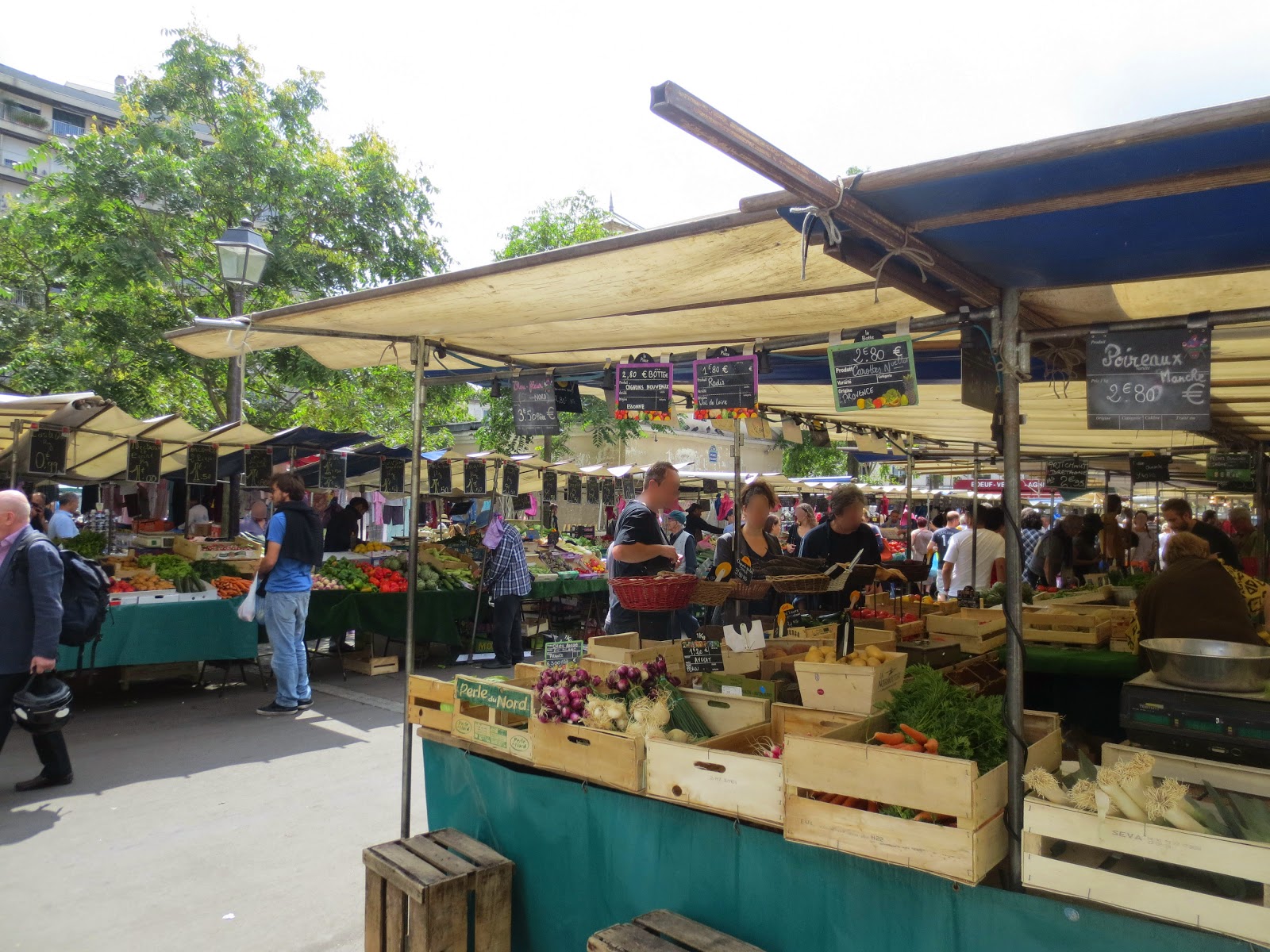
At Marché d'Aligre, I ran into Rene Miller, the musician that I had seen performing in Marché Bastille when I was running Operation 50 First States in the 11th arrondissement last year. It seemed like he was taking a break, and I went over to have a chat. He told me that he was American, and I told him that I was from New Jersey. Then the lady who was standing next to me and who must have listened to Rene's performance, mentioned that she would be in New Jersey soon. Next thing you know, I was talking with her. She said that she knew Rene from before and had just arrived in Paris from Memphis, Tennessee for a stay lasting several weeks. I discovered that she was an illustrator and also an urban sketcher, which only increased my curiosity. Naturally, I told her about the urban sketching community in Paris that I was a part of and invited her to come sketch with us during our session at Jardin du Luxembourg that was taking place the following day and that I was organizing. She said that she planned to make it. What an interesting encounter!
There was another nice moment at Marché d'Aligre once I had resumed the operation there following morning. On one hand, it was remarkable because the girl that I had passed while wading through the crowds was wearing the most lovely, summery white dress. On the other hand, it was unremakable because I had done nothing, except to watch her get farther away.
There was a couple of youngsters that I stumbled upon on Rue du faubourg Saint-Antoine, after leaving the market. They both looked drugged and my interaction with them was weird. The girl acted as if she wanted to help me when I asked the guy if he was from Jackson, Mississippi, whereas the guy wanted to keep walking. They could not make up their mind between themselves, while at the same time they continued their interaction with me (sort of). The whole encounter was a mess. Even my "I'm trying to change the world" remark fell on deaf ears.
5. Opéra Bastille
Opéra de la Bastille, or more commonly Opéra Bastille, is a modern opera house located on Place de la Bastille. Inaugurated on 13 July 1989 on the eve of the 200th anniversary of the storming of the Bastille, it became the main facility of the Paris National Opera, alongside the older Palais Garnier. Many opera performances are shown here along with some ballet performances and symphony concerts.


I was waiting to cross the street to get from Opéra Bastille to the other end of Place de la Bastille when a girl joined me. I jumped on the opportunity and asked her if she was from Lincoln, Nebraska. She replied no, crossed the street smiling (the light was already green), and disappeared. Either she was walking too fast for me to ask her out for a drink, or I was too slow to pop the question. You figure. While lamenting a missed opportunity that had nevertheless started out great, I ran into the girl again on the quay at Port de l'Arsenal sometime later. Talk about luck! I had been granted a second chance, and I did not waste it. In response, she giggled and passed me by without saying a single word. She probably thought that I was not serious. Her loss.
6. Bassin de l'Arsenal
Bassin de l'Arsenal, also known as Port de l'Arsenal, is a boat basin that links Canal Saint-Martin, which begins at Place de la Bastille, to the Seine, at Quai de la Rapée. Excavated after the destruction of the Bastille fortress in during the French Revolution, it was designed to replace the ditch that had been in place to draw water from the Seine to fill the moat at the fortress. During the nineteenth century and most of the twentieth, the basin was a commercial port where goods were loaded and unloaded. It was converted into a leisure port in 1983 and serves as a dock to approximately 180 pleasure boats.

Strolling along the quay at Port de l'Arsenal, I noticed a boat. Actually, it was the blond girl standing alone on a raised floor on the boat that I noticed. Compared to other opportunities, this one was sufficiently unusual to not pass up. Besides, I had one more girl to approach before ending the operation for the day. So I shouted "Hi" to her ‒ I had never realized I could shout ‒ and she said "Hi" back. I asked her if she was from Concord, New Hampshire and she said no. When I asked her if she would like to have a drink, she said "No, thank you" and immediately went inside the boat through a door behind her. I could do nothing else but resume my stroll. Moments later, I turned around and saw the girl getting off the boat with a guy. I looked back again a few seconds later and they were both walking hand in hand on the quay towards Place de la Bastille, away from me.
My last encounter at Port de l'Arsenal was with an older guy seated comfortably on the grass of the garden bordering the quay . In a perfect American accent, he told me that he was from somewhere in Ohio. He added, "Why do you ask [if I am from Trenton, New Jersey]?" I replied that I was trying to change the world, to which he responded, "Good luck".
7. Palais Omnisports de Paris-Bercy
Palais Omnisports de Paris-Bercy, often abbreviated as POPB or Bercy, is an indoor sports arena and concert hall. Easily recognized by its pyramidal shape and its walls covered with sloping lawn, it provides a limitless range of technical applications for unlimited sound, lighting and special effects. POPB is the venue of the Paris Masters tennis tournament, as well as competitions in other sports like including handball, basketball, boxing, gymnastics, athletics, track cycling, and show jumping. It has a seating capacity ranging from 3,500 to 17,000, depending on the event.

As I turned right from Boulevard de Bercy into Rue de Bercy, around the corner where the Palais-Omnisports de Paris-Bercy was, I saw two girls standing with luggage and chatting. Speaking English with an unmistakably British accent, they revealed that they were not from Santa Fe, New Mexico and turned down my invitation for a drink, saying that they had to go somewhere. One of them then asked for the reasons for my actions, and I told her that I was trying to overcome my shyness. Instantly, both girls stated that I was not shy, which I found flattering. They kept asserting that I was not shy, and when I could not take it anymore, I said "well you don't see me all the time". A brief and more conventional conversation ensued. One of the girls saw the sheet of paper fixed to a plastic board that I was holding and asked to see it. I started to present it, saying that it was a list of the capitals of the 50 United States, only to be interrupted by their departure after a third girl had appeared. All alone again, I started to wonder. Word on the street is that I may not be shy after all. What an idea.
8. Parc de Bercy
Parc de Bercy is a public park located along the right bank of the Seine. Inaugurated in 1994 on the site of former Bercy wine warehouses, the park has an area of 13.9 hectares and is composed of three different gardens, each having a distinct theme: the "Meadows", an area of open lawns shaded by tall trees, the "Flowerbeds", dedicated to plant life, and the "Romantic Garden", which includes fishponds and reconstitutions of dunes.


Shortly after arriving in Parc de Bercy, I approached a man who was perhaps in his 60s while he was taking a break from a power walk. When I asked him if he was from Bismarck, North Dakota, he pointed to the ground with a finger and said, with a slight smile: "I am from here".
I had an interesting encounter with a smartly dressed young man with a girl by his side at the end of the park, near Cour Saint-Emilion. When I asked him if he was from Harrisburg, Pennsylvania, he said yes and kept saying yes even though I had started to stress "Pennsylvania". Surprised after the nth yes, I had no choice but to go further in the conversation, so I went, "Well, I'm from Philad ..." before he interrupted me. "Pennsylvania? No I'm from Paris!" The good young fellow that he was, he wished me good luck.
On Passerelle Simone de Beauvoir, I had an somewhat strange encounter with a woman. I wanted to find out if she was from Rhode Island, Providence, but it seemed difficult because she responded with words that were barely audible. Even though I tried to make my question clearer, each time I heard practically nothing in response. When I was about to take my leave, the woman let out a familiar expression in a voice significantly less inaudible than before: "Au revoir".
9. Cour Saint-Emilion
Cour Saint-Emilion is a pedestrian street that is the main attraction of Bercy Village, an area on the southwest end of Parc de Bercy. It takes its name from the wines of Saint-Emilion, a French AOC-designated red wine produced in the region surrounding the town of Saint-Emilion, near Bordeaux. With the 42 white-stoned wine storehouses that border it, the street is a vestige of the Bercy warehouses where there was a large wine-producing industry for more than a century. Today, Cour Saint-Emilion is a shopping mall, offering boutiques, restaurants, a multiplex, and much more.


One of my most interesting encounters of all time ever took place on Cour Saint-Emilion. I saw two girls, both pretty, and I stopped one to find out if she was from Montpelier, Vermont. What ensued was something that I had not expected. In response to the question that I asked about her origins, she inquired about what I was doing and why I was doing it. I no longer remember if I gave her the already prepared reason ("I am trying to stop caring about what people think about me"). In any case, I presented the list of U.S. state capitals to her and explained how I was using it, only for her to claim that I was holding myself captive by roaming the streets to ask random strangers my questions. I defended my actions, arguing that I was just creating potentially interesting interactions. When she asked why it was her that I had stopped, I admitted that it was because she was pretty. I felt that she was displeased by this revelation, especially when I repeated in passing that she was pretty, so I stopped using the word. At some point during our conversation, she told me that God loved me (and would tell me that again several times). It was surprising and rather amusing. She told me about the church that she was going to and asked me I knew it. "Hillsong?", I repeated after her. "Yes, I know it, I have been there before actually." Apparently happy with this discovery, she insisted that I attend the service the following day (a Sunday), no matter how many times that I told her that I had other plans and that I almost never went to church. The pressure that she was putting was rather heavy; it seemed like that she was not listening to what I said. Only so that she would stop, I told her that I would try to make it if I could. At one point, she referred to her friend, who, at a certain distance, was nothing but a spectator throughout this event. Having just learned her friend's name, I asked her what her own name was. She replied "Fille de Dieu", meaning "Daughter of God". We had spoken for a few minutes, and after a while she started to take things less seriously. Perhaps she had understood that what had just happened was an interaction that aimed to be friendly even if a bit peculiar. She insisted once again that I come to Hillsong the following day, and left smiling with her friend. I felt relieved, even though it was a fun experience. Needless to say, I did not get a yes in response to my invitation for a drink.
Before leaving Cour Saint-Emilion, I approached a girl to ask her if she was from Olympia, Washington. At the same moment that she asked the reason for the question, after indicating that she was not from there, I asked her if she wanted to have a drink. Really smooth. I wonder if this abrupt behavior on my part was influenced by the presence of the security guard a few steps away.
10. Place Félix Eboué
Place Félix Eboué is a square located at the former location of the Barrière de Reuilly, one of the barriers along the wall built around Paris in the late 18th century. Formerly called Place Daumesnil, the square was given its current name in 1947 in the memory of Félix Eboué (1884-1944), a French colonial administrator and politician who was among the first people to join the Free France government led by General Charles de Gaulle during World War II. Installed at the center of the square is the Fontaine du Château d'Eau, a large circular basin supporting three smaller ones and decorated with eight statues of lions spitting jets of water.

I met a girl while crossing the street on Place Félix Eboué. No, we were not on the crosswalk, but on the platform on the middle. When I asked her if she was from Madison, Wisconsin, she stated that there were few chances that I would run into someone from Madison in the vicinity. Noting that, I asked her if she wanted to have a drink. She said no and went on to cross the rest of the road, walking rather briskly.
Here are some other interesting scenes captured during the strolls:
50 First States back, tell a friend
Guess who's back, Guess who's back ...
And like Eminem said in "Without Me", Operation 50 First States is back again. And why not, with spring ending and summer starting? It was time to stroll again though Paris in July, when I jump-started the operation (even though, as I write, the fall has arrived and winter is not too far away).
So starting in July, I took on the 12th arrondissement. The game plan remained the same from the 11th arrondissement: stroll through the arrondissement, stopping by 10 landmarks and asking 50 people passed on the way if they came from one of the capitals of the 50 U.S. States. The stroll was divided into 5 parts, each part comprising of 2 landmarks to visit, 10 people to meet, and, quite naturally, 10 inquiries to make. I reused the same list of reasons (one for each of the 5 strolls) to give if the people that I approached asked why I was doing what I was doing:
- I am just bored
- I am just trying to be creative
- I am trying to change the world
- I am trying to overcome my shyness
- I am trying to stop caring about what people think about me
The one "improvement" that I added to the operation was dedicated to the ladies. When the next person that I had to approach had to be a girl, I would only choose a girl whom I found pretty. And before the end of the interaction, I would ask her if she would like to have a drink with me. No frills, just a direct invitation to have a drink together.
It is worth pointing out that I was not able to ask every girl that I met for a drink, since some did not bother to stay five seconds for a chat. Besides, among those that I did ask, not one of them said yes. Nonetheless, I was prepared for the potential rejection.
And without further ado, I present to you a recap of my visit of 10 landmarks in the 12th arrondissement, accompanied with some notes about interesting interactions that I had along the way.
1. Gare de Lyon
Gare de Lyon is one of the six mainline railway stations in Paris. The third busiest station of France, it is named after the city of Lyon, a stop for many long-distance trains departing from the station, most en route to the south of France. Built for the Exposition Universelle (World Fair) of 1900, it is considered a classic example of the architecture of its time, whose most notable feature is the 67-meter high clock tower atop one corner of the station, similar in style to the one in London that houses to Big Ben.
Right on the parvis of Gare de Lyon was a girl standing idle with her phone. After a slight hesitation, I went over to meet her. Well, she was not from Sacramento, California. When I asked her if she was game for a drink, she replied casually that she was actually waiting for her boyfriend, who was late. "Ah", I said. If I had any serious game, I would probably have followed up by asking, "So, if you were not waiting for your boyfriend, would you have liked a drink anyway?" But no, I simply left.
2. Promenade plantée
Promenade plantée is an elevated linear park built atop the old Vincennes railway line. Beginning just east of Opéra Bastille, it follows a 4.7 km (2.9 mi) path eastward that ends at Boulevard Périphérique, a ring road that separates the city of Paris from its suburbs. As if it was not green enough, the promenade provides access to other parks and gardens such as Jardin Hector Malot, Jardin de Reuilly, Jardin de la gare de Reuilly et Square Charles Péguy.
It was in a scene of the film "Before Sunset", directed by Richard Linklater and starring Ethan Hawke and Julie Delpy, that I discovered the promenade for the first time. Since then, I have always enjoyed visiting the promenade, and the film quickly became one of my favorites.
One interesting encounter in this improved version of the operation occurred while I was at Promenade plantée. As I passed through a leafy arch, I came face to face with a girl coming from the opposite direction. I promptly asked her if she was from Tallahassee, Florida. She was attentive but did not seem to understand, so I kept repeating the question, each time more clearly. That was when a young man, whom I had actually just passed before seeing the girl, appeared and inquired what was going on, as if he wanted to protect her. I then figured that they were in the same company, which also included an elderly woman with whom I had seen the man earlier. Suddenly embarrassed, I quickly found my exit without daring to ask the girl if she wanted to have drinks, leaving her to explain to the guy what had just happened.
Also on Promenade plantée, I approached a guy to find out if he was from Atlanta, Georgia. He replied no, and but he was curious. "What do you want?", he asked. When I told him that I was just bored, he smiled.
3. Viaduc des Arts
Viaduc des Arts is a collection of art shops and galleries grouped in a unique construction along Avenue Daumesnil. Its location was previously occupied by the former viaduct of Paris that was built in 1859 to support the old Vincennes railway line. It was in 1990 that the mairie de Paris (Paris city hall) decided to rehabilitate the viaduct by renovating each of its vaults in order to transform them into a new conservatory of arts and crafts.
 |
| Culinary arts, anyone? |
I ran into one guy accompanied by a girl near an intersection along Viaduc des Arts. When I asked him if he was from Indianapolis, Indiana, he shot back : "Do I look like I'm from Indianapolis?" I replied that I was just trying to be creative. "Nice try", he said in return, smiling.
4. Rue d'Aligre
Rue d'Aligre is a street in a neighborhood called Quartier d'Aligre that begins at Rue de Charenton and ends at Rue du faubourg Saint-Antoine. Every day except Monday, it is home to Marché d'Aligre, an open-air market, and in the middle of the street, on Place d'Aligre, is the Marché Beauvau, a covered market.
 |
| Marché Beauvau on Place d'Aligre |
 |
| Rene Miller encore! |
At Marché d'Aligre, I ran into Rene Miller, the musician that I had seen performing in Marché Bastille when I was running Operation 50 First States in the 11th arrondissement last year. It seemed like he was taking a break, and I went over to have a chat. He told me that he was American, and I told him that I was from New Jersey. Then the lady who was standing next to me and who must have listened to Rene's performance, mentioned that she would be in New Jersey soon. Next thing you know, I was talking with her. She said that she knew Rene from before and had just arrived in Paris from Memphis, Tennessee for a stay lasting several weeks. I discovered that she was an illustrator and also an urban sketcher, which only increased my curiosity. Naturally, I told her about the urban sketching community in Paris that I was a part of and invited her to come sketch with us during our session at Jardin du Luxembourg that was taking place the following day and that I was organizing. She said that she planned to make it. What an interesting encounter!
There was another nice moment at Marché d'Aligre once I had resumed the operation there following morning. On one hand, it was remarkable because the girl that I had passed while wading through the crowds was wearing the most lovely, summery white dress. On the other hand, it was unremakable because I had done nothing, except to watch her get farther away.
There was a couple of youngsters that I stumbled upon on Rue du faubourg Saint-Antoine, after leaving the market. They both looked drugged and my interaction with them was weird. The girl acted as if she wanted to help me when I asked the guy if he was from Jackson, Mississippi, whereas the guy wanted to keep walking. They could not make up their mind between themselves, while at the same time they continued their interaction with me (sort of). The whole encounter was a mess. Even my "I'm trying to change the world" remark fell on deaf ears.
5. Opéra Bastille
Opéra de la Bastille, or more commonly Opéra Bastille, is a modern opera house located on Place de la Bastille. Inaugurated on 13 July 1989 on the eve of the 200th anniversary of the storming of the Bastille, it became the main facility of the Paris National Opera, alongside the older Palais Garnier. Many opera performances are shown here along with some ballet performances and symphony concerts.
I was waiting to cross the street to get from Opéra Bastille to the other end of Place de la Bastille when a girl joined me. I jumped on the opportunity and asked her if she was from Lincoln, Nebraska. She replied no, crossed the street smiling (the light was already green), and disappeared. Either she was walking too fast for me to ask her out for a drink, or I was too slow to pop the question. You figure. While lamenting a missed opportunity that had nevertheless started out great, I ran into the girl again on the quay at Port de l'Arsenal sometime later. Talk about luck! I had been granted a second chance, and I did not waste it. In response, she giggled and passed me by without saying a single word. She probably thought that I was not serious. Her loss.
6. Bassin de l'Arsenal
Bassin de l'Arsenal, also known as Port de l'Arsenal, is a boat basin that links Canal Saint-Martin, which begins at Place de la Bastille, to the Seine, at Quai de la Rapée. Excavated after the destruction of the Bastille fortress in during the French Revolution, it was designed to replace the ditch that had been in place to draw water from the Seine to fill the moat at the fortress. During the nineteenth century and most of the twentieth, the basin was a commercial port where goods were loaded and unloaded. It was converted into a leisure port in 1983 and serves as a dock to approximately 180 pleasure boats.
 |
| The port beyond the platform of the Bastille metro station |
 |
| Towards the north : Place de la Bastille |
 |
| Towards the south : Quai de la Rapée |
Strolling along the quay at Port de l'Arsenal, I noticed a boat. Actually, it was the blond girl standing alone on a raised floor on the boat that I noticed. Compared to other opportunities, this one was sufficiently unusual to not pass up. Besides, I had one more girl to approach before ending the operation for the day. So I shouted "Hi" to her ‒ I had never realized I could shout ‒ and she said "Hi" back. I asked her if she was from Concord, New Hampshire and she said no. When I asked her if she would like to have a drink, she said "No, thank you" and immediately went inside the boat through a door behind her. I could do nothing else but resume my stroll. Moments later, I turned around and saw the girl getting off the boat with a guy. I looked back again a few seconds later and they were both walking hand in hand on the quay towards Place de la Bastille, away from me.
My last encounter at Port de l'Arsenal was with an older guy seated comfortably on the grass of the garden bordering the quay . In a perfect American accent, he told me that he was from somewhere in Ohio. He added, "Why do you ask [if I am from Trenton, New Jersey]?" I replied that I was trying to change the world, to which he responded, "Good luck".
7. Palais Omnisports de Paris-Bercy
Palais Omnisports de Paris-Bercy, often abbreviated as POPB or Bercy, is an indoor sports arena and concert hall. Easily recognized by its pyramidal shape and its walls covered with sloping lawn, it provides a limitless range of technical applications for unlimited sound, lighting and special effects. POPB is the venue of the Paris Masters tennis tournament, as well as competitions in other sports like including handball, basketball, boxing, gymnastics, athletics, track cycling, and show jumping. It has a seating capacity ranging from 3,500 to 17,000, depending on the event.
 |
| The POPB becoming Bercy Arena |
As I turned right from Boulevard de Bercy into Rue de Bercy, around the corner where the Palais-Omnisports de Paris-Bercy was, I saw two girls standing with luggage and chatting. Speaking English with an unmistakably British accent, they revealed that they were not from Santa Fe, New Mexico and turned down my invitation for a drink, saying that they had to go somewhere. One of them then asked for the reasons for my actions, and I told her that I was trying to overcome my shyness. Instantly, both girls stated that I was not shy, which I found flattering. They kept asserting that I was not shy, and when I could not take it anymore, I said "well you don't see me all the time". A brief and more conventional conversation ensued. One of the girls saw the sheet of paper fixed to a plastic board that I was holding and asked to see it. I started to present it, saying that it was a list of the capitals of the 50 United States, only to be interrupted by their departure after a third girl had appeared. All alone again, I started to wonder. Word on the street is that I may not be shy after all. What an idea.
8. Parc de Bercy
Parc de Bercy is a public park located along the right bank of the Seine. Inaugurated in 1994 on the site of former Bercy wine warehouses, the park has an area of 13.9 hectares and is composed of three different gardens, each having a distinct theme: the "Meadows", an area of open lawns shaded by tall trees, the "Flowerbeds", dedicated to plant life, and the "Romantic Garden", which includes fishponds and reconstitutions of dunes.
 |
| The Meadows |
 |
| The Flowerbeds |
 |
| Crossing over to the Romantic Garden |
 |
| The Romantic Garden |
 |
| La Grande Terrasse |
Shortly after arriving in Parc de Bercy, I approached a man who was perhaps in his 60s while he was taking a break from a power walk. When I asked him if he was from Bismarck, North Dakota, he pointed to the ground with a finger and said, with a slight smile: "I am from here".
I had an interesting encounter with a smartly dressed young man with a girl by his side at the end of the park, near Cour Saint-Emilion. When I asked him if he was from Harrisburg, Pennsylvania, he said yes and kept saying yes even though I had started to stress "Pennsylvania". Surprised after the nth yes, I had no choice but to go further in the conversation, so I went, "Well, I'm from Philad ..." before he interrupted me. "Pennsylvania? No I'm from Paris!" The good young fellow that he was, he wished me good luck.
On Passerelle Simone de Beauvoir, I had an somewhat strange encounter with a woman. I wanted to find out if she was from Rhode Island, Providence, but it seemed difficult because she responded with words that were barely audible. Even though I tried to make my question clearer, each time I heard practically nothing in response. When I was about to take my leave, the woman let out a familiar expression in a voice significantly less inaudible than before: "Au revoir".
9. Cour Saint-Emilion
Cour Saint-Emilion is a pedestrian street that is the main attraction of Bercy Village, an area on the southwest end of Parc de Bercy. It takes its name from the wines of Saint-Emilion, a French AOC-designated red wine produced in the region surrounding the town of Saint-Emilion, near Bordeaux. With the 42 white-stoned wine storehouses that border it, the street is a vestige of the Bercy warehouses where there was a large wine-producing industry for more than a century. Today, Cour Saint-Emilion is a shopping mall, offering boutiques, restaurants, a multiplex, and much more.
 |
| Hello Cour Saint-Emilion |
 |
| Goodbye Cour Saint-Emilion |
One of my most interesting encounters of all time ever took place on Cour Saint-Emilion. I saw two girls, both pretty, and I stopped one to find out if she was from Montpelier, Vermont. What ensued was something that I had not expected. In response to the question that I asked about her origins, she inquired about what I was doing and why I was doing it. I no longer remember if I gave her the already prepared reason ("I am trying to stop caring about what people think about me"). In any case, I presented the list of U.S. state capitals to her and explained how I was using it, only for her to claim that I was holding myself captive by roaming the streets to ask random strangers my questions. I defended my actions, arguing that I was just creating potentially interesting interactions. When she asked why it was her that I had stopped, I admitted that it was because she was pretty. I felt that she was displeased by this revelation, especially when I repeated in passing that she was pretty, so I stopped using the word. At some point during our conversation, she told me that God loved me (and would tell me that again several times). It was surprising and rather amusing. She told me about the church that she was going to and asked me I knew it. "Hillsong?", I repeated after her. "Yes, I know it, I have been there before actually." Apparently happy with this discovery, she insisted that I attend the service the following day (a Sunday), no matter how many times that I told her that I had other plans and that I almost never went to church. The pressure that she was putting was rather heavy; it seemed like that she was not listening to what I said. Only so that she would stop, I told her that I would try to make it if I could. At one point, she referred to her friend, who, at a certain distance, was nothing but a spectator throughout this event. Having just learned her friend's name, I asked her what her own name was. She replied "Fille de Dieu", meaning "Daughter of God". We had spoken for a few minutes, and after a while she started to take things less seriously. Perhaps she had understood that what had just happened was an interaction that aimed to be friendly even if a bit peculiar. She insisted once again that I come to Hillsong the following day, and left smiling with her friend. I felt relieved, even though it was a fun experience. Needless to say, I did not get a yes in response to my invitation for a drink.
Before leaving Cour Saint-Emilion, I approached a girl to ask her if she was from Olympia, Washington. At the same moment that she asked the reason for the question, after indicating that she was not from there, I asked her if she wanted to have a drink. Really smooth. I wonder if this abrupt behavior on my part was influenced by the presence of the security guard a few steps away.
10. Place Félix Eboué
Place Félix Eboué is a square located at the former location of the Barrière de Reuilly, one of the barriers along the wall built around Paris in the late 18th century. Formerly called Place Daumesnil, the square was given its current name in 1947 in the memory of Félix Eboué (1884-1944), a French colonial administrator and politician who was among the first people to join the Free France government led by General Charles de Gaulle during World War II. Installed at the center of the square is the Fontaine du Château d'Eau, a large circular basin supporting three smaller ones and decorated with eight statues of lions spitting jets of water.
I met a girl while crossing the street on Place Félix Eboué. No, we were not on the crosswalk, but on the platform on the middle. When I asked her if she was from Madison, Wisconsin, she stated that there were few chances that I would run into someone from Madison in the vicinity. Noting that, I asked her if she wanted to have a drink. She said no and went on to cross the rest of the road, walking rather briskly.
Here are some other interesting scenes captured during the strolls:
 |
| Jardin Hector Malot, accessible from Promenade plantée |
 |
| Rue du faubourg Saint-Antoine in the direction of Place de la Bastille |
 |
| Barrio Latino, a salsa spot on Sundays |
 |
| Where rollerbladers and skateboarders meet on Place de la Bastille |
 |
| Look, it's the Maison de la RATP! |
 |
| The Cinémathèque Française in hiding |
 |
| Passerelle Simone de Beauvoir towards the 13th arrondissement |
 |
| Passerelle Simone de Beauvoir towards the 12th arrondissement |
 |
| When metro line 6 crosses the Seine |
 |
| Jardinière Avenue Daumesnil |
Subscribe to:
Posts (Atom)