50 First States back, tell a friend
Guess who's back, Guess who's back ...
And like Eminem said in "Without Me", Operation 50 First States is back again. And why not, with spring ending and summer starting? It was time to stroll again though Paris in July, when I jump-started the operation (even though, as I write, the fall has arrived and winter is not too far away).
So starting in July, I took on the 12th arrondissement. The game plan remained the same from the 11th arrondissement: stroll through the arrondissement, stopping by 10 landmarks and asking 50 people passed on the way if they came from one of the capitals of the 50 U.S. States. The stroll was divided into 5 parts, each part comprising of 2 landmarks to visit, 10 people to meet, and, quite naturally, 10 inquiries to make. I reused the same list of reasons (one for each of the 5 strolls) to give if the people that I approached asked why I was doing what I was doing:
- I am just bored
- I am just trying to be creative
- I am trying to change the world
- I am trying to overcome my shyness
- I am trying to stop caring about what people think about me
The one "improvement" that I added to the operation was dedicated to the ladies. When the next person that I had to approach had to be a girl, I would only choose a girl whom I found pretty. And before the end of the interaction, I would ask her if she would like to have a drink with me. No frills, just a direct invitation to have a drink together.
It is worth pointing out that I was not able to ask every girl that I met for a drink, since some did not bother to stay five seconds for a chat. Besides, among those that I did ask, not one of them said yes. Nonetheless, I was prepared for the potential rejection.
And without further ado, I present to you a recap of my visit of 10 landmarks in the 12th arrondissement, accompanied with some notes about interesting interactions that I had along the way.
1. Gare de Lyon
Gare de Lyon is one of the six mainline railway stations in Paris. The third busiest station of France, it is named after the city of Lyon, a stop for many long-distance trains departing from the station, most en route to the south of France. Built for the Exposition Universelle (World Fair) of 1900, it is considered a classic example of the architecture of its time, whose most notable feature is the 67-meter high clock tower atop one corner of the station, similar in style to the one in London that houses to Big Ben.


Right on the parvis of Gare de Lyon was a girl standing idle with her phone. After a slight hesitation, I went over to meet her. Well, she was not from Sacramento, California. When I asked her if she was game for a drink, she replied casually that she was actually waiting for her boyfriend, who was late. "Ah", I said. If I had any serious game, I would probably have followed up by asking, "So, if you were not waiting for your boyfriend, would you have liked a drink anyway?" But no, I simply left.
2. Promenade plantée
Promenade plantée is an elevated linear park built atop the old Vincennes railway line. Beginning just east of Opéra Bastille, it follows a 4.7 km (2.9 mi) path eastward that ends at Boulevard Périphérique, a ring road that separates the city of Paris from its suburbs. As if it was not green enough, the promenade provides access to other parks and gardens such as Jardin Hector Malot, Jardin de Reuilly, Jardin de la gare de Reuilly et Square Charles Péguy.
It was in a scene of the film "Before Sunset", directed by Richard Linklater and starring Ethan Hawke and Julie Delpy, that I discovered the promenade for the first time. Since then, I have always enjoyed visiting the promenade, and the film quickly became one of my favorites.


One interesting encounter in this improved version of the operation occurred while I was at Promenade plantée. As I passed through a leafy arch, I came face to face with a girl coming from the opposite direction. I promptly asked her if she was from Tallahassee, Florida. She was attentive but did not seem to understand, so I kept repeating the question, each time more clearly. That was when a young man, whom I had actually just passed before seeing the girl, appeared and inquired what was going on, as if he wanted to protect her. I then figured that they were in the same company, which also included an elderly woman with whom I had seen the man earlier. Suddenly embarrassed, I quickly found my exit without daring to ask the girl if she wanted to have drinks, leaving her to explain to the guy what had just happened.
Also on Promenade plantée, I approached a guy to find out if he was from Atlanta, Georgia. He replied no, and but he was curious. "What do you want?", he asked. When I told him that I was just bored, he smiled.
3. Viaduc des Arts
Viaduc des Arts is a collection of art shops and galleries grouped in a unique construction along Avenue Daumesnil. Its location was previously occupied by the former viaduct of Paris that was built in 1859 to support the old Vincennes railway line. It was in 1990 that the mairie de Paris (Paris city hall) decided to rehabilitate the viaduct by renovating each of its vaults in order to transform them into a new conservatory of arts and crafts.

 |
| Culinary arts, anyone? |
I ran into one guy accompanied by a girl near an intersection along Viaduc des Arts. When I asked him if he was from Indianapolis, Indiana, he shot back : "Do I look like I'm from Indianapolis?" I replied that I was just trying to be creative. "Nice try", he said in return, smiling.
4. Rue d'Aligre
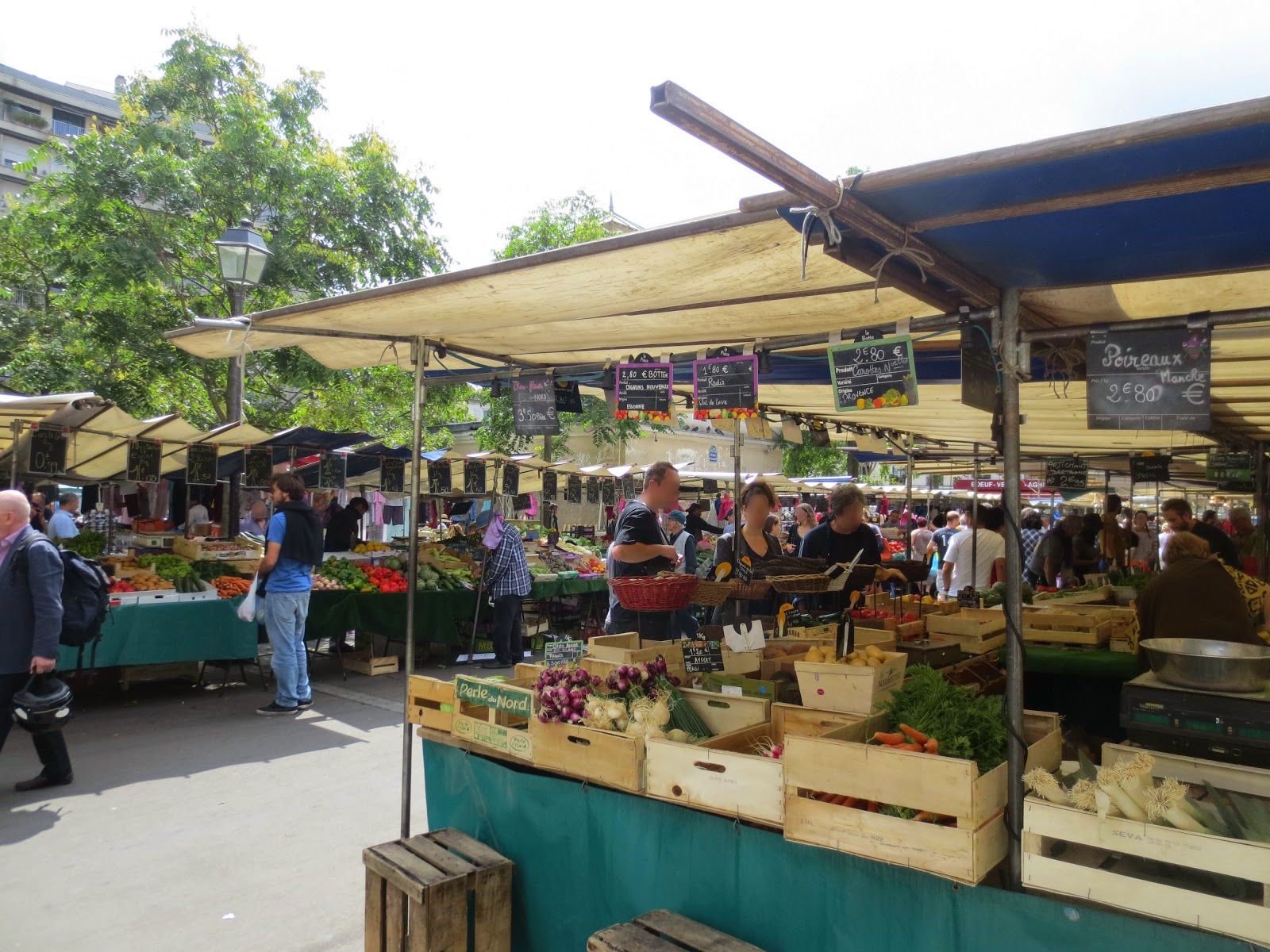
Rue d'Aligre is a street in a neighborhood called Quartier d'Aligre that begins at Rue de Charenton and ends at Rue du faubourg Saint-Antoine. Every day except Monday, it is home to Marché d'Aligre, an open-air market, and in the middle of the street, on Place d'Aligre, is the Marché Beauvau, a covered market.
 |
| Marché Beauvau on Place d'Aligre |

 |
| Rene Miller encore! |
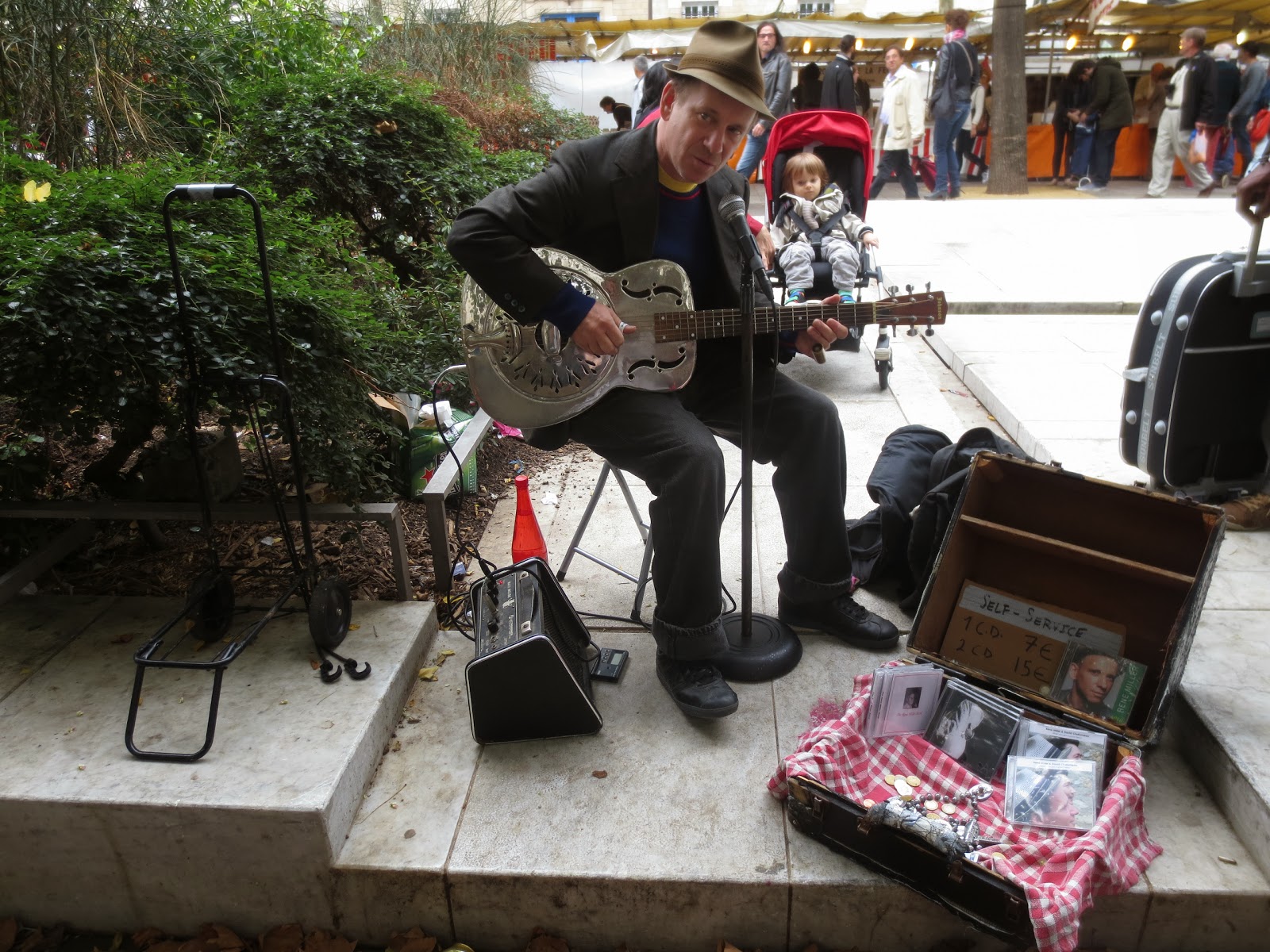
At Marché d'Aligre, I ran into Rene Miller, the musician that I had seen performing in Marché Bastille when I was running Operation 50 First States in the 11th arrondissement last year. It seemed like he was taking a break, and I went over to have a chat. He told me that he was American, and I told him that I was from New Jersey. Then the lady who was standing next to me and who must have listened to Rene's performance, mentioned that she would be in New Jersey soon. Next thing you know, I was talking with her. She said that she knew Rene from before and had just arrived in Paris from Memphis, Tennessee for a stay lasting several weeks. I discovered that she was an illustrator and also an urban sketcher, which only increased my curiosity. Naturally, I told her about the urban sketching community in Paris that I was a part of and invited her to come sketch with us during our session at Jardin du Luxembourg that was taking place the following day and that I was organizing. She said that she planned to make it. What an interesting encounter!
There was another nice moment at Marché d'Aligre once I had resumed the operation there following morning. On one hand, it was remarkable because the girl that I had passed while wading through the crowds was wearing the most lovely, summery white dress. On the other hand, it was unremakable because I had done nothing, except to watch her get farther away.
There was a couple of youngsters that I stumbled upon on Rue du faubourg Saint-Antoine, after leaving the market. They both looked drugged and my interaction with them was weird. The girl acted as if she wanted to help me when I asked the guy if he was from Jackson, Mississippi, whereas the guy wanted to keep walking. They could not make up their mind between themselves, while at the same time they continued their interaction with me (sort of). The whole encounter was a mess. Even my "I'm trying to change the world" remark fell on deaf ears.
5. Opéra Bastille
Opéra de la Bastille, or more commonly Opéra Bastille, is a modern opera house located on Place de la Bastille. Inaugurated on 13 July 1989 on the eve of the 200th anniversary of the storming of the Bastille, it became the main facility of the Paris National Opera, alongside the older Palais Garnier. Many opera performances are shown here along with some ballet performances and symphony concerts.


I was waiting to cross the street to get from Opéra Bastille to the other end of Place de la Bastille when a girl joined me. I jumped on the opportunity and asked her if she was from Lincoln, Nebraska. She replied no, crossed the street smiling (the light was already green), and disappeared. Either she was walking too fast for me to ask her out for a drink, or I was too slow to pop the question. You figure. While lamenting a missed opportunity that had nevertheless started out great, I ran into the girl again on the quay at Port de l'Arsenal sometime later. Talk about luck! I had been granted a second chance, and I did not waste it. In response, she giggled and passed me by without saying a single word. She probably thought that I was not serious. Her loss.
6. Bassin de l'Arsenal
Bassin de l'Arsenal, also known as Port de l'Arsenal, is a boat basin that links Canal Saint-Martin, which begins at Place de la Bastille, to the Seine, at Quai de la Rapée. Excavated after the destruction of the Bastille fortress in during the French Revolution, it was designed to replace the ditch that had been in place to draw water from the Seine to fill the moat at the fortress. During the nineteenth century and most of the twentieth, the basin was a commercial port where goods were loaded and unloaded. It was converted into a leisure port in 1983 and serves as a dock to approximately 180 pleasure boats.
 |
| The port beyond the platform of the Bastille metro station |

 |
| Towards the north : Place de la Bastille |
 |
| Towards the south : Quai de la Rapée |
Strolling along the quay at Port de l'Arsenal, I noticed a boat. Actually, it was the blond girl standing alone on a raised floor on the boat that I noticed. Compared to other opportunities, this one was sufficiently unusual to not pass up. Besides, I had one more girl to approach before ending the operation for the day. So I shouted "Hi" to her ‒ I had never realized I could shout ‒ and she said "Hi" back. I asked her if she was from Concord, New Hampshire and she said no. When I asked her if she would like to have a drink, she said "No, thank you" and immediately went inside the boat through a door behind her. I could do nothing else but resume my stroll. Moments later, I turned around and saw the girl getting off the boat with a guy. I looked back again a few seconds later and they were both walking hand in hand on the quay towards Place de la Bastille, away from me.
My last encounter at Port de l'Arsenal was with an older guy seated comfortably on the grass of the garden bordering the quay . In a perfect American accent, he told me that he was from somewhere in Ohio. He added, "Why do you ask [if I am from Trenton, New Jersey]?" I replied that I was trying to change the world, to which he responded, "Good luck".
7. Palais Omnisports de Paris-Bercy
Palais Omnisports de Paris-Bercy, often abbreviated as POPB or Bercy, is an indoor sports arena and concert hall. Easily recognized by its pyramidal shape and its walls covered with sloping lawn, it provides a limitless range of technical applications for unlimited sound, lighting and special effects. POPB is the venue of the Paris Masters tennis tournament, as well as competitions in other sports like including handball, basketball, boxing, gymnastics, athletics, track cycling, and show jumping. It has a seating capacity ranging from 3,500 to 17,000, depending on the event.
 |
| The POPB becoming Bercy Arena |

As I turned right from Boulevard de Bercy into Rue de Bercy, around the corner where the Palais-Omnisports de Paris-Bercy was, I saw two girls standing with luggage and chatting. Speaking English with an unmistakably British accent, they revealed that they were not from Santa Fe, New Mexico and turned down my invitation for a drink, saying that they had to go somewhere. One of them then asked for the reasons for my actions, and I told her that I was trying to overcome my shyness. Instantly, both girls stated that I was not shy, which I found flattering. They kept asserting that I was not shy, and when I could not take it anymore, I said "well you don't see me all the time". A brief and more conventional conversation ensued. One of the girls saw the sheet of paper fixed to a plastic board that I was holding and asked to see it. I started to present it, saying that it was a list of the capitals of the 50 United States, only to be interrupted by their departure after a third girl had appeared. All alone again, I started to wonder. Word on the street is that I may not be shy after all. What an idea.
8. Parc de Bercy
Parc de Bercy is a public park located along the right bank of the Seine. Inaugurated in 1994 on the site of former Bercy wine warehouses, the park has an area of 13.9 hectares and is composed of three different gardens, each having a distinct theme: the "Meadows", an area of open lawns shaded by tall trees, the "Flowerbeds", dedicated to plant life, and the "Romantic Garden", which includes fishponds and reconstitutions of dunes.
 |
| The Meadows |

 |
| The Flowerbeds |


 |
| Crossing over to the Romantic Garden |
 |
| The Romantic Garden |

 |
| La Grande Terrasse |

Shortly after arriving in Parc de Bercy, I approached a man who was perhaps in his 60s while he was taking a break from a power walk. When I asked him if he was from Bismarck, North Dakota, he pointed to the ground with a finger and said, with a slight smile: "I am from here".
I had an interesting encounter with a smartly dressed young man with a girl by his side at the end of the park, near Cour Saint-Emilion. When I asked him if he was from Harrisburg, Pennsylvania, he said yes and kept saying yes even though I had started to stress "Pennsylvania". Surprised after the nth yes, I had no choice but to go further in the conversation, so I went, "Well, I'm from Philad ..." before he interrupted me. "Pennsylvania? No I'm from Paris!" The good young fellow that he was, he wished me good luck.
On Passerelle Simone de Beauvoir, I had an somewhat strange encounter with a woman. I wanted to find out if she was from Rhode Island, Providence, but it seemed difficult because she responded with words that were barely audible. Even though I tried to make my question clearer, each time I heard practically nothing in response. When I was about to take my leave, the woman let out a familiar expression in a voice significantly less inaudible than before: "Au revoir".
9. Cour Saint-Emilion
Cour Saint-Emilion is a pedestrian street that is the main attraction of Bercy Village, an area on the southwest end of Parc de Bercy. It takes its name from the wines of Saint-Emilion, a French AOC-designated red wine produced in the region surrounding the town of Saint-Emilion, near Bordeaux. With the 42 white-stoned wine storehouses that border it, the street is a vestige of the Bercy warehouses where there was a large wine-producing industry for more than a century. Today, Cour Saint-Emilion is a shopping mall, offering boutiques, restaurants, a multiplex, and much more.
 |
| Hello Cour Saint-Emilion |


 |
| Goodbye Cour Saint-Emilion |
One of my most interesting encounters of all time ever took place on Cour Saint-Emilion. I saw two girls, both pretty, and I stopped one to find out if she was from Montpelier, Vermont. What ensued was something that I had not expected. In response to the question that I asked about her origins, she inquired about what I was doing and why I was doing it. I no longer remember if I gave her the already prepared reason ("I am trying to stop caring about what people think about me"). In any case, I presented the list of U.S. state capitals to her and explained how I was using it, only for her to claim that I was holding myself captive by roaming the streets to ask random strangers my questions. I defended my actions, arguing that I was just creating potentially interesting interactions. When she asked why it was her that I had stopped, I admitted that it was because she was pretty. I felt that she was displeased by this revelation, especially when I repeated in passing that she was pretty, so I stopped using the word. At some point during our conversation, she told me that God loved me (and would tell me that again several times). It was surprising and rather amusing. She told me about the church that she was going to and asked me I knew it. "Hillsong?", I repeated after her. "Yes, I know it, I have been there before actually." Apparently happy with this discovery, she insisted that I attend the service the following day (a Sunday), no matter how many times that I told her that I had other plans and that I almost never went to church. The pressure that she was putting was rather heavy; it seemed like that she was not listening to what I said. Only so that she would stop, I told her that I would try to make it if I could. At one point, she referred to her friend, who, at a certain distance, was nothing but a spectator throughout this event. Having just learned her friend's name, I asked her what her own name was. She replied "Fille de Dieu", meaning "Daughter of God". We had spoken for a few minutes, and after a while she started to take things less seriously. Perhaps she had understood that what had just happened was an interaction that aimed to be friendly even if a bit peculiar. She insisted once again that I come to Hillsong the following day, and left smiling with her friend. I felt relieved, even though it was a fun experience. Needless to say, I did not get a yes in response to my invitation for a drink.
Before leaving Cour Saint-Emilion, I approached a girl to ask her if she was from Olympia, Washington. At the same moment that she asked the reason for the question, after indicating that she was not from there, I asked her if she wanted to have a drink. Really smooth. I wonder if this abrupt behavior on my part was influenced by the presence of the security guard a few steps away.
10. Place Félix Eboué
Place Félix Eboué is a square located at the former location of the Barrière de Reuilly, one of the barriers along the wall built around Paris in the late 18th century. Formerly called Place Daumesnil, the square was given its current name in 1947 in the memory of Félix Eboué (1884-1944), a French colonial administrator and politician who was among the first people to join the Free France government led by General Charles de Gaulle during World War II. Installed at the center of the square is the Fontaine du Château d'Eau, a large circular basin supporting three smaller ones and decorated with eight statues of lions spitting jets of water.

I met a girl while crossing the street on Place Félix Eboué. No, we were not on the crosswalk, but on the platform on the middle. When I asked her if she was from Madison, Wisconsin, she stated that there were few chances that I would run into someone from Madison in the vicinity. Noting that, I asked her if she wanted to have a drink. She said no and went on to cross the rest of the road, walking rather briskly.
Here are some other interesting scenes captured during the strolls:
 |
| Jardin Hector Malot, accessible from Promenade plantée |
 |
| Rue du faubourg Saint-Antoine in the direction of Place de la Bastille |
 |
| Barrio Latino, a salsa spot on Sundays |
 |
| Where rollerbladers and skateboarders meet on Place de la Bastille |
 |
| Look, it's the Maison de la RATP! |
 |
| The Cinémathèque Française in hiding |
 |
| Passerelle Simone de Beauvoir towards the 13th arrondissement |
 |
| Passerelle Simone de Beauvoir towards the 12th arrondissement |
 |
| When metro line 6 crosses the Seine |
 |
| Jardinière Avenue Daumesnil |