Showing posts with label ideas. Show all posts

Wednesday, August 7, 2019

les sacs des parisiennes (2)

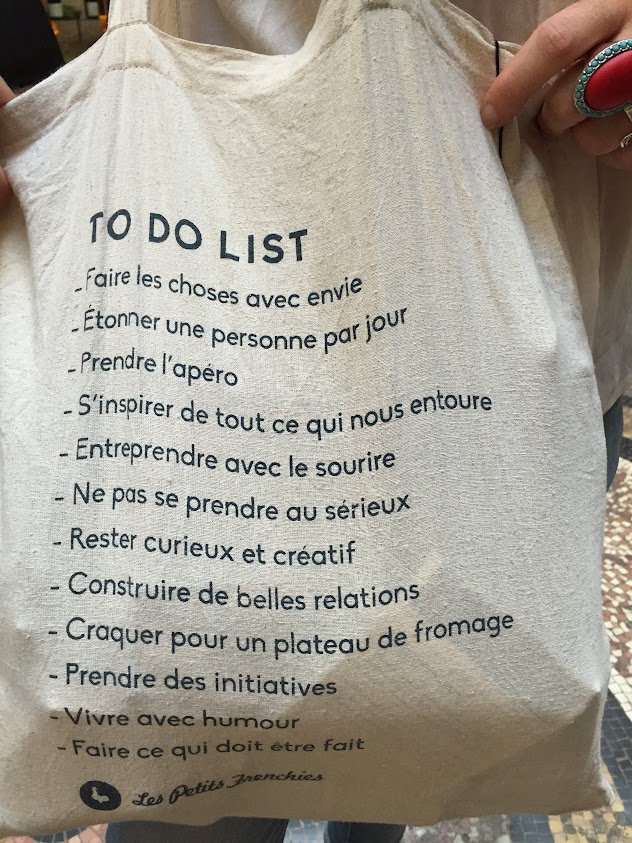
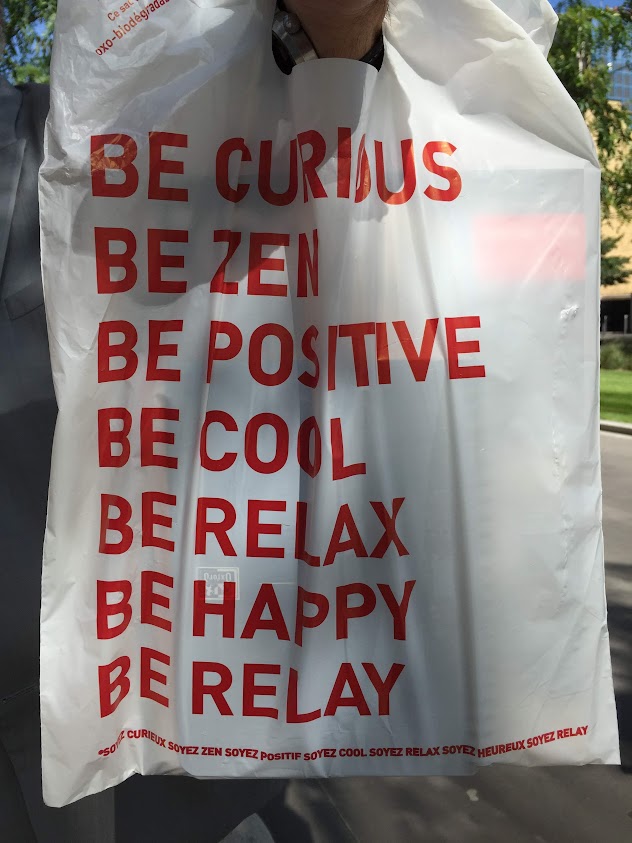
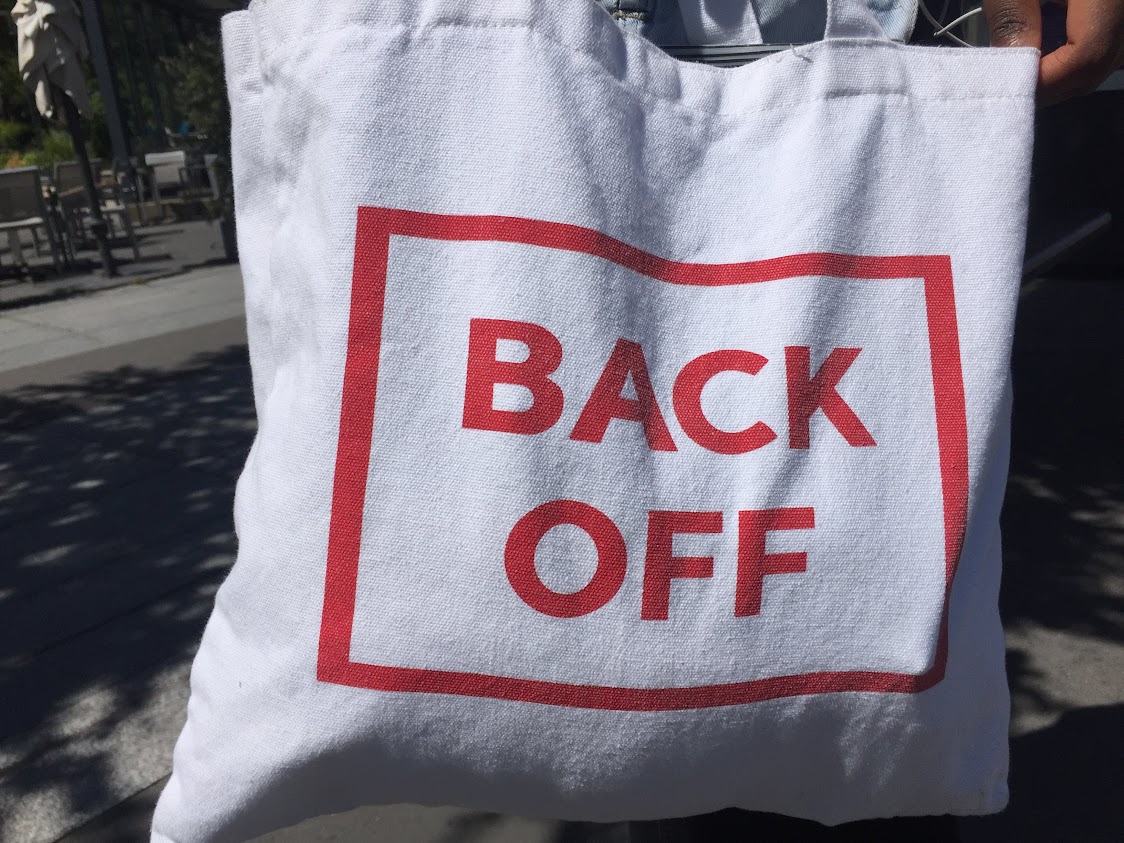
After starting again a few months ago to take photos of bags in Paris, I have become a more sensitive and almost desperate character.

My eyes are always out and about, darting from left to right and back to left, focusing on the slightest sighting of any bag carried by a woman. What is on it? Are there words, or just a bunch of images? What are the words? Are they saying something interesting? How do I feel about the message? Have I already taken a picture of this bag before? These are questions that I ask myself often and very quickly in order to decide whether to act or not.

Paris might very well be the world capital of all things French, yet the majority of bags that one finds on its streets have inspirational messages written in English. Granted, that is the case for the bags that I see and the messages that resonate with me. On one occasion, the girl carrying the bag did not seem to know what the words in English meant (see bag no. 9 below). She must have paid little attention to the message, the bag merely being a tool for her. She even admitted that she was "nulle" in English. Fortunately, I was able to convey the message after translation. "Ah, c'est beau", she said.

Here is a second collection des sacs des Parisiennes.


Saturday, June 15, 2019

the art of saying bonjour (2)

Upon entering the "take off your shoes" area at the local pool last Sunday, I said Bonjour to a man as I took a seat close to him on a bench. The Bonjour just came off spontaneously; I was not working my smile as much as when I make a conscious effort to say Bonjour or to interact with someone. As soon as I began removing my shoes, I sensed that this man was looking insistently at me, as if he was trying to get my attention. I looked towards him and indeed, he was about to ask me a question. So I took off my earbuds to listen to what he had to say. "On se connaît ?" ("Do we know each other?"). I replied no. I could read some surprise on his face before it gave way to something more relaxed. He then said something that I was unable to register. The only thing I could make out was "C'est poli" ("That's polite"). I smiled, he smiled too, and then I was off to the changing rooms ‒ but not before we shared a "Bonne journée !" ("Have a good day!").

Ah, good ol' Bonjour. I have learned during my time here in France that it is common to say "Bonjour" to people that you more or less know or that you need to get information or something else from. But never to random strangers that you don't intend to have a conversation with. I will not go as far as to say "That is a shame", but I will say this: saying Bonjour to random people merely for the sake of doing it can be therapeutic. Both for the giver and the receiver. But especially the giver.

It is surely for this reason that I aim to give out bonjours to fifty random people each day in Paris for the rest of the year. Outdoors, indoors, in the metro, and almost anywhere else.

The more love I can put into each bonjour, the more I can heal. Hopefully at the same time the receiver can heal too.

Tuesday, May 28, 2019

les sacs des parisiennes (1)

Women are such bearers of good messages and one ought to respect both ... women and their messages.

Four years ago, I got the idea that when during my life in Paris I got a glimpse of a woman carrying a bag with a message that I found interesting if not meaningful, I would go up to her and ask her if I could take a photo.

In three months, I got three photos. The following three years, nothing. The idea had ended up in the burial ground.

Just recently, the idea reemerged. Somehow. Maybe it knew that I was finally ready to embrace it.

Here is a collection des sacs des Parisiennes.


Friday, January 18, 2019

love and fear

When you are doing something that you love enough, you really are not thinking about fear.

You are just doing it. It's all love.

The next time fear visits while you are trying to achieve a goal that you consider worthwhile, take a moment to ask yourself the following question:

Maybe this is a goal that I should love more?

The best part is when you end up loving the thing that you initially feared.


Fear for a linchpin is a clue that you're getting close to doing something important.

‒ Seth Godin

Thursday, January 10, 2019

ace yourself

If you love something, you accept it.
If you love something, you care for it.
If you love something, you express it.

LOVE YOURSELF

Monday, June 22, 2015

assume the purpose

I believe more and more that the question of finding out what meaning to give to one's life let's call it one's purpose can be answered by assuming that something is one's purpose and then investing one's energy in living that purpose.  With discipline, what is assumed will become what is true.

All that is left is having solid reasons for assuming that 'something' is one's purpose.

That said, I might as well assume that this blog is a part of my purpose.  After all, I have reasons for maintaining it that are solid.  Well, I assume that they are solid.

Saturday, January 17, 2015

beyond the conversation

When it comes to socializing, a lot of emphasis is placed on conversation.  Starting conversations.  Continuing conversations.  Ending conversations.  Changing conversation subjects.  Avoiding conversation subjects.  And so on.

I think that this is fair.  After all, without conversation, we would have difficulty knowing if we got along with someone else, building social relationships, and learning new things about people and sometimes about the world that we share with them.  Certainly, people that thrive together in a couple, a friendship, or a business partnership generally owe a big part of their success to conversations.

Yet, sometimes, on subject of enjoying real-time, face-to-face communication, conversations do not seem sufficient or appropriate.  They generally require substantial time on the part of the participants, they can easily become too factual, their structure is highly predictable, and the topics discussed tend to be the same ones.  And I say this while recognizing that I have not mastered the art of engaging people in conversations that are both stimulating and insightful.  As a member of society however, I bear a certain responsibility for the current state of conversation.

Real-time, face-to-face communication is about social interaction and conversation is only one form of social interaction.  Or at least that's the way I see it.  And there is so much joy to be derived from other forms of social interaction that are free from the constraints inherent in standard conversation.  I could not even dare naming all of them, since they are limitless in my opinion.  But there are a few that I use on a regular basis, and others less frequently.  I offer you some examples below.
  • When a person looking in your direction waves to someone else (who may be visible to you or not), wave to the person who initiated the wave.
  • When you are aboard an airplane and it lands after an uneventful and relatively short (1 to 2 hours) flight, applaud loudly to celebrate the landing.
  • When you are reading a book in the subway and you spot a fellow passenger reading a book written in the same language as yours, go closer to them and ask "Book swap?"
  • When you cross paths with someone while eating a sample of some delicious pastry from a bakery that you just left, ask them if they have tried that type of pastry from that bakery.  If they respond in any way other than saying yes, say "Well, I recommend it!".
  • When you discover an uncommon animal being presented on the street that you are walking on because of some event or holiday, e.g., a camel on Epiphany, remind yourself to ask a fellow pedestrian that you cross paths with some moments later on the same street if they like that kind of animal.  Better yet, convince them that they are in for a big surprise.
  • When, after just exiting a subway station on your way to work in the morning, you see someone in front of you exit a building and then walk towards the subway station, say hello and ask "You're going home?"
  • When you see a group of five girls or more seated comfortably in a bar chatting away, go over, say hello, and ask, "So, what do you girls want to talk about?"
  • When you see a girl standing with her eyes fixed on the screen of her cellphone, go next to her, quickly pull your cellphone out, and while pretending to use it, say "Ok, I'm listening, area code, 212, go on ..."
  • When you are in a crowded bar and a girl is passing you with a pint of beer that she just bought in her hand, tell her "Hmmmn, that smells good".
  • When someone on the street asks for directions, help them by first asking "How much do you have?"
  • When you are in conversation with peers that you do not know well, interrupt at some unexpected moment by saying "You know, it's like cheese".

Indeed, there is no limit to the forms of interaction we can have with people, if it is not our own imagination that imposes it.  We do not even have to use words, which a conversation could not do without.  All that is needed, at a minimum, are people and some idea that includes people.  The stranger idea is, the better, yet it should be respectful of the wishes and well-being of everyone included.  This is an art that the good people at ImprovEverywhere have definitely mastered.

But why bother with alternative social interactions anyway?  Well, for one thing, it is simply fun using them to step beyond the confines of what is normal ‒ standard conversation ‒ from time to time.  Secondly, they can serve as sources of inspiration, allowing us to dream up new ideas applicable to social settings, try them out, refine our methods, and even imagine other forms of interaction based on the feedback we receive.  A third reason is more personal yet it is universal.  This kind of interaction is a quick way to connect with people in our midst, with whom we would perhaps never imagine having an engaging conversation (an activity that many of us seem to cherish).  I think that some issues that we as individuals face in society would not need to be if we reached out regularly to people that we did not know and shared with them more of what we loved about our lives, even if that lasted only 10 seconds.  Brené Brown, a research professor at the University of Houston Graduate College of Social Work, stated during a TED talk that "connection is why we're here. It's what gives purpose and meaning to our lives."  I am yet to read somewhere that connection required five minutes of conversation.

Yet a conversation of five minutes has its merits.  And it does not have to be restricted to common topics.  If it is engaging conversations that we want, we have a responsibility to foster it, using our personal resources (such as creativity, knowledge, and sense of humor, among others) as much as necessary.  Dare I say that complaining that a conversation is banal or superficial may be a sign that one is not expressing his true interests or his true values during the conversation.

So I'm all in for some good ol' conversation, with family, friends, colleagues.  But I do not want to always wait to be reunited with people in my social circle before I can share an idea, a discovery, or an experience that is worth sharing.  If, for some reason or the other, I am unable to converse with the people around me at any given moment, I prefer to interact with them in other ways, because it can be just as fun as conversation, and sometimes more.  Besides, doing so gives me a sense of purpose.

Tuesday, December 23, 2014

courage, courage, courage

I have come to believe that many personal issues can be resolved once and for all if only we possessed one particular trait.  This trait is courage.

Do you realize how magnificent this piece of news is?  I mean, some of us are struggling to figure out what to do with our lives, and here is an answer.  This one thing.  Courage.  Sure, getting this news won't get the problems solved, but knowing what to do in a tricky situation is certainly an important part of the work that leads to the solution.

So many times in my life, the thing that made the biggest difference between an unsatisfying situation and a satisfying situation was courage.  I find it being as simple as saying "if I have courage, then I win."  It is like the following two equations:

have courage = claim victory

do not have courage = do not claim victory

Courage trumps other qualities

When it comes to getting things done, I think that courage is just as important as other highly desirable qualities out there, if not more.  Among these qualities are discipline, wisdom, optimism, curiosity.  Indeed, there are many others and they each have their just place, but I think that courage is one that is almost always necessary.  Take the virtue of discipline for starters.  It is good to have discipline, but it usually takes courage to retain this discipline when the going gets tough.  And in a life worth living, the going almost always gets tough at some point.  Wisdom, too, has great value.  Yet without the courage to apply it when faced with a difficult situation, wisdom ends up taking an unfortunate hit.  It's like an idea that does not happen, or a "non-idea".  Optimism too is yet another notable quality.  But for someone who is generally disposed to pessimism but who is nevertheless determined to change that for good, a regular dose of courage is needed to carry out the actions that lead to an optimistic outlook.  It is like replacing one daily habit with another.  Since habits are ingrained within us, they are easy to keep.  To change them is necessarily difficult, and to overcome such difficulty, we need courage.  And then there is curiosity, which can make life richer for anyone who possesses it.  But to learn new things and to live new experiences, one must go beyond their comfort zone or what they already know, which may require courage.  Also worthy of mention are traits such as strength, perseverance, and resilience.  You could argue whether or not each of these traits was related to the other, but it would seem largely impossible to discuss any of them without recognizing the pertinence of courage.

Even the popular topics of self-confidence, self-esteem, and self-worth all have something to do with courage.

Get more familiar with courage

Given how unpredictable life is, it is inevitable that we will have to confront the question of courage at various times in our lives, whether at 15, at 30, or at 60 years old.  Some people even deal with it everyday.  I know that I am one of these people.  In fact, I go through moments that test my courage several times during the day.  If we all agreed that the question of courage pervades our lives, wouldn't it be useful to study it more and be more aware of it, only to see how much good could come out of having more of it?

What a few other (and better qualified) people think about courage

Well, all this has been nothing but my opinion.  What do other people think on the topic of courage?

Mihaly Csikszentmihalyi, a Distinguished Professor of Psychology and Management at Claremont Graduate University and former chair of the Department of Psychology at the University of Chicago, notes in his seminal book Flow that courage and the ability to overcome hardship are the reasons why average people admire the individuals that they admire the most.  He even states that the simple act of admiring courage is a positive trait in itself.  Quoting the Stoic philosopher Seneca, he writes: "The good things which belong to prosperity are to be wished, but the good that belong to adversity are to be admired."

Martin Seligman, a Family Professor of Psychology at the University of Pennsylvania and former President of the American Psychological Association, writes in his Positive Psychology Chapter, prepared for the Handbook of Positive Psychology that "we have discovered that there are human strengths that act as buffers against mental illness: courage, future-mindedness, optimism, interpersonal skill, faith, work ethic, hope, honesty, perseverance, the capacity for flow and insight, to name several."  As it is mentioned first in this list, courage can surely be considered an important quality to have in life, especially in tough times.

Defining courage

So what is this thing called courage that we have been discussing so far anyway?

Here is the definition of the term according to the TV5 website (and one that I truly love):


"Force de caractère qui fait supporter la souffrance ou braver le danger."  In English, this translates to "strength of character that enables one to bear suffering or to confront danger."  Less prominent in this definition is the idea that suffering or danger are prerequisites for courage.  In other words, strength of character is great in itself, but if it is accompanied neither by the risk of suffering nor by the risk of danger, there is no courage.

With all due respect to this dictionary definition, I like to simplify matters sometimes by saying that a person has courage when he (or she) does something different from the usual that poses an emotional risk to him.  In other words, he does something makes him emotionally vulnerable.  Unless we are all robots programmed to always act the same way in a given circumstance, we can comprehend that we are generally capable of choosing a plan of action different from the usual, even if this plan makes us experience pain, real or imagined.  For example, most passengers on the Paris metro do not say bonjour (hello) to the person seated or standing beside them, even though they are technically capable of saying bonjour, even though they have already talked to unfamiliar people many times before.  In fact, not much is said on the metro, unless it is the case of people who already know each other, people on the telephone with someone elsewhere, or people soliciting some money or other favors from passengers.  It would thus be courageous to speak to someone in such an environment, but only if it posed an emotional risk to the person did it.  On the other hand, for a person who was self-confident in social settings, saying hello to just about anyone and just about anywhere would be second nature, and not necessarily courageous.

Imagine.

If we had more courage, we would no longer have to care too much about how we look to others.  Instead, we would focus on appreciating what is uniquely valuable about us.  In the process, our self-esteem and our self-worth would increase.

If we had more courage, we would no longer have to accumulate products promising us the good life.  Instead, we would focus on creating something beneficial out of the circumstances that we find ourselves in.  In the process, our self-confidence and our sense of initiative would increase.

If we had more courage, we would no longer have to depend on the lives of other people, famous or not, for our own pleasure.  Instead, we would remember that we are natural sources of excitement, and we would focus more on sharing this wealth that we have always possessed with others.  In the process, our sense of purpose and our overall well-being would increase.

Courage exists when it is shown

Rather than talking about having courage, I think that it is more appropriate to talk about showing courage.  After all, telling someone to have courage is not very actionable.  Seriously, how would you go about having something as abstract as courage?  I don't really know, so I suggest the idea of showing courage.  Showing requires taking actions that are clearly perceived by the senses.  For example, leaving the circle of friends to go talk with someone unfamiliar at a concert.  Revealing troubling but important news to one's parents.  Going in for the kiss on a blind date.  These are all but a few demonstrations of courage, provided that one is exposing himself to emotional risk when taking the action.  And it turns out that when we show courage in action, it is indisputable that we have it.

Few things are greater than courage with a purpose

I don't know about you, but I just want do more things that specifically give me the opportunity to show courage.  Even if I fail repeatedly.  Even if I do nothing in the end.  In other words, the more I think that a particular action demonstrates courage in comparison to others in a given situation, the more interested I am in pursuing that action.  Like they say, "no pain, no gain."  That said, showing courage in itself, albeit admirable, does not go that far.  I think that it is more worthwhile while doing something meaningful.  For example, there was a time a few years ago when I was making efforts to swim longer and faster in the pool and making other efforts to interact more with people that I passed on the street.  I considered both endeavors were emotionally risky and thus they were opportunities to show courage.  In addition, both had value in my life.  After pursuing them together for some time, I realized that I experienced joy and felt satisfied more often with my exploits on the street than with those in the pool.  From this discovery, I concluded that breaking personal records while swimming was less meaningful to me ‒ at that time ‒ than striving to relate better with random people.  It made more sense to me than to demonstrate courage in social situations with unfamiliar people.  So, given the numerous opportunities for showing courage that exist in the pool, on the street, or just about anywhere, I think that it helps to have a sort of filter for choosing those ‒ when the choice is available ‒ that bring the most personal satisfaction.

We have a choice to make

With some feeling of guilt, I must say that any talk of courage within our society, including this very post, would not need to be if we never shied away from the possibility of suffering or danger while pursuing our goals and desires.  But it's too late now.  Many of us go through lengths to avoid pain, so the notion of courage has to exist.  At the same time, some of us settle for admiring those who routinely show courage as if it was an innate quality that only a few people possessed.  Regardless of where we are on the path of life, we can still make a choice on the matter for the sake of our personal satisfaction.  This choice is the one between being content with avoiding the risk of suffering and danger and striving to be as courageous as we need to be.


We have discovered that there are human strengths that act as buffers against mental illness: courage, future-mindedness, optimism, interpersonal skill, faith, work ethic, hope, honesty, perseverance, the capacity for flow and insight, to name several. Much of the task of prevention in this new century will be to create a science of human strength whose mission will be to understand and learn how to foster these virtues in young people.

‒ Martin Seligman

Saturday, October 4, 2014

the simple life made easy

I am currently reading the last chapter of "Keys of Drawing", an instructional book on drawing.  The chapter is titled "Drawing and Imagination", and it has been a delight to read.  In it, the author argues that one way to foster our imagination is by taking two or more distinct ideas and then combining them.  Consider Operation 50 First States for example.  On an elementary level, it is the combination of several things: speaking English, U.S. state capitals, an individual's origin, and pedestrians in Paris.  Each thing on its own is hardly extraordinary.  But when they are put together, one could certainly argue that what results is a product of imagination.

Which brings us to the title of this post: the simple life made easy.

A few years ago, I discovered that life was simple but not necessarily easy.  Indeed, such a discovery was not novel.  In my mind, I must have stumbled on a link between different ideas that I had learned from someone else.

Maybe the "life is simple" part came from the Holstee manifesto below, which resonated strongly with me the first time that I read it.


As for the part that suggests that life can be made easy, perhaps it came from Seneca's famous quote that says "It is not because things are difficult that we do not dare, it is because we do not dare that things are difficult", and that was a source of inspiration for a post that I wrote on the subject of difficulty.

Combined, the two parts form a recipe for making what is already simple easy.

Friday, May 9, 2014

the art of saying bonjour (1)

I arrived at the platform of line 14 at the Bercy metro station in Paris on my way to work one morning last year.  The spot where I chose to stand was exactly where I needed to be in order to end up in front of the escalator in the metro station where I was going to get off.  Nearby, a woman who seemed to be in her 40s or 50s waited also.  The metro came shortly, and we both entered through the same sliding doors.  As the doors began to close, I turned towards the lady and said "Bonjour" ("Hello").  She looked at me and said "Bonjour" in return.  Her reply was clear albeit timid, and she had an expression on her face that conveyed a slight confusion.  She took glances at me, and soon enough I started to feel uneasy.  Then she came closer to me and asked, "On se connaît ?" ("We know each other?").  "Non", I replied calmly.  Her confused state remained and I imagined that she was searching for an explanation without wanting to ask me for one.  I could not tolerate the situation any more, so I decided to resolve it by reassuring the lady with a "C'est comme ça" ("It is what it is").  She let out a smile.  I was no longer uncomfortable.  In fact, I was happy.

The good ol' "Bonjour".  Believe me, this word is magic.  Saying it is clearly one of the simplest and most socially acceptable interactions that you can have with just about anyone.  And I think that many people do not realize this.  Sometimes, we tend to wait for others to say bonjour to us before we decide to return the favor.  When they do, we greet them similarly and often become more agreeable towards them.  If they don't fulfil our expectation, we may become resentful, telling ourselves things like "He did not even say bonjour!"  To me, these attitudes reflect the value of saying bonjour, not only to people that we are familiar with, but to anyone around us.  Needless to say, it is an initial step when we want to acknowledge someone or to connect with someone, even if for 30 seconds.  Moreover, I have found it on occasion to be a simple and effective way to disarm or appease people who I might at first perceive as harmful or distrustful.  As result of saying bonjour to these individuals regularly, I have noticed my perception become more neutral, leaving me to conclude that I had judged them because I did not know them well enough.  Indeed, anytime we attempt to reach out to someone, familiar or not, we expose ourselves to the risk of rejection.  But what is the worst that someone can do to you when you greet them bonjour?  I suppose that either she would ignore you or she would make a harmless gesture of disapproval towards you.  In any case, any disappointment felt after this kind of reaction is ephemeral especially if you consider that there is probably someone else not far away who is eager to respond more favorably to your bonjours.  Besides, such experiences of disappointment can be very well tolerated if the bonjours are given out with joy in a generous way, since most people respond to joy with joy.  Along with their joy is the one that you can give yourself by turning the gift of "Bonjour" into an art to be practiced regularly.

For example, you can say "Bonjour":

In my own experience, saying "Bonjour" allows me to open up more.  It's great when the recipient returns the bonjour, since that can take the interaction further.  However, as it is more important for me to become open, I do not depend too much on the reaction of the recipient.  Having given the gift of bonjour in a way that I find interesting is fulfilling enough.  And so, quite naturally, there is an operation dedicated to saying bonjour, appropriately called Bonjour.  Perhaps it was natural also that it would be the precursor of all operations.

I leave you with a brief message below from our friends at the RATP.

Long live bonjour!

"1 bonjour costs next to nothing, it changes everyday living."

Friday, April 25, 2014

difficulty is unfamiliarity

There is no such thing as difficult.  Only things that we are unfamiliar with.


I am going to bet with you that the above statement was inspired from that famous quote from the Stoic philosopher Seneca.  You know, the one that goes "it is not because things are difficult that we do not dare, it is because we do not dare that things are difficult."  Have you ever heard anything so simple yet so great at the same time?

I haven't.

All I ever wanted was to live a satisfying life.  For as long as I can remember, that seemed too difficult to achieve.  Sure, I felt good every now and then, but it was hardly anything fulfilling.  I knew something was missing.  After a long search for a solution, I realized that I needed to start exposing more.  Exposing things like my deepest feelings and my most cherished ideas, and this especially in the face of people that I knew and of those that I did not know.  In short, the very thing I had spent my whole life avoiding by maintaining the image of a person who was reserved and solitary.

Due to this avoidance, I had little experience in letting myself be exposed (and consequently in drawing the attention and judgment of others).  I had long believed that it was the most difficult thing to do, so I never went near there.  But Seneca thought otherwise and his words challenged me.  If I was serious about having a satisfying life, all I needed to do was get familiar with this kind of exposure.  I did not even have to think of daring anything, since the idea of daring is closely linked with that of having fear.  And we all know the effects that fear has on us.  You can find my favorite example here.

So how would you get familiar with a subject that you imagined useful but that you did not know?  Well, you would read about it, write about it, think about it, talk about with other people, try it, and so on.  And then repeat.  If one of these separate tasks seemed difficult, let's say that of trying, it only meant that gaining more familiarity with the task would be necessary.  You have tried one thing before, right?  Well here is another opportunity to try once more.  This time though, it's a new thing.  What makes it seem different to you from what you tried successfully in the past?  Keep asking questions and looking for answers.  You will find that the process of getting familiar becomes more interesting.  You might even become inspired, simply because you made the choice to confront something that you had imagined useful and difficult.

For my part, I decided to expose more in the public eye.  My operations are one proof of that.  The blog that you are reading is another.  The latter could focus on the touristic travels that I have made, on recipes that I have attempted to pull off, on encounters with famous people, or simply on ordinary events from everyday life.  While I do appreciate such things, my true self is not too concerned with them right now.  The things that I value more tend to be less concrete.  They include feelings that are often universal and ideas that have the potential to influence the life of an individual for the better.  My own life for the better.  I had gone searching and it was these feelings and these ideas that I found.  I believe that exposing them is the solution.  And I don't want to reject a solution discovered to a worthwhile problem just because I imagine its implementation being difficult.

So I am going to get familiar.

Contrary to what we usually believe, moments like these, the best moments in our lives, are not the passive, receptive, relaxing times‒although such experiences can also be enjoyable, if we have worked hard to attain them. The best moments usually occur when a person's body or mind is stretched to its limits in a voluntary effort to accomplish something difficult and worthwhile.

‒ Mihaly Csikszentmihalyi

Sunday, February 23, 2014

emotional independence

Let's face it.

We all have emotional needs and desires.

Many of us need to be loved, and thus expect love from others.  From parents, from friends, from partners.  When we do not receive the love we expect, we feel alone, depressed, or maybe even stressed.  We have all been there.

In addition to expecting love, many of us seek approval from others.  We do not want take worthwhile emotional risks until we have the counsel of others.  If the opinion is not coming from our beloved friends and family, we seek it from the larger society.  And when we eventually make up our minds to put ourselves in a position of vulnerability because we know that it promotes our emotional development, we rely on others to reassure us that we are on the right path.  If we receive too many strange looks, hear too many dissuasive comments, or feel more isolated than before, we might give up the risk by settling into something more comfortable.

But what if we found ways to satisfy our need for love that did not depend on others loving us?

But what if we found ways to satisfy our desire for approval that does not depend on others responding favorably to our ideas and actions?

More than a hobby that allows us to express our personality, more than a job that allows us to use our preferred skills, more than a relationship that allows us to live out our fantasies, I believe that we can satisfy our deepest desires by practicing a lifestyle of emotional independence.  In doing so, we provide the love we need and we grant the approval we seek.

I want to be heard.  That is as simple as a desire can get.  And that is a good thing, because anyone can easily identify with that.  While many people may have difficulty understanding the unusual things that I do, they are much more capable of relating to why I do them.

My desire to be heard has always been there, though for the longest time I neglected it.  I was not even aware of it, until a few years ago.  Yet I have regularly satisfied this desire through hobbies, jobs, and relationships.  Maybe that was what helped me this far in life.  By catering to my desire, I experienced love.  But I often gave more importance to the love received from others than to the efforts to obtain it, up until the point where I depended on it for my emotional well-being.  In the end, I got burned.  When the pain had become too much to bear for an nth time, I discovered the concept of emotional dependence.  Thankfully so.

If I have a desire to be heard, then I have the responsibility to speak.  Or to express myself in general.  After all, how can one be heard if he does not speak?  Now the great thing about the act of speaking is that it depends on no one but myself.  In other words, I am in control of my voice; it resides within me.  If I can exercise this control by practicing a lifestyle where I express myself freely, with purpose, and especially from an deeply emotional place, the chances of me feeling heard will be great.

That would be wonderful, except that I am not going to depend on others to give me that feeling.


I love sharing my sketches online once they are done, but I primarily sketch for my own satisfaction and happiness.  If someone else also likes them, then it's an additional bonus for me.

Sanjeev Joshi

Wednesday, February 5, 2014

the collection of experiences

Pursue experiences...because nobody wants to hear stories of all the money you made
‒ Simon Sinek


Actually, money is not the issue.  So make lots of it if that is what you want and then tell us how you did it.  We will be fascinated by your story and we will perhaps even admire you.  More than money, what we truly care about are experiences.

It is often said that a person is a result of his or her experiences.  Indeed, life can be seen as a set of experiences.  And that alone is a clue to going about changing our lives for the better, if that is what we seek.  After all, if we do wish to be someone better than who we are today, we will have to go through certain experiences to get there.  Just like our past experiences created who we have become, our present experiences will create who we will become.

Certainly, we all enjoy experiences, usually ones that are different compared to those we have been in before.  A new country to visit, a new friend to go out with, a new project at work, a new hobby where we can express ourselves differentlly; these are a few examples of activities among many that satisfy our desire for novelty.  And we pursue these experiences over and over again.  They stimulate us, make us feel better about ourselves, and provide an pleasant escape from our problems.  But what if, in addition to the pursuit of experiences, we collected them as well?

By collecting experiences as opposed to pursuing them, we have a more permanent hold on them.  We are not going after them merely to keep ourselves happy, entertained, or challenged for a moment; we are collecting them because they are at the core of the lives that we wish to have.  Because we are making the choice to collect them, they are not random, they are not going to waste, and they are not easily forgotten.  More than anything, they are there to establish the foundation that we need to have a life better than the one we have now.  While it is probable that we will eventually move on to other kinds of experiences in our quest, the ones already collected will have served their purpose, enabling us to make that move with great confidence.  In this sense, each experience added to the collection is a sort of investment.

Imagine a man who deeply believes that he is shy.  After many years spent suffering from his shyness more than benefiting from it, he makes up his mind to overcome it once and for all.  Whatever strategy he decides to employ, it will ultimately come down to collecting a series of new experiences in which he believes that he is acting more confidently than he has done before.  The more frequent, the more intense, and the more focused these experiences are, the faster he will become naturally confident.  Old habits will progressively make way for new ones.  Our dear gentleman might even end up enjoying the transformation so much ‒ who wouldn't? ‒ that he will want to tell everyone.  Whether some are fascinated by his story or not, whether others admire him or not, one thing is certain as far he is concerned: his experiences of being shy will be a distant memory.  Thanks to his more recent experiences, he will be able to enjoy the benefits of the confidence that he has gained.

If we aspire to a better life, we will need experiences different from the ones that we are used to.  So let us give ourselves chances to collect them.  More importantly, let us know what this better life would look like.

Happy collecting!

Monday, December 2, 2013

investors in paris

Invest in Paris.

Sounds ridiculous, doesn't it?

Well, it just might to some dwellers in Paris, notably French citizens or citizens of former French colonies.  Virtually any Parisian would agree that is not uncommon to come across people who deplore Paris or reiterate their wish to flee to more attractive pastures, which in general refers to English-speaking countries like England or the United States.  Maybe it is the attitude, the expense, the bureaucracy, the aged mentalities, the systems that either seem backwards or simply do not work, or the absence of joyful people in the metro.  I wonder if I have heard it all.  In any case, I doubt that I can help to reduce the woes of these Parisians, given that I am an adult foreigner in Paris whose mother tongue is English.  Having moved to Paris only a couple of years ago, I cannot fully relate.

I do however relate with foreigners who seek to leave Paris because they are, as they might describe, fed up.  I have known a few in recent years and I cannot help but feel sad hearing their wishes to depart.  After all, many people move to the French capital excited about a new adventure, only to end up wanting to leave after a short period because "it is not working out" (whatever that means).  Aside from factors not related to Paris, I'm supposing that a good deal of these ideas of flight have to do with the people in Paris.  Granted, Parisians do not tend to welcome newcomers with open arms.  And while they may not offend you, they may just not recognize that you are there.  The widespread opinion that there is a lot of beauty and culture in Paris is great for someone relocating here, but, at some point, a frequent need for human connection takes over.  Foreigners might as well find this human connection within social groups that cater to them, thereby giving up on the French locals, who will naturally look to themselves when looking to fulfill the same need.  Given the obvious abundance of French people in Paris, the need is easily fulfilled and the sense of comfort is quickly restored.  After all, Paris remains a place built by the French for the French.  For the adult foreigner attached to a different way of life, this kind of situation can instill a pressure to conform or spark an identity crisis.  Or even nurture thoughts of leaving the city.

Yet there is great opportunity in Paris for the foreign resident to engage with the French-speaking local.  The city offers a rich culture and it is more often than not through its residents that one best discovers this culture.  Beyond Paris is France and many Parisians revel at the opportunity of presenting many things French to foreigners who may not have a clue.  Call it French pride if you will.  If you are open to learning new things, you can count on the French to enlighten you that regard.  Indeed, some Parisians come off as disagreeable and others have their quirks that rub people the wrong way.  If we accept that this is a part of life since we are all different (right?), then we can be more understanding.  Besides, an unpleasant behavior is only one side of the story; another side may include brighter things.  Also, there may be something interesting in the way Parisians express themselves (non-violently of course) when angry or annoying.  Sometimes, it's like theater that some of us may be incapable of either producing or producing as well.  We may not like it, but we will talk about it.

That said, the bulk of the opportunity to thrive in the Paris rests more in our hands than in those of the people with whom we share the city.  Each of us has something to offer, something that could enrich the lives of our fellow Parisians.  Yes, our numbers are much smaller when compared to those of the French-speaking locals.  But these low numbers makes us the rarity, the exception.  In other words, our difference makes us special.  We do not even have to strive to be special; we are so just by being in Paris.  And I think that we should embrace that.  Even better, if we can embrace that in beneficial ways that French-speaking Parisians can potentially identify with, then they can value us.  It's not a matter of trying to change French culture or of abiding by French culture.  It's rather about finding some middle ground, where we express our difference in favor of the people among whom we feel different.

It's like the popular saying "Leave a place better than you found it."  It's like the most famous words of former U.S. President John Fitzgerald Kennedy: "Ask not what your country can do for you; ask what you can do for your country."  So what can you do for Paris and its residents?  What is it that your foreign eyes see since you have been in Paris?  What do your foreign eyes see lacking in Paris that, if provided, could  benefit Parisians, as well as yourself?  Indeed, it's not only about Paris; you are just as important.  It's about your own experience in Paris, not just that of the foreigner (or that of the local for that matter).  It's about the time that you invest in Paris.  Is the investment paying off for you right now?  Are you confident that it will yield a high return in the future, even in a life after Paris?

I believe that it is by this mutual consideration for Paris and for oneself that a foreigner can thrive in the city.  It's like a marriage where both sides must maintain a balance.  If the foreigner gives too much to Paris, he risks losing his sense of self.  If he gives too much to himself, he risks feeling isolated.

Some years ago, when I was having a passionate love affair with the French language in the United States, I decided to take a month off work — practically more than my annual leave allowance — to live in Paris.  One afternoon during my stay, I met Colette, a wonderful lady and French teacher that a Francophile friend had put me in contact with.  Between picnicking and strolling together in the park in the center of Place des Vosges, Colette sensed my enchantment with many things Parisian and French.  Consequently, she gathered that I was wondering about a future life in Paris that lasted longer than a month.  She promptly warned me: "Paris, c'est un mythe."  I got a similar reaction after returning to the States as some people pointed out to me the difficulties of living in Paris, perhaps owing to an impression of Parisians as unfriendly people.  In both cases, I thought to myself somewhat naively, "Oh, I'll charm them anyway."

Eight years after that stay in Paris, I finally feel that I am realizing the opportunity to do just that.

Sunday, November 24, 2013

in the absence of the mentor

A few months ago, I had a written exchange with my friend Keith on the subject of mentors.  He presented to me the benefits of having a mentor.  Someone to push you when you are feeling weak.  Someone to guide you through the uncertainties in life.  Someone who has been there before and can show you a way out.  And so on.

I agreed with pretty much all that Keith said.  Really, mentors are great.  But I do not have any at the moment.  Maybe I have not invested enough time and effort in finding one.  Maybe someone that I know has been trying to serve as a mentor to me, but I have not acknowledged him as such.  Anyhow, as far as I am concerned, I do not have one.  So, considering the big dreams that I want to realize, what's the next best thing?

Do things yourself.

The truth remains that not everyone who is skilled in a mentoring role can be a suitable mentor for you.  Even the mentors that seem suitable for you are not always available.  Even after finding a mentor that seems both suitable and available, you cannot just expect them to do wonders in your life.  You have to have something to show.  Be it some clarity about what you want, a willingness to get things done, an experience of accomplishing great things, or even just an intense emotion (that is not necessarily positive) about something in particular.  Or even something else.  I think that the best mentors are inclined to help if you have something to show.  It reminds me of a lovely quote that I learned in French a few years ago: "Aide-toi et le ciel t'aidera" (which literally translates to "Help yourself and the sky will help you" though some take it to mean "God helps those who help themselves").  So, how do you go about having something to show?

Do things yourself.

Until you find a mentor that is good enough and available for you, you are better off getting the ball rolling on your own.  That means no lying idle, no occupying your time with easier and less important matters.  If you are taking action on something meaningful to you, even if slow or questionable, you are cultivating a sense of commitment that can potentially be attractive to a mentor, and he may become inspired to help you.  If you are lying idle or occupying your time with trivial matters, well, you are only developing a habit of doing just that, which makes it more difficult to break the habit after crossing paths with someone who you think could be a great mentor to you.

So do things yourself, when you do not have the luxury of a good mentor.  Besides, at the end of the day, it's all about you doing the work.  Having a mentor does not mean he is going to do the work for you.  A mentor is primarily a means to an end; an end that you define, directly or indirectly.  A mentor is there to make the process faster, easier, and more efficient in general.  And things are arguably more fun with a mentor than without one.  Yet, even in these preferred conditions, the fact remains that there is work to be done and that you will have to do much of it, if not all.

Adapting yourself to work without a mentor while remaining open to the eventuality of finding one requires embracing the approach of trial and error.  It's a process that can be quite enlightening, even if lengthy.  Without a mentor, we can equip ourselves with information from literature of all kinds, from people that we know, from current events ‒ really, the sources of inspiration are endless and within reach.  For my part, I see myself as having "virtual mentors" like Simon Sinek and Paul Arden in the absence of a real one, and they have been helping me for a long time.  Regarding the practice of trying new things, we must keep a open mind, questioning things that we always considered set in stone, imagining different possibilities.  Afterwards, we must allow ourselves to realize some of these possibilities.  Does it work?  Does it not work?  How do I feel about that?  What can I do better?  Where can I find other opportunities?  These are only a few of the numerous questions that you may discover and rediscover during the process.  Questions that excite, questions that motivate, questions that inspire, questions that lead us to develop purpose in our lives.

As I see it, this kind of process is what being a free spirit is all about.  While a mentor is valuable, free spirits do not depend on one, technically speaking.  Free spirits enjoy venturing into unknown territory and figuring out things on their own, even if they choose people to help them do that.  A mentor can be a great resource for a free spirit, but I think that too much mentoring can interfere with free spiriting.  Ideally, the best mentor would be one that enables the free spirit in a person to bloom, so that the person can lead a life of his choice in the absence of the mentor.

If you believe that you can be a good mentor to me and you are available, let me know how I can reach you by leaving a comment below.

Saturday, October 19, 2013

greater expectations

Let's face it.

We all have expectations.  We need them in particular to feel happy, secure, and loved, among other things.

At work, we expect our colleagues to appreciate our presence and our efforts, our bosses to offer us salary increases and constructive feedback.  We expect to have challenging projects to work on, to have opportunities for our professional development.

In our personal relationships, we expect our parents to approve of the decisions that we make.  We expect our spouse or partner to acknowledge our presence, to care about our feelings, to respect our opinions.  We expect our closest friends to relate to us, to be there for us in difficult times, to reach out to us when they need support.

Regarding the society at large, we expect our elected officials to make decisions that reflect our best interests and those of the community.  We expect our celebrities to be role models, to support charitable causes.  We expect our favorite athletes to demonstrate a will to win when participating at sporting events.

And the list goes on.

And let's not even get started on the expectations that others have of us.

Surely, some or all of these expectations are inevitable for our lives to function properly.  For one thing, we are social beings.  We cannot do everything ourselves and in order to survive, we have to trust others on matters that we do not have the skills or the willingness to handle.  Besides, expectations seem to be at the very core of society.  That is, society being a group of people acting in orderly and predictable ways for the sake of social comfort.

But what if we as individuals living in this society placed a lesser value on what we expected from it, and a greater value on what we expected from ourselves?

One benefit of such a shift in our expectations is that we are more emotionally secure.  Each one of us follows normally what makes sense to him or her and to him or her alone, and, because of this, we cannot confer to others the primary responsibility of fulfilling the emotional needs that we crave the most.  Neither can we afford to fault others for not providing for us, since they are just like us with needs of their own.  By expecting more from ourselves, we commit more of ourselves to doing things that satisfy our deepest desires and that depend largely on no one but ourselves.  Through this commitment, we become inseparable from the emotional security that we seek; this security becomes thus a natural and essential part of who we are.

A more important benefit is that we are more in control of our lives.  As we expect more from ourselves, we move deeper within ourselves, to a place that is accessible to only us.  From that point, we discover what we need, how to keep it when we have it, and how to provide it when it is lacking.  Ultimately, what is essential in our lives will be in our own hands.  Liberating indeed, yet it could seem like a daunting challenge.  But as we make gains in self-esteem and in self-confidence as a result of meeting the expectations that we set for ourselves, we become more capable of taking that challenge.  We might even relish it.

So expect things from others, but expect greater from yourself.  It may require more effort than what you are used to.  But you have an energy that is always available to you.  It is the same energy that you are using to understand the words that you are reading.  Why not invest this natural resource in something that rewards you with more control of your life?

Without exception, I expect things from other people.  This expectation manifests itself more in the subsequent resentment that I feel when I do not get what I need than in the upfront demand that I could make for what I need.  Well, I do not want the resentment anymore and I do not want to require that others give me what I need.  That is why I will always expect greater from myself.

Be the change that you wish to see in the world.

– Mahatma Gandhi

Saturday, October 5, 2013

theater everywhere

A few weeks after moving to Paris, I started attending personal development sessions offered by my employer.  These sessions took place in the evening once a month in a studio located in central Paris, and lasted about three hours each time.  I remember the first time I showed up.  The room was filled with 20 to 30 people, all colleagues with the exception of the instructor.  I felt completely out of my league as the newbie in a crowd of French speakers in familiar territory, even if my French was decent.  Besides, I was reserved and discreet by nature, with the body language to prove it.  In spite of this, I kept up with the sessions over the next five years that followed.

The reason why I kept coming back was because it was so much fun trying out new ways of being.  And the person responsible for this was Corinne, the instructor.  Not only did she propose fun games for us to play in a group as a warm-up, she had a way of enabling us to perform to the best of our abilities during improvisational sketches and script performances.  Her enthusiasm was always present and very contagious.  And whenever helpful or necessary, she never hesitated to use her professional expertise as a actress to inspire us.  And what a beauty it was to watch her perform.  Mesmerizing, in fact.  I was in love with Corinne and with her sessions, and sometimes that emotional high was just enough to block out the awareness of feeling different.  I even jumped on board when she informed me of the theater classes that she was teaching at a conservatory near the Eiffel Tower, just so that I could have more opportunities to explore the actor within me.  Each class followed a structure that was very similar to that of the personal development sessions, but the work was more formal.  In any case, the whole thing was a self-discovery adventure that I enjoyed to the fullest.

The latter of my two years of theater classes with Corinne culminated in an end-of-year special, during which the three other students and I performed excerpts from several French plays at the conservatory before an audience of about 30-40 people.  A few days after the performance, I could see how I had progressed from someone who was afraid of exposing himself to public scrutiny to a person nearly capable of losing himself in character.  In conjunction with the personal development sessions, which also ended at the same time, I felt more at ease allowing any unpredictable silliness that I had to manifest itself and speaking a French that some people could have trouble understanding.

Then again, I found it difficult to sign up for next year's theater classes.  I was nowhere being close to a professional actor and thoughts of more intensive classes had crossed my mind, yet the desire to invest more of myself was not strong enough.  In the process of figuring out how to continue the adventure that had brought me much joy and a certain self-confidence, I had an enlightenment.  Each theater class occurred once a week and lasted about two hours.  That's two hours a week at most to explore new ways of expression in everyday situations with virtually complete freedom.  That's great, but the amount of available time (time spent awake) in a week is much more than that (let's say 100 hours for example).  Why wait each week for a period of two hours to let everything out?  Why not partake in theatrical endeavors beyond the classroom, and at anytime?  I was fascinated by these questions, after five years working with Corinne.  I certainly would not have envisioned such a thing during my early involvement in the personal development sessions, which I saw then as an opportunity to learn how to live normally, like other people around me appeared to be doing, in order to find my place in French society.

In some ways, the more social of my operations play with this idea of creating theater beyond the classroom.  I know some people who also have taken to doing new or unusual things in public situations, just for the sake of it or as a personal challenge.  A friend who gave me the idea of this blog once told me a story in which she burst suddenly into song while awaiting the metro on the platform.  Another friend also recounted to me how she once entered a boulangerie (bakery) in the guise of an English-speaking star (with accompanying paparazzi!) and remained in character during her visit.  Even the folks at Improv Everywhere make this playfulness in public a key part of who they are; their purpose is, in their words, to cause scenes.  Since 2001, they have pulled off an immense variety of "missions" to the joy of the unsuspecting public and Internet viewers alike.  You might be familiar with their Frozen Grand Central mission; my own favorites include Say Something Nice, High Five Escalator, and Meet a Black Person.

And the truth, whether we are theater amateurs or not, is that we all have this potential to express ourselves in new ways.  The culture in which we live offers a wealth of resources from which each of us can always draw inspiration to create our very own theater.  There is a wealth in language (words, meanings, accents, figures of speech), a wealth of information (movies, books, songs, television shows, news articles), a wealth of gestures (handshakes, smiles, screams, jumps), a wealth of environments (home, work, supermarket, subway, mall), and most certainly a wealth among people, each person with ideas, experiences, and skills that are unique, as well as a wealth that you possess ‒ yes, you ‒ in your own ideas, your own experiences, and your own skills.  Imagine if we spent more time combining some or all of these resources in order to produce something new.  Without a doubt, our souls would be more creative, our lives would be more exciting, and we would perhaps want to embark on an adventure to prolong the joy of living that came from exploring the actor within us.  I know I would.

To those looking to feel more comfortable with themselves wherever they are, or even to spend an enjoyable moment with other people, I suggest theater classes (Corinne as a wonderful instructor, by the way).  But don't limit yourself there.  The world around you is a stage that is always available.

Réveille l'acteur qui sommeille en toi.

(Wake up the actor that lies dormant in you.)

Thursday, August 8, 2013

in defense of the conservative

All creative people need something to rebel against, it's what gives their lives excitement, and it's creative people who make the clients' lives exciting.

‒ Paul Arden

One Friday evening last December, I went to Le Basile, a café in the 7th arrondissement of Paris, to run Operation Bar Games.  I had already covered arrondissements 1 through 6, so the 7th was up next.  I had my concerns about finding enough friendly bars in this part of Paris, one filled with embassies and government office buildings and considered to be the abode of many wealthy people.  Yet I was to be undeterred.

Le Basile is known as the hangout for students of Sciences Po, the most elite of political science schools in France, located just across the street.  I had been to the café several Fridays in the past and literally gotten lost in discussions on political science matters that I never knew existed.

So that evening, after getting my glass of cranberry juice at the counter, I headed towards the back of the room in order to meet whoever I saw that fit the bill, political science student or not.  I found a table of four by the wall facing the street, went over and started my routine upon arrival:

Me: Hi!
Table of Four (surprised): Hi.
Me (extending glass): Cheers!
Table of Four (still surprised, some willing, others reluctant): Cheers.
Me: So, are you guys left-siders?
Table of Four (confused): A what?
Me: A left-sider.
Table of Four (still confused): What's that?
Me: A left-sider is someone who believes that he can change the world.
Table of Four (smiling yet skeptic): Ah.

Soon after, the conversation takes a more typical turn, similar to one that foreigners in Paris meeting for the first time might have: "Where are you from?", "How long have you been in Paris?", "What are you doing in Paris?"  In the midst of all the chatter, a member of the table suggests that they all go out for a cigarette break.  And I am invited to come along.  How I love it when a random group of people in Paris accept me as one of their own.

So we all went outside the café and continued talking.  A girl from the group then tells me, "I don't think that you will have much success finding the kind of people that you are looking for here, as this part of the city is very conservative."

And I'm thinking: "And that's a bad thing?"

I think that it can be more meaningful to try changing the world in a place considered to be very conservative than not.  Why?  Because the opportunities for action are abundant in such a place.  They will keep someone totally dedicated to the task of changing the world motivated, pushing him to become better at what he does.  He may end up realizing his quest, or he may eventually fall short.  Regardless of the outcome, the experience will nonetheless be worthwhile because of his commitment to doing something great.

It's like working as a street cleaner.  How fulfilling would it be for a person truly dedicated to the task of street cleaning to go to streets that were already clean?  How much experience, how much fulfillment can he gain from cleaning what is already clean?  I bet you not much.  Perhaps he dislikes working in the dirtiest of streets, but for a devoted street cleaner to feel useful, he needs dirty streets.

And for a devoted world-changer ‒ or left-sider ‒ to feel useful, he needs conservative situations.  All the time?  Probably not.  But much of the time?  Oh yes.

Besides, it's exciting work.  Who wouldn't enjoy trying to change the world in a place where doing so is believed to be impossible, or where doing so is not given much thought, if at all?

Conservative places exist for a reason.  So let us try to see the benefit in them.