For the past few years, the first of April has been a special day in my life. It was on that day in 2013 that I published the inaugural post on this blog and announced it to a select group of people. In 2014, I stated why the blog exists. There were no commemorative posts in 2015, but I made the decision to become a linchpin. While I erred in my quest afterward, let us be clear: an important decision was made, and on that day. So now in 2016, I wanted to make something happen, having remembered the anniversary only in the middle of March. Given the state of mind that I was in at the time and what I had done in previous years, I felt the urge to do something that was just as meaningful, but new and certainly different.
Different,
as in wearing a red nose during my morning commute to work.
Conveniently, I already had one, gifted to me by Corinne after
a clown
exercise that she had us do in theater class several years ago. I had
actually worn the nose since then, in 2012, but only around the block
of my
apartment building. At the time, I found the idea of doing that so daring that I labeled it an Operation Original. This "originality", I owe it to Hypnotica,
an artist of sorts who once decided to wear a dildo taped to his forehead while
walking through a shopping mall. It was his attempt to conquer his fears
of uncertainty and public ridicule, which he saw as obstacles to the
ability to think freely. I cannot sincerely say that I had the same
motives as him, but I was captivated by outrageous nature of his experiment and motivated to emulate him. Not quite with a dildo, but
with a red nose.
If truth be told, it took me four years to take the plunge. I had
imagined wearing the red nose in an everyday
situation, while going to work via subway or shopping at the supermarket, but the doing that seemed too daunting for me at the time. I just could not
will myself to do
it. The stuff that I did in my neighborhood was only a
small test, a simulation that lasted less than five minutes and had no practical objective ‒ I was not going anywhere to do anything useful. I remember having felt great nevertheless (and
relieved) when I made it back to my apartment after the test, even though nothing really had happened except some curious looks from several
passers-by and from a client seated on the terrace of a cafe. But something had happened; something within me, that is. I had
stepped out of my comfort zone. Now, four years later, I felt more
ready to go beyond the test, to "do
the real thing". The idea was at the back of my
mind, and even though I did not think about it everyday during that
entire time
span, it was never forgotten. It ended up remaining the lone social
experiment ‒ among those that I had conceived ‒ that I had not dared to
perform yet, notably because it was truly "out there". Besides, when March came by, I found
myself often down in the dumps, while at work, among
others,
or even alone. I knew more or less what I had to do to pick myself up,
and it boiled down to becoming more engaged, among other things. So I
decided to get engaged ... with myself. That is how life starts getting better, right? Given my despair, it only
seemed right to do something big. Big like red-nose big. And then, sometime later, out of the blue, I remembered it would soon be April
1st. It
would be on a Friday, a work day. I began to realize what that day had
meant to me. Memories and thoughts converged naturally to give birth to
the perfect idea albeit a
scary one. I asked myself, "Remember that young, tall, blond
lady that you saw that
morning some time ago when you were heading towards the office building
from the
RER station? Remember she was wearing a red nose, looking so casual as
she walked and talked with someone? What if ... that was you?"
The decision to strike, so to speak, was made two weeks before April
1. During those two weeks, which seemed longer than they really were, I
experienced waves of excitement and anguish. Not only was I trying at times
to
discourage myself, uttering things like "Who wears a red nose in
the metro, in the RER or even at work?" and "Do you look
like a kid?", I found myself worrying about how people would react to me, or to something so unusual. Would I get arrested? Would I get beat up? Would my phone get snatched
from me? Questions that remained without answer. However, I did find it a bit comforting that this non-stop inner monologue revealed something fundamental. The fears of public ridicule and
uncertainty, the same
ones that Hypnotica said that he was trying to overcome, I had them too.
Despite the temptation to give in to the fears, I fought to embrace the opportunity that laid before me, an opportunity that I had myself created. What's more, in the moments that I was lucid, I knew
that I
did not want to be saddled with regret on the eve of April 2. So the best that I could do was to prepare for battle.
I kept my motivation up by consuming my favorite
quotes, my favorite articles, and my favorite videos, over and over again. I even read a couple of my own blog posts, such as the love and responsibility piece, which was particularly instrumental. I also used basic visualization
techniques on a daily basis, to reinforce the belief that I could
perform on the big day. At work, with friends, in the metro, or while group
sketching in Paris, I found myself sometimes preoccupied with the task that I had set out to do. Surely, it was not something to
be shared with anyone. At least not until the task was accomplished.
At
the time of the test four years ago, I imagined some aspects of the ideal game plan. I especially had the vision of myself in the
metro wearing all black ‒ shirt, pants, socks, shoes ‒ except for this
red thing that did not fit. One of the 2016 touches to this plan was something of a security measure: "changing" into my red nose at the bus stop in my neighborhood (rather than at my place) and leaving my valuables in my apartment. In addition, I would leave for
work during rush hour, take public transportation during rush hour, and
arrive during rush hour. I would take off the nose in only
two instances: 1) once I was at my desk and 2) if I needed to
get in air without obstruction for a few seconds, after which I would
put the nose back on. Besides that, I would act like I normally did during
the commute (which was keep to myself, like most people, with something
to read if possible). In other words, nothing would change in my
behavior. And I would certainly not try to bury my face in a newspaper.
During the 45-minute trip to work, everything went according to plan. It was rush hour. I left home. I
walked to the bus stop. I changed. I walked to the metro station. I got
in the metro. I got off and walked to RER station. I got on the RER. I
got off and walked to the office building. I went inside. I took the
elevator. I got off on my floor. I arrived at my desk.
I experienced a variety of things. It all began during the night. I had immense difficulty falling asleep. After succeeding eventually, I ended up
awake on several occasions, each time earlier than the expected time. It was highly unusual, but I understood that the anxiety had taken over me. My
mind was very occupied and focused on the same thing: what I had vowed
to start at 8:55am. When I got up for good, around 7am, I had slept
little. Having no time for discouragement, I had to follow through. Around 9am, at
the bus stop, I hesitated for a moment. "Going in or not?", I asked
myself, painfully. Before I could answer, I pulled out the red plastic
from the inner pocket of my coat and rammed my nose inside it. At the same time, I made
a U-turn and headed towards the metro station. I felt a bit strange,
all the while
staying focused on my path. I got some looks, many of
which I looked out for as I passed by people or stood in a crowd. During a metro ride that included two stops, I noticed a boy glancing at me several times, always discreetly, while holding his father's hand. I saw few smiles here and there as well as some turned heads throughout my journey, though people seemed largely indifferent to my presence.
Some simply did not notice me,
and others who did ended up looking elsewhere after a couple of seconds.
Could you
blame them? After all, it was not like I was performing a clown act in attempt to retain their attention. I was either just walking by or
just standing there. The lack of a notable reaction from anyone ‒ except
from the guy
distributing free newspapers to passers-by, who made a joke that I did not hear well but that I thought was friendly ‒ made me wonder if the experiment was a bust. Maybe
I just no longer cared that much about what people thought of me? The interrogation gave me the thought of stopping to wear the nose.
But I discarded that thought almost immediately.
Upon entering
the office building, I managed to escape the sight of the people seated at the reception desk and especially that of the two security guards in front of the turnstiles leading to the elevators. I had briefly sought eye contact with the guards out of habit, unsuccessfully. While I was not trying to dodge them, I was not at the same
time trying to show up in front of them and say "Hey
look at me! I am wearing a red nose!" Oh well. In the elevator area, there was a guy who worked on my floor and with whom I had gone to speak about an issue several months before, when he was still new in the
organization. Seeing me, he looked puzzled, though he seemed more pleasantly so after I
said "Bonjour" to him (he returned the "Bonjour"). Out of the elevator
with him, I made it to my desk without seeing anyone else on the way.
The members on my team in the vicinity were busy talking and did
not notice that I had arrived. I found two options for what to do next ‒
1) take off the nose, congratulate myself, and go greet the colleagues
or 2) keep the nose, go greet the colleagues, and then return to take
the nose off. Obviously, the second option was more interesting, so I
went with it. As I appeared, I left everyone somewhat bemused, drawing more or less favorable reactions from the majority of them (about seven people). A few others remained in a mild state of
bewilderment, completely speechless even while I shook hands with them. In the midst of the commotion, someone
guessed that it was an April Fools' joke, which I neither confirmed nor denied. In
fact, I did not give much justification for my particular appearance, nor did
anyone inquire that I do so. What happened just happened, and in less
than a minute, having made the rounds, I was
back at my desk, alone. I took off the nose. Finally.
Like many other colleagues, I settled into the events of the day as usual, as if nothing had happened. From time to time though, I wondered if I really did arrive at work wearing a red nose. And each time, I accepted that I must have, otherwise I would not have asked myself such a question. So how did it feel for me being exposed in the public eye, especially before entering the office building? A little funny, a little uncomfortable, but nothing truly frightening. I did my best to walk through the crowded areas, after having consciously made the choice to appear during rush hour, but it seemed as if people were fewer than usual. And, once again, no one really seemed to care at the end of the day. What I had been fearful about turned out to be a non-event. A few looks here and there, and that was it. Nevertheless, when I put things in perspective some time later, I experienced a particular satisfaction. A kind that seemed deep and durable.
Yet,
I ought to be very disappointed. Why? Because I did only half of the job that I had imagined
for two weeks. The undone half? Just the trip back home ‒ or to
the bus stop near my place ‒
with the red nose on, starting from my desk. Essentially, the same
thing that I did in the morning. Except that around 6:15pm, when I was
getting ready to leave for the weekend, the momentum from the morning had dissipated and the old
anxieties were free again. No way was I going to let myself look silly in
front of all these familiar people that, for the most part, had no idea how I arrived at
work in the morning. So I didn't. The nose safely hidden in the
inner pocket of my coat, I got up from my seat, said my goodbyes, and left. Uncertainty
and public ridicule would remain things to fear ...
But the red nose will return.
Wednesday, April 20, 2016

Sunday, September 13, 2015
souvenirs danois
In August 2015, I took off to Denmark for five days. I had been invited by my friend Inga to join her, a group of her friends, and some friends of their friends in Vejby, a coastal town about 58 kilometers north of Copenhagen. Given that it would be my first trip to Scandinavia, I was quite excited but mostly curious. There was also the part of spending time with six people who I had never met that got me a little anxious, especially since they seemed to already know each other for the most part. But they seemed like a friendly crowd from the e-mails exchanged within the group and Eglantine, who organized the trip with Inga, could not be more welcoming of my participation. It was also great that we all lived in the Paris area. I had the idea that since they were getting to Denmark before me to kick off the festivities, the least that I could do was to help in keeping the good vibes flowing once I arrived.
Here's a trip back to "Danmark", in photos and sketches.

Frederiksborg Slot, in Hillerød, was my first stop with the crew after meeting some of them at the Copenhagen airport and others at the Hillerød train station sometime later. We were eight in number ‒ Inga, Eglantine, Vincent, David, Christophe, Nilu, Olivier and myself ‒ to take on this castle, which is home to the Museum of National History.

The elegant grounds of the castle inspired me to bust out my sketchbook. I produced this sketch at our picnic site, on a lawn that laid opposite to the baroque garden and that provided a nice view of the castle over the slotssø (castle lake). If you could look inside the castle as I drew it, you could find the rest of the crew, in a room or several of them, busy admiring the museum's artifacts.

This was an interesting moment, during which I was discovered a small bit of Danish culture. Two boys on bikes, probably teenagers, rolled up behind me on the lawn that I was sketching on, dumped their bikes against the trunk of a tree nearby, and walked away instantly, casually. I watched them until they disappeared from sight. Yet their bikes were neither locked nor fastened to anything. I mean, nothing. When I had finished sketching and was about to leave, some fifteen minutes later, the bikes were still there. I observed similar situations several times during the rest of the trip, where bikes were parked in public places ‒ from the entrance of a famous site to the outside wall of a house on the street ‒ without a lock.

After a rich day of sightseeing, we made a stop near the beach in our neighborhood in Vejby to watch the sun set. I quickly gathered that this activity had become a something of a tradition in our group. Enchanted, Christophe, Olivier and Vincent were taking it all in.

The next day was notable for a visit to Louisiana, a.k.a, "the most beautiful modern art museum in the world", located in Humlebæk. One of the highlights of our visit was an ambitious exhibition on Africa that presented remarkable multimedia, architectural, and sculptural works from artists of mostly African origin and with diverse points of view.

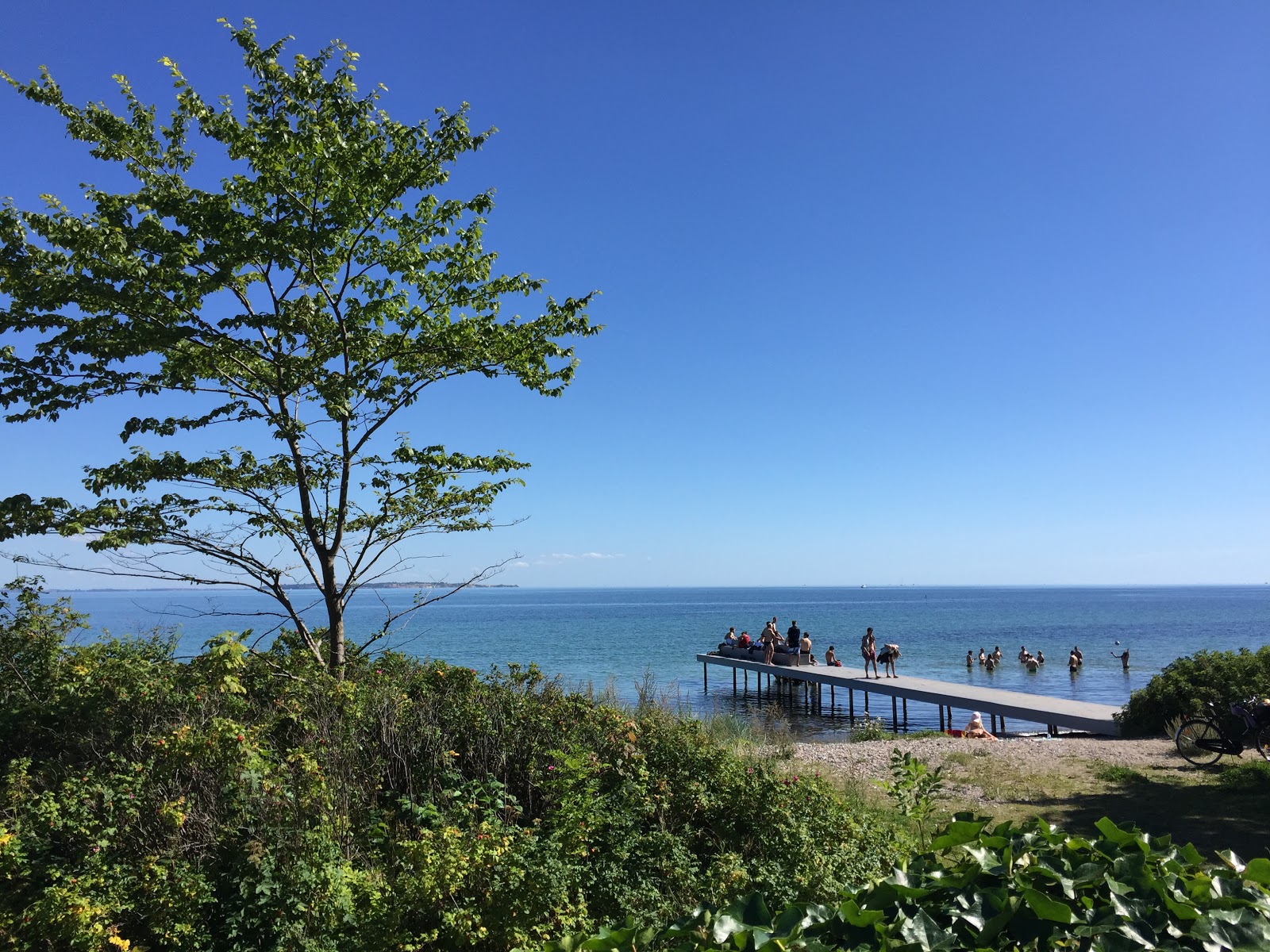
Playing volleyball ‒ or something resembling more or less volleyball ‒ on a sunny day in the water by the border of a beautiful museum is generally a tempting proposition. Too bad I left my swimming trunks at home.

"Gleaming Lights of the Souls" by Yayoi Kusama is one of the main draws of the museum, hands down. With me being enthralled largely by the seaside scenery of the museum's sculpture park, I would have missed this exhibit if I had not heard some members in our crew asking others "Did you see it? Did you see it?" towards the end of our picnic. Naturally, I was curious. "See what?", I asked. They could not describe it, or perhaps they did not want to describe it. I understood that the only way out was to just go see the thing myself.

I felt the urge to sketch in a locale so beautiful. Besides, I was amused with the idea of sketching at our picnic site, like I had done just the day before. So I sat down at the top of the hill in the museum's sculpture park overlooking the Øresund and sketched away. The coolest part was getting two countries in the same sketch.

On our way to Kronborg Slot, a.k.a. Kronborg Castle, in Helsingør, one of us had the great ability to notice our shadows all lined up on the grass. I can no longer remember who it was but I thank him or her for letting us know. I wanted to capture the moment, not expecting Eglantine's foot to feature in it.

Two days later. Inga, Olivier, David and Vincent went off for their almost-traditional morning run. Sometime afterwards, I was teaming with Eglantine and Nilu for a walk on the beach near the house. To get there we had to descend this remarkably long series of stairs ‒ the same stairs from which we watched sunset on the day of my arrival in Denmark.

After days dedicated to visiting castles and museums, we spent most of our last full day in Denmark chilling at home in Vejby. This break was just what I needed to embark on a panoramic sketch of the view at the back of the house. The encouragements that I received from everyone who passed by while I drew only made the moment extra special.

Accompanied by Sylvine, who arrived at the house in the morning, but without Christophe and Nilu, who had already returned to France, we went off for a late afternoon stroll in Tisvilde Hegn, a forest near Vejby that was also the fifth largest in the country. It was upon leaving this forest by the sea that I noticed this gem on the beach.

For the most of us, the next day was the last day in Denmark. It was also, for some of us, an occasion to spend a few hours in Copenhagen before darting off to the airport for our flights back to Paris. After we dropped Inga at Østerport Station and stored our baggage at the airport, I started my discovery of the city with a group stop at Torvehallerne KPH, a well-known covered market near Nørreport Station. Needless to say, we had some of their pastries for a quick, impromptu brunch.

Something to lure me back to Copenhagen for a proper visit: a souvenir of Nyhavn, a canal that shares the name with the surrounding waterfront district.
Here's a trip back to "Danmark", in photos and sketches.

Frederiksborg Slot, in Hillerød, was my first stop with the crew after meeting some of them at the Copenhagen airport and others at the Hillerød train station sometime later. We were eight in number ‒ Inga, Eglantine, Vincent, David, Christophe, Nilu, Olivier and myself ‒ to take on this castle, which is home to the Museum of National History.

The elegant grounds of the castle inspired me to bust out my sketchbook. I produced this sketch at our picnic site, on a lawn that laid opposite to the baroque garden and that provided a nice view of the castle over the slotssø (castle lake). If you could look inside the castle as I drew it, you could find the rest of the crew, in a room or several of them, busy admiring the museum's artifacts.

This was an interesting moment, during which I was discovered a small bit of Danish culture. Two boys on bikes, probably teenagers, rolled up behind me on the lawn that I was sketching on, dumped their bikes against the trunk of a tree nearby, and walked away instantly, casually. I watched them until they disappeared from sight. Yet their bikes were neither locked nor fastened to anything. I mean, nothing. When I had finished sketching and was about to leave, some fifteen minutes later, the bikes were still there. I observed similar situations several times during the rest of the trip, where bikes were parked in public places ‒ from the entrance of a famous site to the outside wall of a house on the street ‒ without a lock.

After a rich day of sightseeing, we made a stop near the beach in our neighborhood in Vejby to watch the sun set. I quickly gathered that this activity had become a something of a tradition in our group. Enchanted, Christophe, Olivier and Vincent were taking it all in.

The next day was notable for a visit to Louisiana, a.k.a, "the most beautiful modern art museum in the world", located in Humlebæk. One of the highlights of our visit was an ambitious exhibition on Africa that presented remarkable multimedia, architectural, and sculptural works from artists of mostly African origin and with diverse points of view.
Playing volleyball ‒ or something resembling more or less volleyball ‒ on a sunny day in the water by the border of a beautiful museum is generally a tempting proposition. Too bad I left my swimming trunks at home.

"Gleaming Lights of the Souls" by Yayoi Kusama is one of the main draws of the museum, hands down. With me being enthralled largely by the seaside scenery of the museum's sculpture park, I would have missed this exhibit if I had not heard some members in our crew asking others "Did you see it? Did you see it?" towards the end of our picnic. Naturally, I was curious. "See what?", I asked. They could not describe it, or perhaps they did not want to describe it. I understood that the only way out was to just go see the thing myself.

I felt the urge to sketch in a locale so beautiful. Besides, I was amused with the idea of sketching at our picnic site, like I had done just the day before. So I sat down at the top of the hill in the museum's sculpture park overlooking the Øresund and sketched away. The coolest part was getting two countries in the same sketch.

On our way to Kronborg Slot, a.k.a. Kronborg Castle, in Helsingør, one of us had the great ability to notice our shadows all lined up on the grass. I can no longer remember who it was but I thank him or her for letting us know. I wanted to capture the moment, not expecting Eglantine's foot to feature in it.

Two days later. Inga, Olivier, David and Vincent went off for their almost-traditional morning run. Sometime afterwards, I was teaming with Eglantine and Nilu for a walk on the beach near the house. To get there we had to descend this remarkably long series of stairs ‒ the same stairs from which we watched sunset on the day of my arrival in Denmark.

After days dedicated to visiting castles and museums, we spent most of our last full day in Denmark chilling at home in Vejby. This break was just what I needed to embark on a panoramic sketch of the view at the back of the house. The encouragements that I received from everyone who passed by while I drew only made the moment extra special.

Accompanied by Sylvine, who arrived at the house in the morning, but without Christophe and Nilu, who had already returned to France, we went off for a late afternoon stroll in Tisvilde Hegn, a forest near Vejby that was also the fifth largest in the country. It was upon leaving this forest by the sea that I noticed this gem on the beach.

For the most of us, the next day was the last day in Denmark. It was also, for some of us, an occasion to spend a few hours in Copenhagen before darting off to the airport for our flights back to Paris. After we dropped Inga at Østerport Station and stored our baggage at the airport, I started my discovery of the city with a group stop at Torvehallerne KPH, a well-known covered market near Nørreport Station. Needless to say, we had some of their pastries for a quick, impromptu brunch.

Something to lure me back to Copenhagen for a proper visit: a souvenir of Nyhavn, a canal that shares the name with the surrounding waterfront district.
Monday, August 31, 2015
exposure to annihilation
Fear.
It was what I often felt before running an operation in public. No matter how many times I had been through the very same operation in the past, under the very same conditions, those feelings of fear were always present and strong, instead of absent or at least weaker, as I had expected them to become over time. Then, one day, I stumbled upon the following words:
I had long attributed the words to Pema Chödrön, who wrote them in her book, "When Things Fall Apart". It was only a few weeks ago that I learned that she may have been quoting Karlfried Graf Dürckheim, who had included the words in his book "The Way of Transformation". So I went looking for the source and discovered the passage below. Nothing but love.
It was what I often felt before running an operation in public. No matter how many times I had been through the very same operation in the past, under the very same conditions, those feelings of fear were always present and strong, instead of absent or at least weaker, as I had expected them to become over time. Then, one day, I stumbled upon the following words:
Only to the extent that we expose ourselves over and over to annihilation can that which is indestructible be found in us.At that instant, I was in love. In love with these words. I believed that they spoke the truth, albeit in a rather poetic manner. After all, they expressed what I had experienced over and over again ‒ the fear of being exposed when I was about to launch an operation and the fear of getting annihilated afterwards, metaphorically speaking. Yet in the end, it was quite the opposite, because I usually felt empowered as a result of my actions. Sometimes, the feeling went beyond empowerment ‒ it bordered on invincibility. But only for a moment, naturally.
I had long attributed the words to Pema Chödrön, who wrote them in her book, "When Things Fall Apart". It was only a few weeks ago that I learned that she may have been quoting Karlfried Graf Dürckheim, who had included the words in his book "The Way of Transformation". So I went looking for the source and discovered the passage below. Nothing but love.
The man, who, being really on the Way, falls upon hard times in the world will not, as a consequence, turn to that friend who offers him refuge and comfort and encourages his old self to survive. Rather, he will seek out someone who will faithfully and inexorably help him to risk himself, so that he may endure the suffering and pass courageously through it, thus making of it a 'raft that leads to the far shore.' Only to the extent that man exposes himself over and over again to annihilation, can that which is indestructible arise within him. In this lies the dignity of daring.
Thursday, August 6, 2015
journée presque parfaite
I had hoped for a good day, but I was not expecting it to be that good. I mean, this is a post that was not meant to happen.
It all started on Monday morning in Paris, on my way to work. I took the metro, getting the opportunity to interact with a few commuters via Operation Metro. Albeit startled (who wouldn't be?), they smiled and returned the "Bonjour!" when I greeted them. The best part was that I had wasted no time before I got into the act. I had not asked myself whether or not to do it, if people were already watching me or were going to watch me, or how weird it was going to be. With an intense focus, I had simply jumped in and created the interactions that I had set out to create. Afterwards, I picked up where I left off in my book of the moment: "Ces impossibles Français", Chapter 5, "Au rendez-vous des libertins". I coasted for the rest of the ride. My mind was at ease.
After the morning spent at work, I got back on the metro during lunch break. I had decided to finish scouting Jardin des serres d'Auteuil, a botanical garden within a major greenhouse complex. I had visited the garden for the first time only the evening before, to determine if it was a suitable location for a future sketcher outing. Since I had to take three different metro lines to get there, I had three chances to run Operation Metro. Yay! Of course, I had my usual anxieties about deciding to stand out among passengers in the metro, but for the most part, I was looking forward to the opportunity. By the time I got out at Porte d'Auteuil, the closest station to the garden, I had scored only two out of three points for the operation. Why? Because on the second leg of the trip, I had interactions that were more involved ‒ and more interesting.
Waiting for the metro at Charles de Gaulle - Etoile to begin this remarkable second leg, I noticed a very pretty girl standing nearby. Then I noticed that the backpack that she was carrying was partially open. Which provided an opening for me to go talk to her. She was accompanied by another girl, but that was secondary. If I hesitated for a second before approaching her, it was because I was busy appreciating this unexpected opportunity to accomplish Operation Insecurity. Eventually, I went over. I said "Bonjour", and followed with "Votre sac est ouvert" ("Your bag is open"). She verified it, smiled and said "Merci", and I left to return to the spot where I was waiting before. Great. Wait, I left?
The only thing that saved me from self-torture after this "hit-and-run", as my friend Sophie would say, was another interaction that took place in the metro after it had arrived and I had entered. Mind you, I was still in Operation Insecurity mode, so I needed to approach another attractive girl to conclude. As a result, Operation Metro was no longer applicable, and it got suspended momentarily. In the metro, there was a pretty woman seated at a certain distance in front of me (I was standing). She had a small backpack on her lap on which it was written "Keziah". After the customary hesitation, I dodged a couple of passengers in order to reach her. "C'est pour Keziah Jones ce sac ?" ("Is that Keziah Jones' bag?"), I asked, referring to the Nigerian singer and guitarist who actually became well-known in France for performing in the Paris metro. "Non", she replied with a smile. "Il est à mon fils" ("It's my son's"). I developed the Keziah joke some more and a conversation ensued, about the origin of the name, French and English languages, and the like. In the process, she complimented my supposed French sans accent, whereas I did the same on her English (she was Congolese). I found it even amusing that she asked me which French words tended to reveal my accent when I said them. I admitted that some words with the "r" were problematic, and she inquired whether the "l" was also an issue. I thought about it. Indeed, my colleagues, all francophone, had once teased me during a meeting when I had said "les rules" (in a French manner), a word that had both "r" and "l" in it. But I digress. Eventually, the lady had to get off and thanked me for an enjoyable chat. What she probably did not know was that I was just as thankful, if not more.
Scouting the garden (after I had eventually made it there) was blissful, just as the day before. I took the opportunity to explore other areas and to ask the woman working at the entrance about picnic spots and restroom access. But what really gave me the thrill, just like the day before, was standing on the border of Roland Garros complex, which is literally across the street from the garden. I walked up this street on my way back to the metro station, gazing at parts of the rounded exterior of Court n° 1 that were not hidden from view by metallic bars and trees. I was particularly drawn to the surface at the top of the court, on which there was a long series of names inscribed for successive years. Names like G. Kuerten. S. Graf. M. Seles. A. Agassi. V. Williams. S. Williams. M. Navrátilová. J. Henin. R. Federer. And R. Nadal, over and over again. I imagined myself linked to these champions, appreciating the moment of being close to the history of the French Open beyond newspaper articles and television and computer screens.

I made the trip back to work via metro, bus and tram and the afternoon passed by. The next delicious moment happened on my way out of the building. When I got into the elevator to get to the ground floor, I was the only person. I wondered if the elevator would stop at an intermediate floor. And it did. And then I wondered if the person about to enter would be male or female. With a slight amount of nervousness, I hoped that the person would be not only female, but solitary as well. And the person was. She entered. I said "Bonjour", she said "Bonsoir" in response. As usual in these circumstances, I scolded myself for not using the appropriate greeting for the evening. Yet I was too focused on this rare occasion to care much about appropriate greetings. When the doors of the elevators closed, I turned to the lady and asked, "Vous venez ici souvent ?" ("Do you come here often?") She replied, in a more or less serious manner, "Mais je travaille ici" ("Well I work here"). We both stared at each other for a brief moment, her facial expression more puzzled than mine. An awkward silence set in. We still faced each other, but we no longer had eye contact. I noticed a faint smile on her face nonetheless. A guy got in at a lower floor, but that did nothing to change the vibe. On the ground floor, the woman got out of the elevator, then out of the building. I lagged behind, reflecting on what had just transpired. Needless to say, I was glad about it. A bit troubled, but glad.
Since it was rush hour, I decided to try out Operation Rush Hour before entering the metro to go home. I was already out on the street, and the lady from the elevator was nowhere to be found (even though I was not necessarily looking for her). I spotted a group of three girls coming my way. Hesitation. Then I spoke to the closest one as I passed her. "Bonjour, le mois d'août, vous passez vos vacances où en général ?" ("Hello, in August, where do you usually spend your vacation ?") "Rwanda", she said. Here was a reply, and even a reaction, that I had not expected. In fact, I was expecting a mild form of repulsion (which only goes to show my comfort level with this type of activity). But no, I was talking with a group of Rwandan girls. We (they and I) got to know a little about each other, but it did not mean much since we dispersed within the minute. Later on, I came across a woman who I found older and less attractive than the Rwandans but attractive nonetheless (call me a bit desperate), and stopped to quiz her on when the next public holiday was. The ideas that I have sometimes. But she was quite agreeable and played along. Each time (out of two) that she suggested a holiday that fell on a weekend, I contested her response, saying that it did not count. So we reached a conclusion that the next real holiday was on November 11, otherwise known as the anniversary of the signature of the armistice that ended World War I in 1918. We then separated and I completed my journey to the metro, where I did not hesitate to run Operation Metro once more. Pure joy.
Back at home, I announced an upcoming group outing to Jardin des serres d'Auteuil on the Paris Sketchers website. I also wrote a first draft of this very blog post.
And to think that these events happened because I decided at each instant to take responsibility for loving myself.
May the most of the following days be similar, or simply presque parfaites.
It all started on Monday morning in Paris, on my way to work. I took the metro, getting the opportunity to interact with a few commuters via Operation Metro. Albeit startled (who wouldn't be?), they smiled and returned the "Bonjour!" when I greeted them. The best part was that I had wasted no time before I got into the act. I had not asked myself whether or not to do it, if people were already watching me or were going to watch me, or how weird it was going to be. With an intense focus, I had simply jumped in and created the interactions that I had set out to create. Afterwards, I picked up where I left off in my book of the moment: "Ces impossibles Français", Chapter 5, "Au rendez-vous des libertins". I coasted for the rest of the ride. My mind was at ease.
After the morning spent at work, I got back on the metro during lunch break. I had decided to finish scouting Jardin des serres d'Auteuil, a botanical garden within a major greenhouse complex. I had visited the garden for the first time only the evening before, to determine if it was a suitable location for a future sketcher outing. Since I had to take three different metro lines to get there, I had three chances to run Operation Metro. Yay! Of course, I had my usual anxieties about deciding to stand out among passengers in the metro, but for the most part, I was looking forward to the opportunity. By the time I got out at Porte d'Auteuil, the closest station to the garden, I had scored only two out of three points for the operation. Why? Because on the second leg of the trip, I had interactions that were more involved ‒ and more interesting.
Waiting for the metro at Charles de Gaulle - Etoile to begin this remarkable second leg, I noticed a very pretty girl standing nearby. Then I noticed that the backpack that she was carrying was partially open. Which provided an opening for me to go talk to her. She was accompanied by another girl, but that was secondary. If I hesitated for a second before approaching her, it was because I was busy appreciating this unexpected opportunity to accomplish Operation Insecurity. Eventually, I went over. I said "Bonjour", and followed with "Votre sac est ouvert" ("Your bag is open"). She verified it, smiled and said "Merci", and I left to return to the spot where I was waiting before. Great. Wait, I left?
The only thing that saved me from self-torture after this "hit-and-run", as my friend Sophie would say, was another interaction that took place in the metro after it had arrived and I had entered. Mind you, I was still in Operation Insecurity mode, so I needed to approach another attractive girl to conclude. As a result, Operation Metro was no longer applicable, and it got suspended momentarily. In the metro, there was a pretty woman seated at a certain distance in front of me (I was standing). She had a small backpack on her lap on which it was written "Keziah". After the customary hesitation, I dodged a couple of passengers in order to reach her. "C'est pour Keziah Jones ce sac ?" ("Is that Keziah Jones' bag?"), I asked, referring to the Nigerian singer and guitarist who actually became well-known in France for performing in the Paris metro. "Non", she replied with a smile. "Il est à mon fils" ("It's my son's"). I developed the Keziah joke some more and a conversation ensued, about the origin of the name, French and English languages, and the like. In the process, she complimented my supposed French sans accent, whereas I did the same on her English (she was Congolese). I found it even amusing that she asked me which French words tended to reveal my accent when I said them. I admitted that some words with the "r" were problematic, and she inquired whether the "l" was also an issue. I thought about it. Indeed, my colleagues, all francophone, had once teased me during a meeting when I had said "les rules" (in a French manner), a word that had both "r" and "l" in it. But I digress. Eventually, the lady had to get off and thanked me for an enjoyable chat. What she probably did not know was that I was just as thankful, if not more.
Scouting the garden (after I had eventually made it there) was blissful, just as the day before. I took the opportunity to explore other areas and to ask the woman working at the entrance about picnic spots and restroom access. But what really gave me the thrill, just like the day before, was standing on the border of Roland Garros complex, which is literally across the street from the garden. I walked up this street on my way back to the metro station, gazing at parts of the rounded exterior of Court n° 1 that were not hidden from view by metallic bars and trees. I was particularly drawn to the surface at the top of the court, on which there was a long series of names inscribed for successive years. Names like G. Kuerten. S. Graf. M. Seles. A. Agassi. V. Williams. S. Williams. M. Navrátilová. J. Henin. R. Federer. And R. Nadal, over and over again. I imagined myself linked to these champions, appreciating the moment of being close to the history of the French Open beyond newspaper articles and television and computer screens.

I made the trip back to work via metro, bus and tram and the afternoon passed by. The next delicious moment happened on my way out of the building. When I got into the elevator to get to the ground floor, I was the only person. I wondered if the elevator would stop at an intermediate floor. And it did. And then I wondered if the person about to enter would be male or female. With a slight amount of nervousness, I hoped that the person would be not only female, but solitary as well. And the person was. She entered. I said "Bonjour", she said "Bonsoir" in response. As usual in these circumstances, I scolded myself for not using the appropriate greeting for the evening. Yet I was too focused on this rare occasion to care much about appropriate greetings. When the doors of the elevators closed, I turned to the lady and asked, "Vous venez ici souvent ?" ("Do you come here often?") She replied, in a more or less serious manner, "Mais je travaille ici" ("Well I work here"). We both stared at each other for a brief moment, her facial expression more puzzled than mine. An awkward silence set in. We still faced each other, but we no longer had eye contact. I noticed a faint smile on her face nonetheless. A guy got in at a lower floor, but that did nothing to change the vibe. On the ground floor, the woman got out of the elevator, then out of the building. I lagged behind, reflecting on what had just transpired. Needless to say, I was glad about it. A bit troubled, but glad.
Since it was rush hour, I decided to try out Operation Rush Hour before entering the metro to go home. I was already out on the street, and the lady from the elevator was nowhere to be found (even though I was not necessarily looking for her). I spotted a group of three girls coming my way. Hesitation. Then I spoke to the closest one as I passed her. "Bonjour, le mois d'août, vous passez vos vacances où en général ?" ("Hello, in August, where do you usually spend your vacation ?") "Rwanda", she said. Here was a reply, and even a reaction, that I had not expected. In fact, I was expecting a mild form of repulsion (which only goes to show my comfort level with this type of activity). But no, I was talking with a group of Rwandan girls. We (they and I) got to know a little about each other, but it did not mean much since we dispersed within the minute. Later on, I came across a woman who I found older and less attractive than the Rwandans but attractive nonetheless (call me a bit desperate), and stopped to quiz her on when the next public holiday was. The ideas that I have sometimes. But she was quite agreeable and played along. Each time (out of two) that she suggested a holiday that fell on a weekend, I contested her response, saying that it did not count. So we reached a conclusion that the next real holiday was on November 11, otherwise known as the anniversary of the signature of the armistice that ended World War I in 1918. We then separated and I completed my journey to the metro, where I did not hesitate to run Operation Metro once more. Pure joy.
Back at home, I announced an upcoming group outing to Jardin des serres d'Auteuil on the Paris Sketchers website. I also wrote a first draft of this very blog post.
And to think that these events happened because I decided at each instant to take responsibility for loving myself.
May the most of the following days be similar, or simply presque parfaites.
Sunday, July 19, 2015
adventures in queueland
One of the most remarkable sights in Paris is that of people lining up for something. And I'm not talking about lines to enter the Louvre Museum or to go up the Eiffel Tower. I am talking rather about everyday situations in which an average Parisian would find himself in a line. For example, a stop at the butcher's. A visit to the bakery. An outing at the movie theater. An evening at a concert hall. Keep in mind that the venues just cited can attract queues that are formed outside on the sidewalk and that for a number of them, such is often the case. It seems that this occurrence is something that most Parisians have long accepted. A reasoning that some of them may offer is that the sight of a line of people in front of the entrance to a shop is a clear sign that the products on sale in that shop are of good quality, and sometimes of very good quality. So queues in Paris can be good. Otherwise, they are most likely just a matter of too many people to be served and too few people to do the actual serving. Sure, other cities that I have lived in (as well as those that I have not lived in for that matter) can boast their own queues and this for their own reasons, but I had not paid any significant attention to queues anywhere before moving to Paris. They seem to be a part of life in this city. Given the good chances of finding one in front of the butcher's shop on Saturday morning or another outside the bakery on Sunday morning, something had to be done. I mean, seriously.
It was only a few years ago that I discovered that there was personal value in creating interactions with people, especially those unfamiliar to me, a.k.a. strangers, and started doing just that. One Saturday morning, on my way home from the swimming pool, I noticed a line of people waiting outside the butcher's shop near my place. I had often seen a line there at that time of the week without giving it much consideration. I hardly shopped there anyway. But, at that very instant, I was seeing beyond the line. What I was seeing was a group of people with unfamiliar faces, each having a few minutes to spare (before the moment came to place his order) for something to happen (a little entertainment perhaps). In other words, ladies and gentlemen, I saw opportunity. And thus, Operation Queues was born.
Well, the birth did not happen so instantly. While opportunity had been perceived, a natural process of experimentation had to take place before Operation Queues took form. The very first question ("What to do?") after discovery of the opportunity was answered by simply going to somewhere in the middle of the queue and walking along it to the end, saying "Bonjour" to each person in line along the way. As this approach was another way of saying "Bonjour", it started out as a new phase of Operation Bonjour. Ultimately, it became clear that such a style of interaction deserved its own operation, even if it was only necessary to say "Bonjour". So a spin-off was created.
With a set of rules, Operation Queues became more formal. Among other things, these rules state that upon stumbling upon a queue that has at least 5 people in the process of everyday living, I am allowed to run the operation on the queue. Doing so involves saying "Bonjour!" to between 5 and 10 people successively in a line within the queue. If the line was disorderly ‒ in other words, not a line ‒ then it was not necessary to do anything special. Since the judgment of line of people as disorderly can be subjective, I sometimes let my instincts decide the course of action to take. Also, if I have to say "Bonjour" to people in the queue who know each other and who are huddled together, for example, a family or a couple, I generally consider all of them as only one person, unless the line was too short and I wanted to reach the target of 5 to 10 people. In this case, I would greet as many members of the group one after the other as necessary. Other boundaries, such as the number of times it is possible to run the operation on a regular basis (twice per week at most), were established to avoid acting too much like a robot.
I remember roughly the very first time I ran the operation. It was at that same butcher's shop where I conceived the idea, and it was a Saturday morning. Before I even got anywhere close to the shop, I was feeling very anxious about what I was about to do (I was not even 100% sure that there would be a queue). A familiar voice within me kept trying to discourage me from doing something so weird, so ridiculous, and obviously so senseless. It was a voice that kept reminding me that the majority of the people who frequented the shop at that time were elderly people and that I should not bother them with my antics. But I was already hooked, haunted by an opportunity that refused to leave me. In hindsight, I admit that what I wanted really was to seize the opportunity. The opportunity to give life to yet another idea, to yet another operation, and, in the process, to myself. There was no way out but to follow through. Soon enough, I reached the butcher's shop and saw the queue. With my nerves raging, I proceeded to do what I had set out to do. When it was done, I walked away, without looking back.
The moments that followed were a blur. Everything happened so quickly. Getting to say "Bonjour" to the first person turned out to be the most difficult step, as I had to overcome the resistance of the inner voice that kept talking to get me to abandon. After that "Bonjour", the voice calmed down and the resistance subsided, even though the operation was not yet completed. I had the impression of being out of myself during the ordeal especially after it. But more important than anything was the feeling of accomplishment. It was undeniable, and I was still alive. I was happy.
And what about the people that I "met" in the queue? They did not seem to understand what was going on (maybe they did not like it). For the most part, they did not return the "Bonjour" nor did they do anything particular in response. Some, especially those who had probably seen me carry out the operation earlier in the queue, made little or no eye contact when I approached them. Besides, I was too focused on running the operation in the simplest possible way, and, as a result, I did not wait long enough for anyone to give me a reply. I simply moved on the next person.
Over the past few years of running the operation in places such as bakeries, cinemas, museums, libraries, cafeterias, restaurants, and nightclubs, more often outside than outside, I received a small range of reactions from queue filers. On average, most of the people returned the "Bonjour", sometimes with enthusiasm, at other times with indifference. Other people just ignored me or even looked away. Very rarely did a conversation ensue. When one occurred, it was usually because I had taken the initiative to engage it with the person. Attempting to make conversation ‒ a conversation with an opening sentence chosen on the spur of the moment for that matter ‒ was in fact an enhancement added to the operation along the way to make things more interesting, and it was only with the last person approached that I did so, for practical reasons. Even then, every attempt did not always lead to a conversation. Some people were just not keen on talking, perhaps because they did not know me. Or maybe because I was doing something unexpected.
Granted, my own attitude has a lot of influence in the reactions that I get from people in queue. The more enthusiastic and engaged I am during my interactions with them, the higher the likelihood that they will respond in a similar manner. At least, that is what I believe. On the other hand, if I am simply running things by the book just to get the task over with, I cannot expect to feel or give much joy during the interaction. And here lies a great challenge that I face in this operation. Bringing enthusiasm and engagement. The only challenge greater that I see would be having people that I know and that know me participate in these interactions. On that note, I am beginning to entertain the idea that with great challenge comes great opportunity.
And why all this fuss about queues anyway? It is probably because I see in them a way for the individual to maintain or regain his freedom while still being a part of society. Other than that, I sometimes feel like being a little different when I find myself in a group of people that seem to be doing more or less the same thing, especially when this "same thing" is expected. It turns out more often than not that honoring this feeling is good for my health. And if there is a possibility of having a positive effect on someone else in the process, even for one second, then that is just great.
It was only a few years ago that I discovered that there was personal value in creating interactions with people, especially those unfamiliar to me, a.k.a. strangers, and started doing just that. One Saturday morning, on my way home from the swimming pool, I noticed a line of people waiting outside the butcher's shop near my place. I had often seen a line there at that time of the week without giving it much consideration. I hardly shopped there anyway. But, at that very instant, I was seeing beyond the line. What I was seeing was a group of people with unfamiliar faces, each having a few minutes to spare (before the moment came to place his order) for something to happen (a little entertainment perhaps). In other words, ladies and gentlemen, I saw opportunity. And thus, Operation Queues was born.
Well, the birth did not happen so instantly. While opportunity had been perceived, a natural process of experimentation had to take place before Operation Queues took form. The very first question ("What to do?") after discovery of the opportunity was answered by simply going to somewhere in the middle of the queue and walking along it to the end, saying "Bonjour" to each person in line along the way. As this approach was another way of saying "Bonjour", it started out as a new phase of Operation Bonjour. Ultimately, it became clear that such a style of interaction deserved its own operation, even if it was only necessary to say "Bonjour". So a spin-off was created.
With a set of rules, Operation Queues became more formal. Among other things, these rules state that upon stumbling upon a queue that has at least 5 people in the process of everyday living, I am allowed to run the operation on the queue. Doing so involves saying "Bonjour!" to between 5 and 10 people successively in a line within the queue. If the line was disorderly ‒ in other words, not a line ‒ then it was not necessary to do anything special. Since the judgment of line of people as disorderly can be subjective, I sometimes let my instincts decide the course of action to take. Also, if I have to say "Bonjour" to people in the queue who know each other and who are huddled together, for example, a family or a couple, I generally consider all of them as only one person, unless the line was too short and I wanted to reach the target of 5 to 10 people. In this case, I would greet as many members of the group one after the other as necessary. Other boundaries, such as the number of times it is possible to run the operation on a regular basis (twice per week at most), were established to avoid acting too much like a robot.
I remember roughly the very first time I ran the operation. It was at that same butcher's shop where I conceived the idea, and it was a Saturday morning. Before I even got anywhere close to the shop, I was feeling very anxious about what I was about to do (I was not even 100% sure that there would be a queue). A familiar voice within me kept trying to discourage me from doing something so weird, so ridiculous, and obviously so senseless. It was a voice that kept reminding me that the majority of the people who frequented the shop at that time were elderly people and that I should not bother them with my antics. But I was already hooked, haunted by an opportunity that refused to leave me. In hindsight, I admit that what I wanted really was to seize the opportunity. The opportunity to give life to yet another idea, to yet another operation, and, in the process, to myself. There was no way out but to follow through. Soon enough, I reached the butcher's shop and saw the queue. With my nerves raging, I proceeded to do what I had set out to do. When it was done, I walked away, without looking back.
The moments that followed were a blur. Everything happened so quickly. Getting to say "Bonjour" to the first person turned out to be the most difficult step, as I had to overcome the resistance of the inner voice that kept talking to get me to abandon. After that "Bonjour", the voice calmed down and the resistance subsided, even though the operation was not yet completed. I had the impression of being out of myself during the ordeal especially after it. But more important than anything was the feeling of accomplishment. It was undeniable, and I was still alive. I was happy.
And what about the people that I "met" in the queue? They did not seem to understand what was going on (maybe they did not like it). For the most part, they did not return the "Bonjour" nor did they do anything particular in response. Some, especially those who had probably seen me carry out the operation earlier in the queue, made little or no eye contact when I approached them. Besides, I was too focused on running the operation in the simplest possible way, and, as a result, I did not wait long enough for anyone to give me a reply. I simply moved on the next person.
Over the past few years of running the operation in places such as bakeries, cinemas, museums, libraries, cafeterias, restaurants, and nightclubs, more often outside than outside, I received a small range of reactions from queue filers. On average, most of the people returned the "Bonjour", sometimes with enthusiasm, at other times with indifference. Other people just ignored me or even looked away. Very rarely did a conversation ensue. When one occurred, it was usually because I had taken the initiative to engage it with the person. Attempting to make conversation ‒ a conversation with an opening sentence chosen on the spur of the moment for that matter ‒ was in fact an enhancement added to the operation along the way to make things more interesting, and it was only with the last person approached that I did so, for practical reasons. Even then, every attempt did not always lead to a conversation. Some people were just not keen on talking, perhaps because they did not know me. Or maybe because I was doing something unexpected.
Granted, my own attitude has a lot of influence in the reactions that I get from people in queue. The more enthusiastic and engaged I am during my interactions with them, the higher the likelihood that they will respond in a similar manner. At least, that is what I believe. On the other hand, if I am simply running things by the book just to get the task over with, I cannot expect to feel or give much joy during the interaction. And here lies a great challenge that I face in this operation. Bringing enthusiasm and engagement. The only challenge greater that I see would be having people that I know and that know me participate in these interactions. On that note, I am beginning to entertain the idea that with great challenge comes great opportunity.
And why all this fuss about queues anyway? It is probably because I see in them a way for the individual to maintain or regain his freedom while still being a part of society. Other than that, I sometimes feel like being a little different when I find myself in a group of people that seem to be doing more or less the same thing, especially when this "same thing" is expected. It turns out more often than not that honoring this feeling is good for my health. And if there is a possibility of having a positive effect on someone else in the process, even for one second, then that is just great.
Tuesday, June 30, 2015
why i love paris (9)
Shortly after 9am on Tuesday, April 7, 2015, I joined fellow Paris Sketchers in front of Shakespeare and Company, the famed English bookstore on the left bank of the Seine river, in Paris. Brigitte had organized an exclusive sketching session there, to start an hour before the bookstore was open to the public and notably to the tourists. It was an event that I could not miss, especially since I had personally attempted almost a year before to obtain permission for a group of us sketchers to draw there. I had not gone very far in this initiative, due to complications of having about a dozen people drawing in a commercial venue that was also iconic, somewhat confined, and often crowded, with visitors outnumbering shoppers. Luckily, Brigitte, who had recently become a Paris Sketcher, decided to take up the challenge all on her own, as if it was a natural thing to do and without knowledge of my previous efforts. And it was a challenge that she pulled off with gusto.
It was so cool just walking to the bookstore that morning, from the Cité metro station, past Notre-Dame, and across the Seine. Surely, the half-day off from work was a big reason for that. Also, there was the old yet pleasant feeling of being in the heart of Paris. I may have lived in Paris for more than eight years, but I can still be delighted at the idea of rediscovering a popular part of the city. Like a tourist.

It was even cooler joining the ten or so sketchers who had showed up on time in front of the bookstore. Brigitte, Sophie, Martine, Marion, Blandine, Béatrice, Gu, Claire, Joelle, and Constance, who I met for the first time. The moment felt special, as if we were about to set out together on a secret mission. Soon enough, the bookstore was open and we filed in. Eriko arrived just in time, before the door was closed. I wondered if latecomers would be allowed in. Then my attention shifted to what was happening inside the room.
We were given a warm welcome by Camille, a store representative and our contact person for the day (who would in the next hour come around to offer us coffee ‒ nice!!!), before we set off scouring the different rooms and hallways across the two floors in search of something worth sketching.
I started things off in a room on the top floor whose walls were bordered for the most part by shelves filled with books, books, and more books. A door leading to a somewhat hidden room and a window providing a view of Notre-Dame completed the wall decor. Several sketchers, notably Blandine, Martine, and Constance, had already taken up their spots and were indulging in a chatter as they drew. I saw some space on a long bench and settled myself there.

It was only when I had finished ‒ around 10am ‒ that I realized that I should have spent the visitor-free hour on the ground floor, which tended to be more crowded because everyone passed by there. Besides, that was where the cash registers were. Trying to make up for the missed opportunity, I rushed downstairs. Even though the store was already open to the public, even though groups of passers-by had become a constant occurrence, I was dead set on making my second sketch there. Giving me hope was Brigitte, who I found seated on the ground in a room near the entrance, with her large sketchbook wide open and its pages adorned with a variety of colors. I told her about the situation that I was in and, to my astonishment, she managed to find me something to sit on! She ended up pulling out a stool that was underneath a nearby table, but in a way that let one think that she had not known it was hidden there. It was like magic. Enthralled, I tried to show my gratitude by sketching some of the view that she was already giving the watercolor treatment.

2 hours, 2 sketches. I was quite satisfied with my pace. Lunch was scheduled for 12:30pm in La Bûcherie, a restaurant very close to the bookstore, which meant that I could easily embark on a third sketch. There was a small room on the top floor with a piano that everyone (or so it seemed) had sketched in. I had dropped by earlier for a quick tour and it did look interesting indeed. So I went back upstairs to try my luck. Once inside, I was lucky enough to find a spot facing the piano, on the other end of the room. I was not without company. Eriko, Lionel, Gu, and Blandine were also present. Some non-sketchers came by or were already there, to look around, to browse through books, or to read more comfortably seated next to us. A curious few engaged in conversations in English with a sketcher or two. All the while, I drew on, amused.

Around 12:30pm, I thanked the staff members that I saw and stepped out of the bookstore. The (relative) calm that was present outside in the morning had long disappeared, which was hardly surprising. Most of the sketchers were already there and I accompanied them to the restaurant. There were about 15 of us to accommodate, including Camille, but the waiters made it work. At the table, we passed sketchbooks around, commenting here and complimenting there. It was a nice way to wrap up a fantastic experience ‒ at least for me, who had to leave the restaurant before the others, saying goodbye to touristic Paris and good afternoon to working Paris. Alas.
It was so cool just walking to the bookstore that morning, from the Cité metro station, past Notre-Dame, and across the Seine. Surely, the half-day off from work was a big reason for that. Also, there was the old yet pleasant feeling of being in the heart of Paris. I may have lived in Paris for more than eight years, but I can still be delighted at the idea of rediscovering a popular part of the city. Like a tourist.

It was even cooler joining the ten or so sketchers who had showed up on time in front of the bookstore. Brigitte, Sophie, Martine, Marion, Blandine, Béatrice, Gu, Claire, Joelle, and Constance, who I met for the first time. The moment felt special, as if we were about to set out together on a secret mission. Soon enough, the bookstore was open and we filed in. Eriko arrived just in time, before the door was closed. I wondered if latecomers would be allowed in. Then my attention shifted to what was happening inside the room.
We were given a warm welcome by Camille, a store representative and our contact person for the day (who would in the next hour come around to offer us coffee ‒ nice!!!), before we set off scouring the different rooms and hallways across the two floors in search of something worth sketching.
I started things off in a room on the top floor whose walls were bordered for the most part by shelves filled with books, books, and more books. A door leading to a somewhat hidden room and a window providing a view of Notre-Dame completed the wall decor. Several sketchers, notably Blandine, Martine, and Constance, had already taken up their spots and were indulging in a chatter as they drew. I saw some space on a long bench and settled myself there.

It was only when I had finished ‒ around 10am ‒ that I realized that I should have spent the visitor-free hour on the ground floor, which tended to be more crowded because everyone passed by there. Besides, that was where the cash registers were. Trying to make up for the missed opportunity, I rushed downstairs. Even though the store was already open to the public, even though groups of passers-by had become a constant occurrence, I was dead set on making my second sketch there. Giving me hope was Brigitte, who I found seated on the ground in a room near the entrance, with her large sketchbook wide open and its pages adorned with a variety of colors. I told her about the situation that I was in and, to my astonishment, she managed to find me something to sit on! She ended up pulling out a stool that was underneath a nearby table, but in a way that let one think that she had not known it was hidden there. It was like magic. Enthralled, I tried to show my gratitude by sketching some of the view that she was already giving the watercolor treatment.

2 hours, 2 sketches. I was quite satisfied with my pace. Lunch was scheduled for 12:30pm in La Bûcherie, a restaurant very close to the bookstore, which meant that I could easily embark on a third sketch. There was a small room on the top floor with a piano that everyone (or so it seemed) had sketched in. I had dropped by earlier for a quick tour and it did look interesting indeed. So I went back upstairs to try my luck. Once inside, I was lucky enough to find a spot facing the piano, on the other end of the room. I was not without company. Eriko, Lionel, Gu, and Blandine were also present. Some non-sketchers came by or were already there, to look around, to browse through books, or to read more comfortably seated next to us. A curious few engaged in conversations in English with a sketcher or two. All the while, I drew on, amused.

Around 12:30pm, I thanked the staff members that I saw and stepped out of the bookstore. The (relative) calm that was present outside in the morning had long disappeared, which was hardly surprising. Most of the sketchers were already there and I accompanied them to the restaurant. There were about 15 of us to accommodate, including Camille, but the waiters made it work. At the table, we passed sketchbooks around, commenting here and complimenting there. It was a nice way to wrap up a fantastic experience ‒ at least for me, who had to leave the restaurant before the others, saying goodbye to touristic Paris and good afternoon to working Paris. Alas.
Monday, June 22, 2015
assume the purpose
I believe more and more that the question of finding out what meaning to give to one's
life — let's call it one's purpose — can be answered by assuming that
something is one's purpose and then investing one's energy in
living that purpose. With discipline, what is assumed will become what is true.
All that is left is having solid reasons for assuming that 'something' is one's purpose.
That said, I might as well assume that this blog is a part of my purpose. After all, I have reasons for maintaining it that are solid. Well, I assume that they are solid.
All that is left is having solid reasons for assuming that 'something' is one's purpose.
That said, I might as well assume that this blog is a part of my purpose. After all, I have reasons for maintaining it that are solid. Well, I assume that they are solid.
Monday, June 15, 2015
becoming the linchpin
On my second and recent read of the book "Linchpin: Are You Indispensable?" by Seth Godin, a fear crept up within me. "Would I spend the next seven months reading and re-reading this book like I did with Flow, analyzing the chapters one by one, highlighting passages with my yellow marker, typing entire sections of the book on my computer, making drawings of the concepts presented?" The book was just that good, that relevant, and I could not put it down.

I am no publishing expert, so I will simply copy what the back cover of the book says:

I am no publishing expert, so I will simply copy what the back cover of the book says:
In bestsellers such as Purple Cow and Tribes, Seth Godin taught readers how to make remarkable products and spread powerful ideas. But this book is about you—your choices, your future, and your potential to make a huge difference in whatever field you choose.One may claim that the book says nothing new, but Seth writes with an edge that I find so rare and insightful that I would debate that claim. Needless to say, he is a linchpin himself, and he is indispensable. His book is nothing short of art and is a gift of his to us. Naturally, like he points out, there is no manual for becoming a linchpin. Each of us must draw his or her own map. Besides, isn't that where all the fun is?
There used to be two teams in every workplace: management and labor. Now there's a third team, the linchpins. These people figure out what to do when there's no rule book. They delight and challenge their customers and peers. They love their work, pour their best selves into it, and turn each day into a kind of art.
Linchpins are the essential building blocks of great organizations. They may not be famous but they're indispensable. And in today's world, they get the best jobs and the most freedom.
As Godin writes, "Every day I meet people who have so much to give but have been bullied enough or frightened enough to hold it back. It's time to stop complying with the system and draw your own map. You have brilliance in you, your contribution is essential, and the art you create is precious. Only you can do it, and you must."
 |
| The Linchpin poster |
Sunday, April 19, 2015
love and responsibility
You infer that your WHY is the result of "a habit of repressing things — not just my favorite ideas — when feeling intimidated by the masses or by authority".
Actually, it has nothing to do with feeling intimidated. It has nothing to do with the masses or with authority. The former is only a symptom, whereas the latter only serves to provoke the symptom.
It has everything to do with you. You don't love your favorite ideas enough, and instead of loving them enough to express them, you fear them and then blame the masses and authority for intimidating you.
You have found out that when you love your favorite ideas enough to express them in presence of the masses and authority, you do not feel intimidated by the masses and authority.
Actually you feel empowered.
And when you are feeling empowered, there is no room in consciousness for feeling intimidated. By anyone, including yourself.
Actually, it has nothing to do with feeling intimidated. It has nothing to do with the masses or with authority. The former is only a symptom, whereas the latter only serves to provoke the symptom.
It has everything to do with you. You don't love your favorite ideas enough, and instead of loving them enough to express them, you fear them and then blame the masses and authority for intimidating you.
You have found out that when you love your favorite ideas enough to express them in presence of the masses and authority, you do not feel intimidated by the masses and authority.
Actually you feel empowered.
And when you are feeling empowered, there is no room in consciousness for feeling intimidated. By anyone, including yourself.
Tuesday, March 31, 2015
"do you have a joke?"
Before 2pm on Saturday, February 28, 2015, I showed up at Gare de Lyon, one of the six major railway stations in Paris. I had no train to catch and I had not come to pick up someone. I had no ticket on hand and I was not going to purchase one. I was not even getting something to eat, and I had no need for the restroom. No, I was only there to run Operation Insecurity.
Operation Insecurity is nothing more than a spin-off of Operation Les Jolies Filles, which was also targeted at pretty women. In all honesty, it is exactly the same thing as Operation Les Jolies Filles. I had just changed its name to remind myself why I was running it: to overcome my feelings of insecurity towards doing unusual things in public. And to help me were the pretty women to be found all over Paris, whether they knew it or not.
Once I stepped into in Hall 1 of the train station, I began looking for a target. Walking the length of the hall, in the area that separated the platforms from the dispersed travelers, I kept my eyes open, scanning the crowd. To calm my nerves and keep away the dissuasive thoughts, I repeated a quote from the mythologist Joseph Campbell that I had remembered only after failing the same operation in the same place five hours before: "Find a place inside where there's joy, and the joy will burn out the pain." It was a quote that I believed in, given the numerous successes that I had had when running challenging operations in the past.
I got through the hall without a single approach. That's not to say that there were no pretty women around, on the contrary. I just did not make out any clear-cut opportunity or, when I did, I did not muster the courage to do anything about it, telling myself that I did not know what to say to the girl, even though I had allowed myself to say anything that came to mind. All the while, moments came and went as quickly as the number of people that were moving all over the place. Not to be discouraged, I kept on moving myself, armed with words of wisdom from Joseph Campbell.
I made my way into the Galerie des fresques, which linked Hall 1 to Hall 2. Soon enough, I spotted a woman in a very colorful outfit walking towards me, alone. As the gap between us got closer, I quickly looked around and verified that there were people nearby : some were standing by on her left, others walking behind her, and several walking behind me. Perfect. As I crossed paths with the woman, I got her attention by saying hello, in English.
"So how was vacation?", I asked.
"..."
"You know, the school vacation period just ended."
"Yes ..."
"And it lasted two weeks."
"Yes ..."
"So how did it go?"
The woman kept silent for a short moment before continuing.
"I don't quite understand. Do you speak German?"
"German?", I asked in return, surprised.
"Yes, German."
"No, I don't. Are you German?"
"No, but I speak it."
"But you do speak French?"
"Yes", she replied.
I was intrigued as to why she had asked me if I spoke German instead of asking me if I spoke French. We were in France, after all. Or did I miss something? In any case, I was not going to switch to French for the sake of convenience, so the interaction swiftly ended and we parted ways right after.
I kept on walking until I reached Hall 2. Upon entering, I found myself on one end of the floor. I went straight towards the platforms to be in the middle of the action while walking towards the other end of the floor. Of course, I was still keeping a lookout. And my efforts were about to pay off when, somewhere along the middle of the floor, I noticed two women standing together, facing the trains. One was looked like she was in her late 20s or early 30s. The other was perhaps her mother, as she looked much older. Without hesitation, I jumped into action. It was what I wanted after all. Action.
"Hello", I said, looking more at the younger woman, who was closer to me.
"..."
"Are you waiting for your train?"
"No."
"Oh, you are waiting for someone then?"
"Yes."
Silence. All the while, I could pick up a certain discomfort on their part (or was it on my part rather?). The younger woman was giving me one-word answers, though I took some responsibility for this, having coming up with such simple questions in the first place. The other woman had turned her head away and remained quiet. As for me, I had run out of things to say, and it seemed that the best thing to do at that point was to end the conversation.
"Well, have a good day", I said, smiling.
"Thanks", said the younger woman, with a faint smile. The other woman kept her silence, though she gave a hint of a smile.
I completed my tour of Hall 2 and left, going through the Galerie des fresques again to return to Hall 1. Having initiated a conversation on two separate occasions inside the same building, I had completed the operation that I had failed only five hours before. But I did not feel satisfied with this victory. In fact, I felt like I had not given an acceptable effort, notably with the two women that I met in Hall 2. The interaction with them had been simply too brief, and the questions that I asked them did not require more than "Yes" or "No" answers. Also, I had been taken aback by their relatively distant reaction. "I mean, why can't some people just lighten up sometimes?", I complained to myself, almost impulsively. And at that instant, my mind got to racing to thinking what I could do foster light-hearted interactions with strangers (in this case, with pretty women). Then an idea emerged and stood over everything else in my consciousness. I liked it and decided to give it a go.
I was already back in Hall 1, which seemed more crowded than before. But I was undeterred. In fact, I was more determined than ever, Joseph Campbell's words still by my side. I walked below the main departure board suspended in the middle of the hall, among the dozens of travelers who had their eyes fixed on it. Nearby, I saw three girls standing in a small circle, talking. Given the mass of people around them, it was an excellent opportunity for me to feature my insecurity. So I chose to go capture it.
"Hello", I said.
"Hello".
"Do you have a joke?"
"Er ... what?"
"Do you have a joke?"
"A joke?"
"Yes. A joke. Do you have one?"
The girls looked amused. I guessed that they also felt perplexed. But they were game, and started conferring quietly among themselves. It took place quite quickly, and I could not record everything that was going on. However, I remember being pleasantly surprised by the success that I was having in pulling off this stunt. Some silence had crept in, so naturally, I made sure to pick up the dialogue.
"Okay, I'm waiting for a joke!", I stated, with a hand gesture meant to convey my impatience.
"Do you speak French?", one of the girls asked me.
"Yes, I do. But not today."
She seemed to take that well.
"What about a bad joke?", another girl asked.
"Well, a bad joke is still a joke", I conceded.
"All right, I am going say it, it's in French."
I moved in closer to listen. I found it a bit odd yet humorous that I was going to have to understand a joke in French even though everyone was aware that I had chosen to not speak a word of French.
"Qu'est-ce qui est jaune et attend?" (In English: "What is yellow and wait?")
"'Jaune', OK, I got that. 'Attend'? Like from the verb 'attendre'?"
"Yes."
I thought about it for a while, trying to come up with an answer. I asked for a clue, but I don't think that my request registered with the girls. Helpless, I did not spend much time before giving up.
"Jaune-attend!", one of them said.
"Jaune-attend? Wha ... oh! Jonathan? The name Jonathan?"
"Yes."
"Wait ... Jonathan ... pronounced in what language? French? English?"
I cannot remember their reply. But the joke ‒ or rather the riddle ‒ was more or less understood. I just assumed that the French pronounced the name Jonathan differently compared to native English speakers. "Jaune-attend", I repeated. "Hmmn."
"Not bad at all, not bad", I added.
The girls were all smiles.
"Do you mind if I use it?", I asked them.
"Not at all", one girl replied, giggling with the others.
I decided to end the interaction. I had the feeling that I no longer had anything plausible to say. My mind was blank actually. I felt that I had already redeemed myself after the disappointment of the previous encounter. Pleased about this last experience, I wished the girls "bon voyage" before leaving them, even though I did not know whether they were going to take a train or if they were simply waiting for someone to arrive.
Alone once again and feeling liberated more than anything, I headed for the bus stop outside the train station, amusing myself with ideas to take things further with this operation.
Operation Insecurity is nothing more than a spin-off of Operation Les Jolies Filles, which was also targeted at pretty women. In all honesty, it is exactly the same thing as Operation Les Jolies Filles. I had just changed its name to remind myself why I was running it: to overcome my feelings of insecurity towards doing unusual things in public. And to help me were the pretty women to be found all over Paris, whether they knew it or not.
Once I stepped into in Hall 1 of the train station, I began looking for a target. Walking the length of the hall, in the area that separated the platforms from the dispersed travelers, I kept my eyes open, scanning the crowd. To calm my nerves and keep away the dissuasive thoughts, I repeated a quote from the mythologist Joseph Campbell that I had remembered only after failing the same operation in the same place five hours before: "Find a place inside where there's joy, and the joy will burn out the pain." It was a quote that I believed in, given the numerous successes that I had had when running challenging operations in the past.
I got through the hall without a single approach. That's not to say that there were no pretty women around, on the contrary. I just did not make out any clear-cut opportunity or, when I did, I did not muster the courage to do anything about it, telling myself that I did not know what to say to the girl, even though I had allowed myself to say anything that came to mind. All the while, moments came and went as quickly as the number of people that were moving all over the place. Not to be discouraged, I kept on moving myself, armed with words of wisdom from Joseph Campbell.
I made my way into the Galerie des fresques, which linked Hall 1 to Hall 2. Soon enough, I spotted a woman in a very colorful outfit walking towards me, alone. As the gap between us got closer, I quickly looked around and verified that there were people nearby : some were standing by on her left, others walking behind her, and several walking behind me. Perfect. As I crossed paths with the woman, I got her attention by saying hello, in English.
"So how was vacation?", I asked.
"..."
"You know, the school vacation period just ended."
"Yes ..."
"And it lasted two weeks."
"Yes ..."
"So how did it go?"
The woman kept silent for a short moment before continuing.
"I don't quite understand. Do you speak German?"
"German?", I asked in return, surprised.
"Yes, German."
"No, I don't. Are you German?"
"No, but I speak it."
"But you do speak French?"
"Yes", she replied.
I was intrigued as to why she had asked me if I spoke German instead of asking me if I spoke French. We were in France, after all. Or did I miss something? In any case, I was not going to switch to French for the sake of convenience, so the interaction swiftly ended and we parted ways right after.
I kept on walking until I reached Hall 2. Upon entering, I found myself on one end of the floor. I went straight towards the platforms to be in the middle of the action while walking towards the other end of the floor. Of course, I was still keeping a lookout. And my efforts were about to pay off when, somewhere along the middle of the floor, I noticed two women standing together, facing the trains. One was looked like she was in her late 20s or early 30s. The other was perhaps her mother, as she looked much older. Without hesitation, I jumped into action. It was what I wanted after all. Action.
"Hello", I said, looking more at the younger woman, who was closer to me.
"..."
"Are you waiting for your train?"
"No."
"Oh, you are waiting for someone then?"
"Yes."
Silence. All the while, I could pick up a certain discomfort on their part (or was it on my part rather?). The younger woman was giving me one-word answers, though I took some responsibility for this, having coming up with such simple questions in the first place. The other woman had turned her head away and remained quiet. As for me, I had run out of things to say, and it seemed that the best thing to do at that point was to end the conversation.
"Well, have a good day", I said, smiling.
"Thanks", said the younger woman, with a faint smile. The other woman kept her silence, though she gave a hint of a smile.
I completed my tour of Hall 2 and left, going through the Galerie des fresques again to return to Hall 1. Having initiated a conversation on two separate occasions inside the same building, I had completed the operation that I had failed only five hours before. But I did not feel satisfied with this victory. In fact, I felt like I had not given an acceptable effort, notably with the two women that I met in Hall 2. The interaction with them had been simply too brief, and the questions that I asked them did not require more than "Yes" or "No" answers. Also, I had been taken aback by their relatively distant reaction. "I mean, why can't some people just lighten up sometimes?", I complained to myself, almost impulsively. And at that instant, my mind got to racing to thinking what I could do foster light-hearted interactions with strangers (in this case, with pretty women). Then an idea emerged and stood over everything else in my consciousness. I liked it and decided to give it a go.
I was already back in Hall 1, which seemed more crowded than before. But I was undeterred. In fact, I was more determined than ever, Joseph Campbell's words still by my side. I walked below the main departure board suspended in the middle of the hall, among the dozens of travelers who had their eyes fixed on it. Nearby, I saw three girls standing in a small circle, talking. Given the mass of people around them, it was an excellent opportunity for me to feature my insecurity. So I chose to go capture it.
"Hello", I said.
"Hello".
"Do you have a joke?"
"Er ... what?"
"Do you have a joke?"
"A joke?"
"Yes. A joke. Do you have one?"
The girls looked amused. I guessed that they also felt perplexed. But they were game, and started conferring quietly among themselves. It took place quite quickly, and I could not record everything that was going on. However, I remember being pleasantly surprised by the success that I was having in pulling off this stunt. Some silence had crept in, so naturally, I made sure to pick up the dialogue.
"Okay, I'm waiting for a joke!", I stated, with a hand gesture meant to convey my impatience.
"Do you speak French?", one of the girls asked me.
"Yes, I do. But not today."
She seemed to take that well.
"What about a bad joke?", another girl asked.
"Well, a bad joke is still a joke", I conceded.
"All right, I am going say it, it's in French."
I moved in closer to listen. I found it a bit odd yet humorous that I was going to have to understand a joke in French even though everyone was aware that I had chosen to not speak a word of French.
"Qu'est-ce qui est jaune et attend?" (In English: "What is yellow and wait?")
"'Jaune', OK, I got that. 'Attend'? Like from the verb 'attendre'?"
"Yes."
I thought about it for a while, trying to come up with an answer. I asked for a clue, but I don't think that my request registered with the girls. Helpless, I did not spend much time before giving up.
"Jaune-attend!", one of them said.
"Jaune-attend? Wha ... oh! Jonathan? The name Jonathan?"
"Yes."
"Wait ... Jonathan ... pronounced in what language? French? English?"
I cannot remember their reply. But the joke ‒ or rather the riddle ‒ was more or less understood. I just assumed that the French pronounced the name Jonathan differently compared to native English speakers. "Jaune-attend", I repeated. "Hmmn."
"Not bad at all, not bad", I added.
The girls were all smiles.
"Do you mind if I use it?", I asked them.
"Not at all", one girl replied, giggling with the others.
I decided to end the interaction. I had the feeling that I no longer had anything plausible to say. My mind was blank actually. I felt that I had already redeemed myself after the disappointment of the previous encounter. Pleased about this last experience, I wished the girls "bon voyage" before leaving them, even though I did not know whether they were going to take a train or if they were simply waiting for someone to arrive.
Alone once again and feeling liberated more than anything, I headed for the bus stop outside the train station, amusing myself with ideas to take things further with this operation.
Subscribe to:
Posts (Atom)