A few months ago, I had a written exchange with my friend Keith on the subject of mentors. He presented to me the benefits of having a mentor. Someone to push you when you are feeling weak. Someone to guide you through the uncertainties in life. Someone who has been there before and can show you a way out. And so on.
I agreed with pretty much all that Keith said. Really, mentors are great. But I do not have any at the moment. Maybe I have not invested enough time and effort in finding one. Maybe someone that I know has been trying to serve as a mentor to me, but I have not acknowledged him as such. Anyhow, as far as I am concerned, I do not have one. So, considering the big dreams that I want to realize, what's the next best thing?
Do things yourself.
The truth remains that not everyone who is skilled in a mentoring role can be a suitable mentor for you. Even the mentors that seem suitable for you are not always available. Even after finding a mentor that seems both suitable and available, you cannot just expect them to do wonders in your life. You have to have something to show. Be it some clarity about what you want, a willingness to get things done, an experience of accomplishing great things, or even just an intense emotion (that is not necessarily positive) about something in particular. Or even something else. I think that the best mentors are inclined to help if you have something to show. It reminds me of a lovely quote that I learned in French a few years ago: "Aide-toi et le ciel t'aidera" (which literally translates to "Help yourself and the sky will help you" though some take it to mean "God helps those who help themselves"). So, how do you go about having something to show?
Do things yourself.
Until you find a mentor that is good enough and available for you, you are better off getting the ball rolling on your own. That means no lying idle, no occupying your time with easier and less important matters. If you are taking action on something meaningful to you, even if slow or questionable, you are cultivating a sense of commitment that can potentially be attractive to a mentor, and he may become inspired to help you. If you are lying idle or occupying your time with trivial matters, well, you are only developing a habit of doing just that, which makes it more difficult to break the habit after crossing paths with someone who you think could be a great mentor to you.
So do things yourself, when you do not have the luxury of a good mentor. Besides, at the end of the day, it's all about you doing the work. Having a mentor does not mean he is going to do the work for you. A mentor is primarily a means to an end; an end that you define, directly or indirectly. A mentor is there to make the process faster, easier, and more efficient in general. And things are arguably more fun with a mentor than without one. Yet, even in these preferred conditions, the fact remains that there is work to be done and that you will have to do much of it, if not all.
Adapting yourself to work without a mentor while remaining open to the eventuality of finding one requires embracing the approach of trial and error. It's a process that can be quite enlightening, even if lengthy. Without a mentor, we can equip ourselves with information from literature of all kinds, from people that we know, from current events ‒ really, the sources of inspiration are endless and within reach. For my part, I see myself as having "virtual mentors" like Simon Sinek and Paul Arden in the absence of a real one, and they have been helping me for a long time. Regarding the practice of trying new things, we must keep a open mind, questioning things that we always considered set in stone, imagining different possibilities. Afterwards, we must allow ourselves to realize some of these possibilities. Does it work? Does it not work? How do I feel about that? What can I do better? Where can I find other opportunities? These are only a few of the numerous questions that you may discover and rediscover during the process. Questions that excite, questions that motivate, questions that inspire, questions that lead us to develop purpose in our lives.
As I see it, this kind of process is what being a free spirit is all about. While a mentor is valuable, free spirits do not depend on one, technically speaking. Free spirits enjoy venturing into unknown territory and figuring out things on their own, even if they choose people to help them do that. A mentor can be a great resource for a free spirit, but I think that too much mentoring can interfere with free spiriting. Ideally, the best mentor would be one that enables the free spirit in a person to bloom, so that the person can lead a life of his choice in the absence of the mentor.
If you believe that you can be a good mentor to me and you are available, let me know how I can reach you by leaving a comment below.
Sunday, November 24, 2013

Saturday, November 16, 2013
five strolls through the 11th
Guess who's back?
Operation 50 First States!
I should perhaps rename it to "5 x 10 First States" or something similar. Long story.
Anyways, after several letdowns and restarts, my feet finally traveled through the 11th arrondissement of Paris, passing various notable places along the way. It took five strolls, where each one continued from where the previous had ended on a previous day.
In addition to approaching only people surrounded by other people in order to end up in a crowd, which was necessary for this stage of the operation, I decided to formalize a "comeback" reply for each stroll if the person approached asked why I was doing what I was doing. While the reason given in the comeback had to be either unusual or amusing given the context of meeting strangers on the street, it had to be also genuine.
The five comebacks:
Lastly, I wanted the comebacks to mention things that people could relate to. They may not know or care for Cheyenne, Wyoming, for example, but shyness? That, they are familiar with.
1. Place de la Nation
Place de la Nation is a square on the border of the 11th and 12th arrondissements. Formerly named the Place du Trône to commemorate the solemn entry into Paris of Louis XIV and Maria Theresa of Spain, it used to be a vast grassy space of vines and market gardens within the Mur des fermiers généraux, one of the former city wall of Paris. In its center lies Le Triomphe de la République, a bronze monument commissioned in 1879 to mark the centenary of the French Revolution. This monument showcases a statue personifying the Republic surrounded by various symbolic figures and facing the Place de la Bastille, thereby creating a Republican axis frequently used for public demonstrations.


2. Rue de Charonne
Rue de Charonne is a long street that runs through the arrondissement, beginning in the 12th near the Bastille neighborhood and ending in the 20th near the Père-Lachaise Cemetery. Along the way, one can find many shops, art galleries, and restaurants ranging in ambience from casual to trendy. The street is also home to several sites, including courtyards Cour Saint-Joseph and Cour Jacques-Viguès, as well as Palais de la Femme, a large residence belonging to the Salvation Army that houses women that are single or with children.


After entering Rue du Faubourg Saint-Antoine from Rue to Charonne, I approached a middle-aged woman waiting at a bus stop and asked her if she was from Tallahassee, Florida. With an air of friendliness, she replied : "I have never been to Florida. I don't have any feeling for that kind of society." Which prompted me to ask: "What kind of society do you think is there?" Regrettably, I didn't give her a chance to come up with an answer, as I butted in by saying "Beach society? Yeah, I don't like the beach that much either." She smiled.
Right after this encounter, I spotted a middle-aged man standing on the sidewalk in front of a restaurant terrace. He had a somewhat punk look and was enjoying a cigarette. I went over and asked him if he was from Atlanta, Georgia. He stopped me using a hand gesture to signal that he did not want to be disturbed, adding "Don't speak French." Hmmn.
3. Rue de Lappe
Rue de Lappe is a street near the Bastille neighborhood. It was home in the early 19th century to boutiques specializing in the distribution of metals such as zinc, copper, and iron. By the turn of the century, however, the street had ceded to more festive activities, with the arrival of cabarets, cafes, and bars where patrons sang and danced bal-musette and bourrée, styles of music popular at the time. Today, the street is renowned for its nightlife.


4. Place de la Bastille
Place de la Bastille is a large square at the intersection of the 4th, 11th, and 12th arrondissements. The square and its surrounding areas are often simply referred to as Bastille. It was the site of the former Bastille prison, which was stormed on July 14, 1789 at the onset of the French Revolution. At the center of the square lies the colonne de juillet, a column erected to commemorate the three days of the July Revolution of 1830 known as "Les Trois Glorieuses." Today, the square is popular among locals and tourists alike and serves as a frequent host to political and cultural demonstrations.


On the square, I ran into a tall man who appeared to speak English well. After revealing that he did not come from Annapolis, Maryland, he asked : "Why did you ask that?" I told him that I was just trying to be creative. He smiled and then left, without saying a word.
5. Boulevard Richard-Lenoir
Boulevard Richard-Lenoir is a wide tree-lined boulevard that runs northward from Place de la Bastille. It is named after textile industrialists François Richard and Joseph Lenoir-Dufresne, who brought prosperity to the cotton industry in France at the turn of the 19th century. The boulevard is noteworthy for its median strip, which, in addition to covering a part of Canal Saint-Martin, is home to several small gardens, a weekly art market (Marché de la création), and a bi-weekly fruit and vegetable market that is one of the largest in Paris (Marché Bastille).


Making my way through the busy market, I caught a woman standing among other people in front of a stand. I went over to find out if she was from Jefferson City, Missouri. In an English comparable to that of an American, she replied no, adding "Do I look like someone you know?" It was my turn to reply : "No. Do I look like someone you know?" In the end, she must have gotten the point that the dialogue was not meant to be taking (too) seriously.
6. Cirque d'hiver
Cirque d'hiver ("Winter Circus") has been a prominent venue for circuses, equestrian exhibitions, musical concerts, and even fashion shows. Designed by the architect Jacques-Ignace Hittorff and inaugurated by Emperor Napoleon III on 11 December 1852 as Cirque Napoléon, the circus is a polygon of 20 sides having 40 windows, with a diameter of 41 meters and Corinthian columns at the angles.


7. Rue Oberkampf
Rue Oberkampf is a street that runs through the arrondissement, from the 3rd arrondissement on the west to the 20th arrondissement on the east. Formed by a progressive urbanization beginning at the end of the 18th century, this street is sometimes considered as a "rue-faubourg", because it is a busy street that travels from the center of Paris towards its outskirts and that is lined with various kinds of shops. In the 1990s, Rue Oberkampf became a trendy place with a rich offering of bars, cafés, restaurants, nightclubs and concert venues, particularly in the neighborhood around its eastern end, near Ménilmontant.


I bumped into a man on Rue Oberkampf and inquired if he was from Albany, New York. He asked what I was looking for. I replied that I was trying to overcome my shyness. He indicated that he did not understand the word. So I said "timidity" and he understood. He said "Good luck" and left.
After having walked east on Rue Oberkampf all the way to Boulevard de Ménilmontant, I made a U-turn to walk in the other direction, but on the other sidewalk. Soon after crossing the street to start going back, I ran into an middle-aged man with a pretty, young Indian-looking girl by his arm. As it was time to approach a man, so I went up to him. "Hi. Are you from Bismarck, North Dakota?", I asked. He did not say much, and it was the girl who translated for him, in crystal clear English. She told me that he was French and that he could only speak French. So she asked if I spoke French. To which I replied : "yes but not today". This seemed to have clarified things, as the guy then went, "Bonjour" and I replied "Bonjour" in return. "Ca va ?", he asked. "Ca va", I replied, in a good French accent. At this point, it appeared that my admission of being able to speak French had been ignored. In any case, the dialogue carries on between me and girl, in English. She asks politely for the motivation of my actions. I replied that I was trying to overcome my shyness. Then she starts giving me pointers on where to meet English speakers in Paris, citing Saint-Michel and Rue Mouffetard, as if I was a tourist or someone who had just moved to the city. She admitted that she went to Rue Mouffetard after moving to Paris 5 years before and met English-speaking people everywhere there. I was touched by the whole thing. Eventually, we went our separate ways, ending one of the most pleasant interactions in the history of the operation.
8. Bataclan
Bataclan is an auditorium designed by the architect Charles Duval in 1864. Then named "Le Grand Café Chinois-Théâtre Bataclan", it takes its name from Offenbach's operetta. With a facade representing a Chinese pagoda, the Bataclan was originally a music hall that presented ballets and acrobatic shows. In 1926, the auditorium was resold and transformed into a cinema; it will remain one until 1969. One of the most prestigious performance venues in Paris today, the Bataclan hosts the biggest names in music and stage, catering to shows, theater, nightclubbing, but above all to concerts.


There was a mass of people that camped out right beside the Bataclan entrance. Virtually all of them were dressed for a Gothic rock concert. Not exactly seeking to disturb the peace, I approached a middle-aged woman standing at a corner open to passers-by and asked her if she was from Providence, Rhode Island. She said no. When I asked her what was happening, she told me that there was a Finnish band playing. In her explanation, she kept acting as if I did not know what Finnish meant, even though I kept repeating Helsinki. It was an amusing piece of miscommunication.
I stopped a guy near the Bataclan to ask if he was from Columbia. He happily replied "No." South Carolina? "No." He then asked what I was doing. I said that I was trying to overcome my shyness. He told me that I was doing a good job and started walking away afterwards. I could do nothing but shout "Thanks for the encouragement!" as he was getting further away.
9. Eglise Saint-Ambroise
Eglise Saint-Ambroise ("Saint-Ambroise Church") is a church that shares its name with the administrative district in which it is located. It was constructed from 1863 to 1868, according to the plans and under the direction of the architect Théodore Ballu, shortly after the inauguration of Boulevard du Prince-Eugène (former name of Boulevard Voltaire). It replaced a church called Notre-Dame de la Procession that was located slightly in front, approximately at the location of the garden in front of the current church. Its style is a mix of neo-Gothic, neo-Roman and neo-Byzantine elements that were in fashion at the time, notably in Paris.


In the vicinity of the church, when a woman told me that she was not from Pierre, South Dakota, it was the big moment to usher in a brand new comeback: "I am trying to stop caring about what people think about me." I no longer remember her reaction. But I did it! Ecstatic about having made real for the first time what I imagined as different from social conventions, I felt my nerves tingling for a while.
10. Place Léon Blum
Place Léon Blum is a square inaugurated in 1857 under the name of Place du Prince-Eugène, in homage to the uncle of Napoléon III, and later renamed in 1870 to Place Voltaire, owing to the proximity of the boulevard bearing the same name. Since 1957, it has taken its name from the politician Léon Blum (1872-1950), whose statue is visible in front of the city hall of the arrondissement.

I met a man near the McDonald's on the square between Rue de la Roquette and Boulevard Voltaire. With difficulty, I confirmed that he was not from Richmond, Virginia. He was curious about my intentions, so I gave him the comeback reply. He did not understand and asked if I spoke French. I said, "Yes, but not today." Yet he really wanted to understand what I had said. It was very endearing; I had never met a person as curious and kind during previous runs of this operation before. He did not appear satisfied when I told him that I was only carrying out a mental exercise. I ended up deciding to break character (sorry Charlie Todd) and told him that I had never done it and would do it only once. So I delivered comeback reply number 5 in French, clumsily: "J'essaie d'arrêter de penser à ce que les autres pensent de moi." The translation was a struggle. Back to speaking in English. The man did not seem to care much for what I had just said after all. He conceded that he had seen my board (on it I had fixed a map of the arrondissement et a sheet of paper listing the 50 states and their capitals) and had thought that I wanted his signature. He joked that I was not as old as he was even with all my grey hair. He got that right. He introduced himself as Michel, and said he was 54. In return, I told him my age and maybe my name as well. We shook hands on two occasions. The interaction was that special.
I met a group of four (one woman, three guys) standing at corner of an intersection along Rue de la Roquette. I went up to the woman and asked if she was from Olympia, Washington. She got to smiling while saying "No." I caught the others smiling too. She asked what I was up to. I took my time to provide comeback reply number 5. Then she went, "Well, I don't know you." I shot back quickly with "I didn't know you either." We exchanged one more round of smiles and then good day wishes as we parted ways.
As a bonus, some interesting things seen during the strolls:
Operation 50 First States!
I should perhaps rename it to "5 x 10 First States" or something similar. Long story.
Anyways, after several letdowns and restarts, my feet finally traveled through the 11th arrondissement of Paris, passing various notable places along the way. It took five strolls, where each one continued from where the previous had ended on a previous day.
In addition to approaching only people surrounded by other people in order to end up in a crowd, which was necessary for this stage of the operation, I decided to formalize a "comeback" reply for each stroll if the person approached asked why I was doing what I was doing. While the reason given in the comeback had to be either unusual or amusing given the context of meeting strangers on the street, it had to be also genuine.
The five comebacks:
- I am just bored
- I am just trying to be creative
- I am trying to change the world
- I am trying to overcome my shyness (new)
- I am trying to stop caring about what people think about me (new)
Lastly, I wanted the comebacks to mention things that people could relate to. They may not know or care for Cheyenne, Wyoming, for example, but shyness? That, they are familiar with.
1. Place de la Nation
Place de la Nation is a square on the border of the 11th and 12th arrondissements. Formerly named the Place du Trône to commemorate the solemn entry into Paris of Louis XIV and Maria Theresa of Spain, it used to be a vast grassy space of vines and market gardens within the Mur des fermiers généraux, one of the former city wall of Paris. In its center lies Le Triomphe de la République, a bronze monument commissioned in 1879 to mark the centenary of the French Revolution. This monument showcases a statue personifying the Republic surrounded by various symbolic figures and facing the Place de la Bastille, thereby creating a Republican axis frequently used for public demonstrations.


 |
| Columns of the former barrière du Trône |
2. Rue de Charonne
Rue de Charonne is a long street that runs through the arrondissement, beginning in the 12th near the Bastille neighborhood and ending in the 20th near the Père-Lachaise Cemetery. Along the way, one can find many shops, art galleries, and restaurants ranging in ambience from casual to trendy. The street is also home to several sites, including courtyards Cour Saint-Joseph and Cour Jacques-Viguès, as well as Palais de la Femme, a large residence belonging to the Salvation Army that houses women that are single or with children.


After entering Rue du Faubourg Saint-Antoine from Rue to Charonne, I approached a middle-aged woman waiting at a bus stop and asked her if she was from Tallahassee, Florida. With an air of friendliness, she replied : "I have never been to Florida. I don't have any feeling for that kind of society." Which prompted me to ask: "What kind of society do you think is there?" Regrettably, I didn't give her a chance to come up with an answer, as I butted in by saying "Beach society? Yeah, I don't like the beach that much either." She smiled.
Right after this encounter, I spotted a middle-aged man standing on the sidewalk in front of a restaurant terrace. He had a somewhat punk look and was enjoying a cigarette. I went over and asked him if he was from Atlanta, Georgia. He stopped me using a hand gesture to signal that he did not want to be disturbed, adding "Don't speak French." Hmmn.
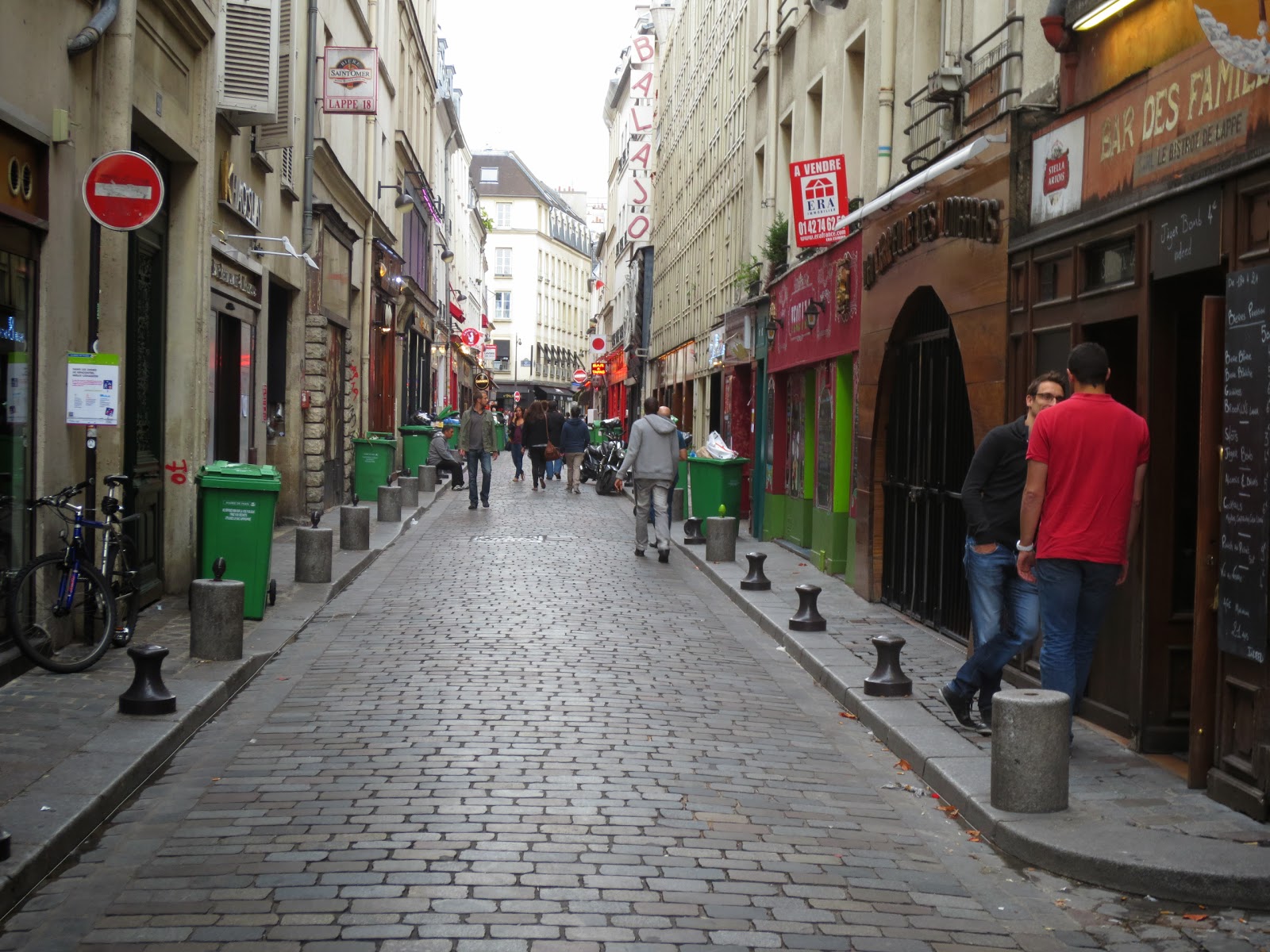
3. Rue de Lappe
Rue de Lappe is a street near the Bastille neighborhood. It was home in the early 19th century to boutiques specializing in the distribution of metals such as zinc, copper, and iron. By the turn of the century, however, the street had ceded to more festive activities, with the arrival of cabarets, cafes, and bars where patrons sang and danced bal-musette and bourrée, styles of music popular at the time. Today, the street is renowned for its nightlife.

4. Place de la Bastille
Place de la Bastille is a large square at the intersection of the 4th, 11th, and 12th arrondissements. The square and its surrounding areas are often simply referred to as Bastille. It was the site of the former Bastille prison, which was stormed on July 14, 1789 at the onset of the French Revolution. At the center of the square lies the colonne de juillet, a column erected to commemorate the three days of the July Revolution of 1830 known as "Les Trois Glorieuses." Today, the square is popular among locals and tourists alike and serves as a frequent host to political and cultural demonstrations.
 |
| Undaunted cyclistes |

 |
| Génie de la Liberté |


 |
| On the sunny side of things |

On the square, I ran into a tall man who appeared to speak English well. After revealing that he did not come from Annapolis, Maryland, he asked : "Why did you ask that?" I told him that I was just trying to be creative. He smiled and then left, without saying a word.
5. Boulevard Richard-Lenoir
Boulevard Richard-Lenoir is a wide tree-lined boulevard that runs northward from Place de la Bastille. It is named after textile industrialists François Richard and Joseph Lenoir-Dufresne, who brought prosperity to the cotton industry in France at the turn of the 19th century. The boulevard is noteworthy for its median strip, which, in addition to covering a part of Canal Saint-Martin, is home to several small gardens, a weekly art market (Marché de la création), and a bi-weekly fruit and vegetable market that is one of the largest in Paris (Marché Bastille).
 |
| A Sunday morning at Marché Bastille |


 |
| One of several gardens on Promenade Richard-Lenoir |
Making my way through the busy market, I caught a woman standing among other people in front of a stand. I went over to find out if she was from Jefferson City, Missouri. In an English comparable to that of an American, she replied no, adding "Do I look like someone you know?" It was my turn to reply : "No. Do I look like someone you know?" In the end, she must have gotten the point that the dialogue was not meant to be taking (too) seriously.
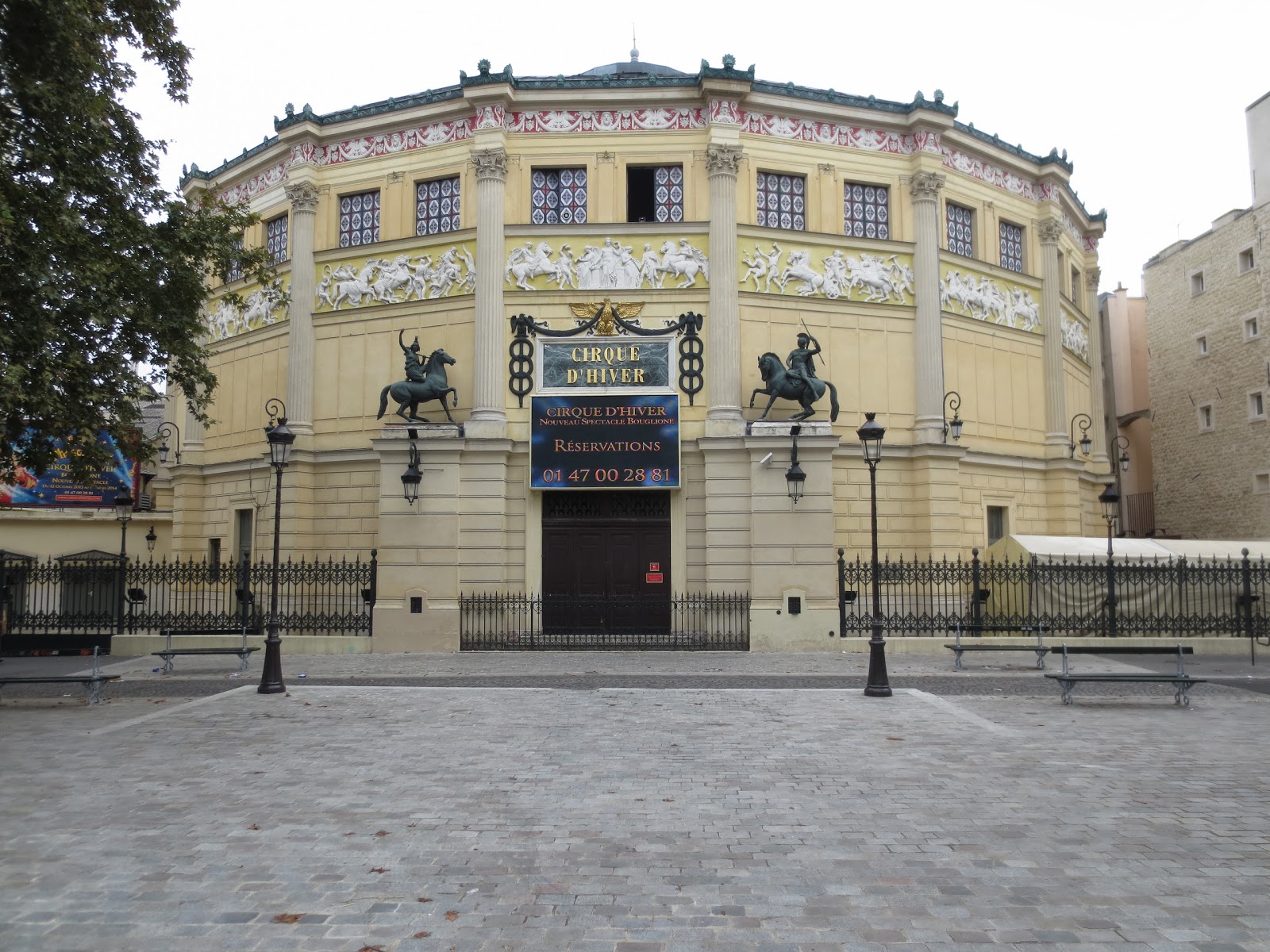
6. Cirque d'hiver
Cirque d'hiver ("Winter Circus") has been a prominent venue for circuses, equestrian exhibitions, musical concerts, and even fashion shows. Designed by the architect Jacques-Ignace Hittorff and inaugurated by Emperor Napoleon III on 11 December 1852 as Cirque Napoléon, the circus is a polygon of 20 sides having 40 windows, with a diameter of 41 meters and Corinthian columns at the angles.
 |
| Woman with baguette |

 |
| Tigers in Paris! |
7. Rue Oberkampf
Rue Oberkampf is a street that runs through the arrondissement, from the 3rd arrondissement on the west to the 20th arrondissement on the east. Formed by a progressive urbanization beginning at the end of the 18th century, this street is sometimes considered as a "rue-faubourg", because it is a busy street that travels from the center of Paris towards its outskirts and that is lined with various kinds of shops. In the 1990s, Rue Oberkampf became a trendy place with a rich offering of bars, cafés, restaurants, nightclubs and concert venues, particularly in the neighborhood around its eastern end, near Ménilmontant.


I bumped into a man on Rue Oberkampf and inquired if he was from Albany, New York. He asked what I was looking for. I replied that I was trying to overcome my shyness. He indicated that he did not understand the word. So I said "timidity" and he understood. He said "Good luck" and left.
After having walked east on Rue Oberkampf all the way to Boulevard de Ménilmontant, I made a U-turn to walk in the other direction, but on the other sidewalk. Soon after crossing the street to start going back, I ran into an middle-aged man with a pretty, young Indian-looking girl by his arm. As it was time to approach a man, so I went up to him. "Hi. Are you from Bismarck, North Dakota?", I asked. He did not say much, and it was the girl who translated for him, in crystal clear English. She told me that he was French and that he could only speak French. So she asked if I spoke French. To which I replied : "yes but not today". This seemed to have clarified things, as the guy then went, "Bonjour" and I replied "Bonjour" in return. "Ca va ?", he asked. "Ca va", I replied, in a good French accent. At this point, it appeared that my admission of being able to speak French had been ignored. In any case, the dialogue carries on between me and girl, in English. She asks politely for the motivation of my actions. I replied that I was trying to overcome my shyness. Then she starts giving me pointers on where to meet English speakers in Paris, citing Saint-Michel and Rue Mouffetard, as if I was a tourist or someone who had just moved to the city. She admitted that she went to Rue Mouffetard after moving to Paris 5 years before and met English-speaking people everywhere there. I was touched by the whole thing. Eventually, we went our separate ways, ending one of the most pleasant interactions in the history of the operation.
8. Bataclan
Bataclan is an auditorium designed by the architect Charles Duval in 1864. Then named "Le Grand Café Chinois-Théâtre Bataclan", it takes its name from Offenbach's operetta. With a facade representing a Chinese pagoda, the Bataclan was originally a music hall that presented ballets and acrobatic shows. In 1926, the auditorium was resold and transformed into a cinema; it will remain one until 1969. One of the most prestigious performance venues in Paris today, the Bataclan hosts the biggest names in music and stage, catering to shows, theater, nightclubbing, but above all to concerts.


 |
| HIM happens to be a Finnish rock band ... |

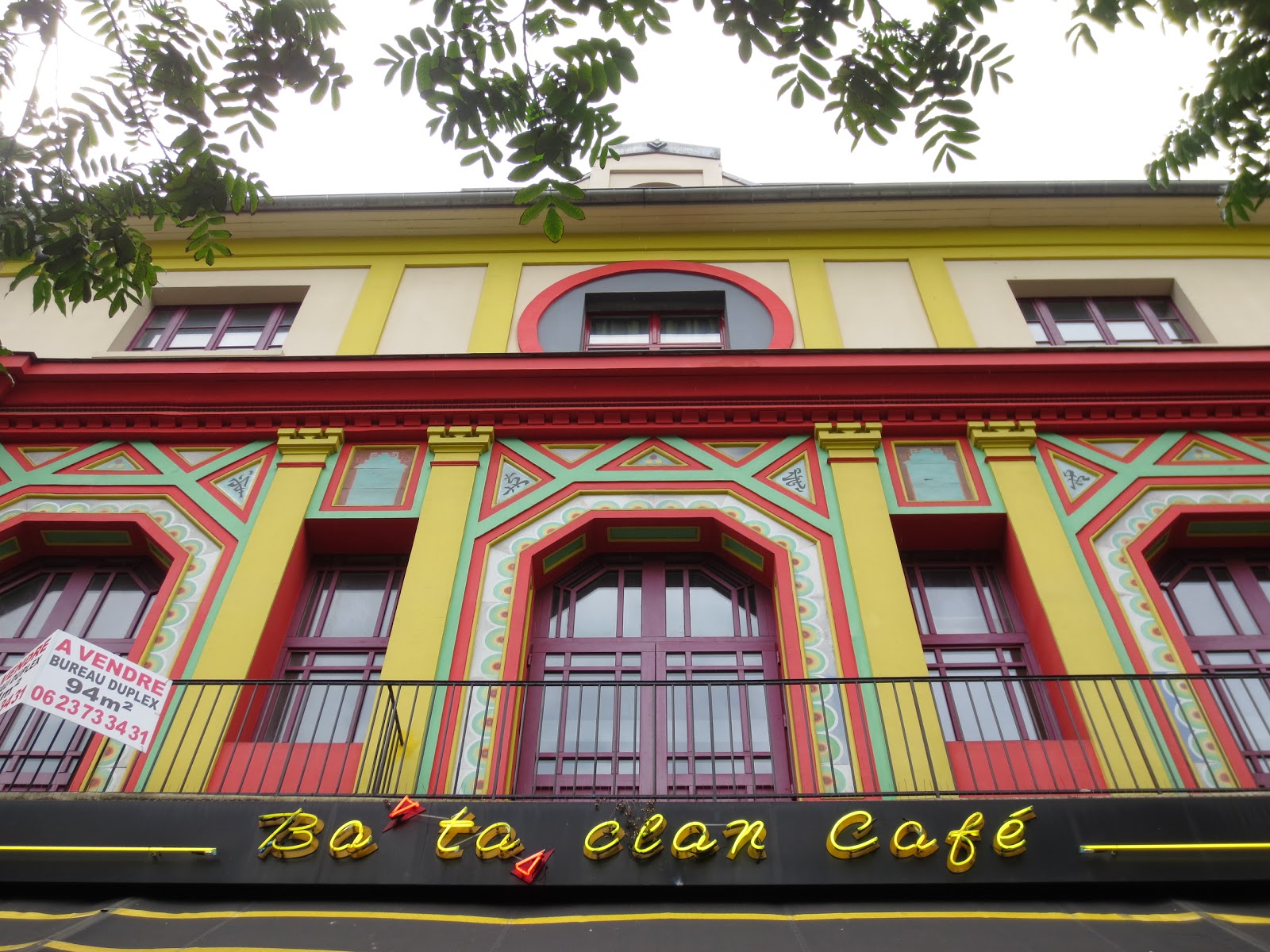
There was a mass of people that camped out right beside the Bataclan entrance. Virtually all of them were dressed for a Gothic rock concert. Not exactly seeking to disturb the peace, I approached a middle-aged woman standing at a corner open to passers-by and asked her if she was from Providence, Rhode Island. She said no. When I asked her what was happening, she told me that there was a Finnish band playing. In her explanation, she kept acting as if I did not know what Finnish meant, even though I kept repeating Helsinki. It was an amusing piece of miscommunication.
I stopped a guy near the Bataclan to ask if he was from Columbia. He happily replied "No." South Carolina? "No." He then asked what I was doing. I said that I was trying to overcome my shyness. He told me that I was doing a good job and started walking away afterwards. I could do nothing but shout "Thanks for the encouragement!" as he was getting further away.
9. Eglise Saint-Ambroise
Eglise Saint-Ambroise ("Saint-Ambroise Church") is a church that shares its name with the administrative district in which it is located. It was constructed from 1863 to 1868, according to the plans and under the direction of the architect Théodore Ballu, shortly after the inauguration of Boulevard du Prince-Eugène (former name of Boulevard Voltaire). It replaced a church called Notre-Dame de la Procession that was located slightly in front, approximately at the location of the garden in front of the current church. Its style is a mix of neo-Gothic, neo-Roman and neo-Byzantine elements that were in fashion at the time, notably in Paris.


In the vicinity of the church, when a woman told me that she was not from Pierre, South Dakota, it was the big moment to usher in a brand new comeback: "I am trying to stop caring about what people think about me." I no longer remember her reaction. But I did it! Ecstatic about having made real for the first time what I imagined as different from social conventions, I felt my nerves tingling for a while.
10. Place Léon Blum
Place Léon Blum is a square inaugurated in 1857 under the name of Place du Prince-Eugène, in homage to the uncle of Napoléon III, and later renamed in 1870 to Place Voltaire, owing to the proximity of the boulevard bearing the same name. Since 1957, it has taken its name from the politician Léon Blum (1872-1950), whose statue is visible in front of the city hall of the arrondissement.

 |
| Mairie de l'arrondissement |
 |
| Statue of Léon Blum |
I met a man near the McDonald's on the square between Rue de la Roquette and Boulevard Voltaire. With difficulty, I confirmed that he was not from Richmond, Virginia. He was curious about my intentions, so I gave him the comeback reply. He did not understand and asked if I spoke French. I said, "Yes, but not today." Yet he really wanted to understand what I had said. It was very endearing; I had never met a person as curious and kind during previous runs of this operation before. He did not appear satisfied when I told him that I was only carrying out a mental exercise. I ended up deciding to break character (sorry Charlie Todd) and told him that I had never done it and would do it only once. So I delivered comeback reply number 5 in French, clumsily: "J'essaie d'arrêter de penser à ce que les autres pensent de moi." The translation was a struggle. Back to speaking in English. The man did not seem to care much for what I had just said after all. He conceded that he had seen my board (on it I had fixed a map of the arrondissement et a sheet of paper listing the 50 states and their capitals) and had thought that I wanted his signature. He joked that I was not as old as he was even with all my grey hair. He got that right. He introduced himself as Michel, and said he was 54. In return, I told him my age and maybe my name as well. We shook hands on two occasions. The interaction was that special.
I met a group of four (one woman, three guys) standing at corner of an intersection along Rue de la Roquette. I went up to the woman and asked if she was from Olympia, Washington. She got to smiling while saying "No." I caught the others smiling too. She asked what I was up to. I took my time to provide comeback reply number 5. Then she went, "Well, I don't know you." I shot back quickly with "I didn't know you either." We exchanged one more round of smiles and then good day wishes as we parted ways.
As a bonus, some interesting things seen during the strolls:
 |
| It's the second edition of the "Sex in the City" exhibition! |
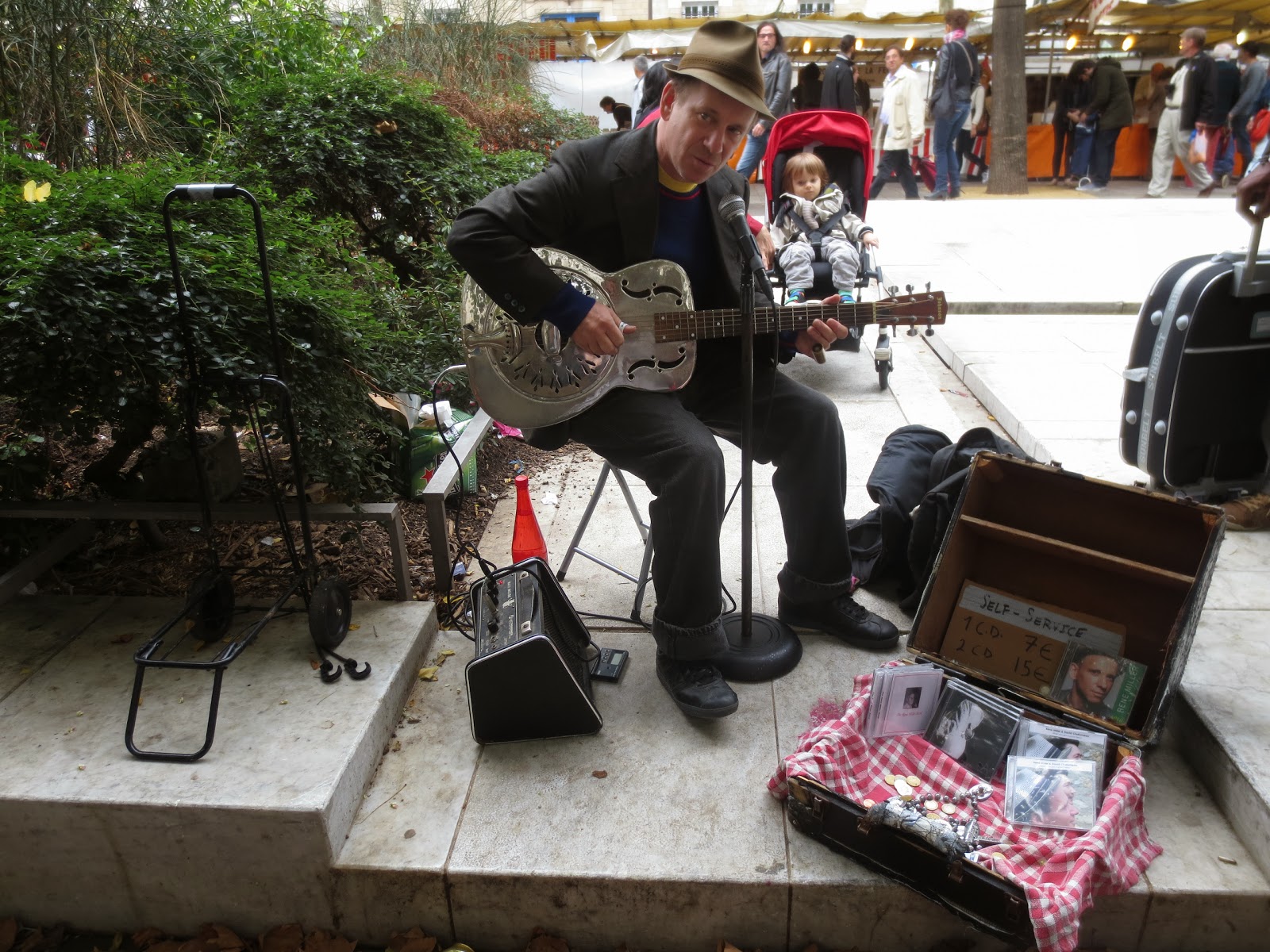 |
| Rene Miller entertains shoppers at Marché Bastille |
 |
| Game Heaven, a.k.a. the place where I can get back my Nintendo, my Sega Genesis, and my Playstation |
 |
 |
| Preferred testing grounds pour Operation Bar Games |
 |
| The highest ranked (and possibly the best) Thai restaurant in Paris |
Wednesday, November 6, 2013
ne plus ignorer
I discovered the poster below in the metro in Paris several months ago.

"Ignorer" is one of those French verbs that I have always been fond of. Which is funny, now that I think about it, because I almost never use it. However, I tend to pay more attention when I notice it in a text.
As you may guess, "ignorer" means "to ignore" in English. But it is a second and less apparent meaning that always gets me: "to not know". I used to think that stating publicly in French that you "ignored" an important matter resembled an act of defiance, but now I understand that it might also be you simply admitting that you do not know what the matter was!
Which brings us back to the poster. The lovely thing here, I think, is that both meanings work after translation.
A student in difficulty is a child who ignores his strong points.
A student in difficulty is a child who does not know his strong points.
Now if we apply this message to our lives:
Maybe we find ourselves in certain difficult situations because do not know our gifts?
And when we do know these gifts, maybe we still find ourselves in difficult situations because we ignore them?
Here's to us always knowing our gifts and no longer ignoring them.
In other words, "ne plus ignorer".

"Ignorer" is one of those French verbs that I have always been fond of. Which is funny, now that I think about it, because I almost never use it. However, I tend to pay more attention when I notice it in a text.
As you may guess, "ignorer" means "to ignore" in English. But it is a second and less apparent meaning that always gets me: "to not know". I used to think that stating publicly in French that you "ignored" an important matter resembled an act of defiance, but now I understand that it might also be you simply admitting that you do not know what the matter was!
Which brings us back to the poster. The lovely thing here, I think, is that both meanings work after translation.
A student in difficulty is a child who ignores his strong points.
A student in difficulty is a child who does not know his strong points.
Now if we apply this message to our lives:
Maybe we find ourselves in certain difficult situations because do not know our gifts?
And when we do know these gifts, maybe we still find ourselves in difficult situations because we ignore them?
Here's to us always knowing our gifts and no longer ignoring them.
In other words, "ne plus ignorer".
Friday, November 1, 2013
operation handshake explained
Dear Lionel,
I am very excited about this opportunity to finally tell with you all about Operation Handshake. You know, the thing where you noticed me walking the entire open space once a week, stopping at each person's desk to shake his hand. It has been a year since we parted ways as colleagues and I have always appreciated your curiosity regarding the mechanics of the operation. I even remember the state machine that you drew up on the whiteboard in the conference room during my farewell party to describe to others how the operation worked based on the little that I had revealed. You got some things right, and those that you did not, I will attempt to clarify below. So bear with me since I have never given this much spotlight in writing to any of my operations before.
Before proceeding, I want to take this moment to let you know how much I cherished the moments that we spent working together (well, to be more accurate, the moments that we spent at work together). You were a great guy to bother, if not for your inviting desk decorated with Dilbert comic strips. I felt elated to practice my English with you and always admired your ability to speak the language very well. Above all though, it was your openness, your enthusiasm, and your sense of humor that I will remember the most. How did you do it so naturally?
Anyway, the explanation that follows is for you, buddy. I love you man!
The inspiration
The idea for the operation was a convergence of several things. Firstly, there was the practice of shaking hands at work. It seemed too French to go shake the hand of each person in the team upon arriving at work in the morning. The subject even came up occasionally in conversation, inside and outside of work. I was quite amused by the whole thing. I had never experienced, thought, or discussed anything of the sort while working in the U.S.. While most people in our team did not actually shake hands in the morning, the practice had already left an impression on me. I have Joao in particular to thank for this. He was very disciplined during his first couple of weeks at work about going to shake the hand of everyone in the room (the one that I shared with him before we moved to the open space). I even expressed my gratitude to him in his greeting card during his farewell party. At the time, Operation Handshake was in its infancy.
Then there was the workplace culture. Whenever a colleague shook hands, he usually did not bother going beyond his team. And the open space was shared by several small teams, but each person clung to his team; note that I was far from being the exception. Outside of work requirements and random gatherings by the coffee machine, there was not much interaction among members of different teams. It resembled the French society but on a much smaller scale, where people spent virtually the whole time with the people that they already knew. I mean, it was great, except that there were other people too with whom we shared the open space. I thought that things could be more interesting if we took the time to go meet colleagues that we weren't used to talking to, just to greet them or to acknowledge their presence in some sense, without the context of a project. I also imagined that a more open workplace would help to ease inevitable tensions and to prevent false assumptions that colleagues tend to have.
Yet the primary motivation for kicking off this operation was personal. I felt invisible at work. Maybe I did not need to have that sentiment, being the English-speaking foreigner that could also speak French well, that was curious about French culture, that was kind of a cool guy, and whose jokes were somewhat funny. But that was how I felt. Beyond my efforts to always abide by some unspoken French code of conduct ("le code", in the words of my friend Mélodie), I shrunk myself and what made me different out of habit ‒ I had been doing so for years. So I felt the need to stop making myself invisible and consequently feeling bad about myself.
Not wanting to ask everyone to look at me nor wanting to strive to gain attention, this idea came to mind. Somehow. No one else was doing something like it. It seemed fitting given the combination of factors mentioned above. I loved it, and did not want to let it die. Such had been the fate of other similar ideas that I had conceived, and this probably because they were different from what most people did.
I wanted therefore to accept what made me different instead of rejecting it by not letting it show. Truth be told, many of the most enjoyable moments in my life were those where I had expressed my difference. So why try to hide it, right? The best way that I came up with to go about things was obviously to show my difference, to make sure everyone had a chance to know about it. I mean, if you believed that everyone kept seeing your difference and that you were enjoying being different, there would be no more reason to hide your difference from anyone, right? Thus, I felt it necessary to target as many people as possible for the operation.
Since I had difficulty expressing my difference in the midst of certain people, I also wanted to perceive each person in the open space in the same way as any other person. Without seeking to become friends with him, I wanted most of all to not see him as an obstacle. So whether he was someone that I liked, or someone that I liked less, or someone that I knew hardly or not at all, I was going to go over to offer him a handshake.
Being public was also key. Like I said, I wanted to give everyone the chance to see me doing something unusual in order to become desensitized to the feeling that everyone was looking at me. The thought of that feeling had often prevented me from expressing myself in certain situations, and I wanted to get rid of it.
The procedure
The operation as you may remember it involved me arriving at work one morning during the week and walking the entire open space to greet each person by shaking hands with him until I sat down at my desk. It was that simple.
The details
But it was also complex, of course.
It included several details, and I did my best to make them easy to remember. I quickly learned that the lot of details made the game more fun.
Regularity. I sought to go shaking hands once a week. I figured that one day a week was good enough spacing. I certainly did not want to program myself to shake hands everyday. Neither did I want to become too predictable. And yes, I did not want to bother people too often either. As far as the choice of day, there was nothing special really, contrary to what you all were thinking. The whole thing was largely dependent on my mood. That said, if it was Thursday afternoon and I still hadn't run the operation all week for some reason, I would plan on running it the following morning, whether my mood was cooperating or not.
Timing. I planned on arriving by 9:30am; sometimes after 9:15am but always before 9:45am. I even timed my departure from home to be on time, waiting occasionally in a seat in front of the RER platform if I was too early! Regarding the choice of time, 9:30am seemed reasonable. I estimated that the open space would have a decent amount of people at that time (at least half the capacity) and that most of them would not yet be too absorbed in their work.
Entrances. It took a while to get the system of entering the open space worked out. Not that I was even thinking about that when I launched the operation. I just noticed that I was moving always in the same direction and therefore I decided to vary things up. I ended up taking one of the two entrances one week, and the other one the following week. When I started covering the adjacent open space (see below), I had four entrances to play with, two per open space. So I continued the same system of alternating entrances, though in a clockwise direction. That kept matters simple, since I had to only remember the entrance that I took the previous week to figure out which one to take on a given week.
Handwashing. I washed my hands in the restroom before showtime. It is only the right thing to do before shaking dozens of hands in a matter of a few minutes! I got around to washing my hands afterwards as well.
Scope 1. Once I was getting comfortable with the operation in our open space, I decided to branch out to the adjacent one. In other words, I would go there to shake the hands of people who we saw much less, who we knew much less, and with whom we worked much less, if ever at all. The strangeness of that idea was too alluring to pass up. Besides, I wanted to keep my spirits up by thinking bigger.
Scope 2. Over time, after taking about 5-10 quick minutes of a given day of the week to visit about 40 people on average in two open spaces, I was once again used to the operation as it was and thought about taking it a step further. So I traded in quantity for quality. I decided to visit one open space on one day of the week, and the other on another day of the same week. I figured that this would allow me time to chat briefly with the people that I greeted, if they were so inclined for a chat. I can assure you that not everyone was!
Conversation. Quite naturally, the time to engage in conversations came. Even if I found myself on occasion already chatting with people during my visit, I felt the urge to structure things a bit. So I decided to prompt conversations with specific people each week, in addition to the spontaneous chats. Since I was not really at ease with conversing with unfamiliar people or with certain people that I knew, I settled on asking "Ca va ?" ("How are things?") after the handshake and seeing where that led to. The few reactions that I got have been pretty much forgotten since and, in any case, this part remains the least developed of the operation. I am glad however for having tried.
The results
The results were incredible. You know, Handshake became my first successful operation and the only one for a long while, if we define success by the fact that I went through with it every week without fail. Whenever I realized that I was on a winning streak, I became more motivated to ensure that the streak continued, even while seeking new challenges within the operation.
Yes, it took effort to keep the streak going. Why? Because there was a certain stage fright that was often present, notably in the early stages of the operation. After all, I was coming out of my quiet and comfortable corner, to which I had confined myself for a long time to avoid bothering anyone, to begin approaching each person in the open space in a regular and unusual way, exposing myself to public scrutiny in the process. Some people must have turned heads. Nevertheless, it was not always easy getting into the mindset necessary to accomplish the task. Most of the time, I heard voices in my head trying to dissuade me, saying things like "Why are you doing this? There is no point", "Do you know how weird it's going to be?", "You don't work with those people; you don't even know them. Why are you going to bother them ‒ just to shake their hand? They will not be pleased at all." The voices were so persuasive that I had the shivers in the restroom after washing my hands, carrying not much else in mind but the weight of the duty that had chosen to fulfill. In order to calm myself in these moments since I was getting acquainted with them regularly, I kept in my pocket a piece of paper on which I had written within the comfort of my apartment. It had words of encouragement and purpose to remind me how my unwanted feelings would persist if not worsen had I refused to take action. Fortunately, I was able to do take action, each time, in spite of the fear. At some point, the fear that had escalated began to diminish.
One of the turning points that I truly cherished was that when I started doing la bise ("cheek kisses") with the ladies. After so many handshakes, the ice had broken and it had suddenly become natural to advance to the bise stage with them.
It was also amusing how some people, a few of whom that I did not know well, would stop by at my desk during the day to shake my hand and then continue on their journey without having said a single word to me. I took it as a compliment, a sign that the operation was appreciated. It just brightened my day. In fact, you were one of these people!
Among the many gifts that you guys gave me during my farewell party, the antiseptic soap was one of those that I found quite touching. I have hardly used it! I may just keep it as a souvenir of good times.
I wonder sometimes if my initiative helped improve the lives of others at work, even if a little. What do you think?
For my part, I just felt that I was more like the person that I wanted to be. I started to enjoy the time spent at work more. I felt more open, more spontaneous, more assertive, and certainly less invisible. More visible? Who knows. But I felt good, and better among you guys. It was sad that it came to an end, but such is life.
Until next time dude. Make sure that you forward this "algorithm" to François.
Regards.
Monsieur Conf.
I am very excited about this opportunity to finally tell with you all about Operation Handshake. You know, the thing where you noticed me walking the entire open space once a week, stopping at each person's desk to shake his hand. It has been a year since we parted ways as colleagues and I have always appreciated your curiosity regarding the mechanics of the operation. I even remember the state machine that you drew up on the whiteboard in the conference room during my farewell party to describe to others how the operation worked based on the little that I had revealed. You got some things right, and those that you did not, I will attempt to clarify below. So bear with me since I have never given this much spotlight in writing to any of my operations before.
Before proceeding, I want to take this moment to let you know how much I cherished the moments that we spent working together (well, to be more accurate, the moments that we spent at work together). You were a great guy to bother, if not for your inviting desk decorated with Dilbert comic strips. I felt elated to practice my English with you and always admired your ability to speak the language very well. Above all though, it was your openness, your enthusiasm, and your sense of humor that I will remember the most. How did you do it so naturally?
Anyway, the explanation that follows is for you, buddy. I love you man!
The inspiration
The idea for the operation was a convergence of several things. Firstly, there was the practice of shaking hands at work. It seemed too French to go shake the hand of each person in the team upon arriving at work in the morning. The subject even came up occasionally in conversation, inside and outside of work. I was quite amused by the whole thing. I had never experienced, thought, or discussed anything of the sort while working in the U.S.. While most people in our team did not actually shake hands in the morning, the practice had already left an impression on me. I have Joao in particular to thank for this. He was very disciplined during his first couple of weeks at work about going to shake the hand of everyone in the room (the one that I shared with him before we moved to the open space). I even expressed my gratitude to him in his greeting card during his farewell party. At the time, Operation Handshake was in its infancy.
Then there was the workplace culture. Whenever a colleague shook hands, he usually did not bother going beyond his team. And the open space was shared by several small teams, but each person clung to his team; note that I was far from being the exception. Outside of work requirements and random gatherings by the coffee machine, there was not much interaction among members of different teams. It resembled the French society but on a much smaller scale, where people spent virtually the whole time with the people that they already knew. I mean, it was great, except that there were other people too with whom we shared the open space. I thought that things could be more interesting if we took the time to go meet colleagues that we weren't used to talking to, just to greet them or to acknowledge their presence in some sense, without the context of a project. I also imagined that a more open workplace would help to ease inevitable tensions and to prevent false assumptions that colleagues tend to have.
Yet the primary motivation for kicking off this operation was personal. I felt invisible at work. Maybe I did not need to have that sentiment, being the English-speaking foreigner that could also speak French well, that was curious about French culture, that was kind of a cool guy, and whose jokes were somewhat funny. But that was how I felt. Beyond my efforts to always abide by some unspoken French code of conduct ("le code", in the words of my friend Mélodie), I shrunk myself and what made me different out of habit ‒ I had been doing so for years. So I felt the need to stop making myself invisible and consequently feeling bad about myself.
Not wanting to ask everyone to look at me nor wanting to strive to gain attention, this idea came to mind. Somehow. No one else was doing something like it. It seemed fitting given the combination of factors mentioned above. I loved it, and did not want to let it die. Such had been the fate of other similar ideas that I had conceived, and this probably because they were different from what most people did.
I wanted therefore to accept what made me different instead of rejecting it by not letting it show. Truth be told, many of the most enjoyable moments in my life were those where I had expressed my difference. So why try to hide it, right? The best way that I came up with to go about things was obviously to show my difference, to make sure everyone had a chance to know about it. I mean, if you believed that everyone kept seeing your difference and that you were enjoying being different, there would be no more reason to hide your difference from anyone, right? Thus, I felt it necessary to target as many people as possible for the operation.
Since I had difficulty expressing my difference in the midst of certain people, I also wanted to perceive each person in the open space in the same way as any other person. Without seeking to become friends with him, I wanted most of all to not see him as an obstacle. So whether he was someone that I liked, or someone that I liked less, or someone that I knew hardly or not at all, I was going to go over to offer him a handshake.
Being public was also key. Like I said, I wanted to give everyone the chance to see me doing something unusual in order to become desensitized to the feeling that everyone was looking at me. The thought of that feeling had often prevented me from expressing myself in certain situations, and I wanted to get rid of it.
The procedure
The operation as you may remember it involved me arriving at work one morning during the week and walking the entire open space to greet each person by shaking hands with him until I sat down at my desk. It was that simple.
The details
But it was also complex, of course.
It included several details, and I did my best to make them easy to remember. I quickly learned that the lot of details made the game more fun.
Regularity. I sought to go shaking hands once a week. I figured that one day a week was good enough spacing. I certainly did not want to program myself to shake hands everyday. Neither did I want to become too predictable. And yes, I did not want to bother people too often either. As far as the choice of day, there was nothing special really, contrary to what you all were thinking. The whole thing was largely dependent on my mood. That said, if it was Thursday afternoon and I still hadn't run the operation all week for some reason, I would plan on running it the following morning, whether my mood was cooperating or not.
Timing. I planned on arriving by 9:30am; sometimes after 9:15am but always before 9:45am. I even timed my departure from home to be on time, waiting occasionally in a seat in front of the RER platform if I was too early! Regarding the choice of time, 9:30am seemed reasonable. I estimated that the open space would have a decent amount of people at that time (at least half the capacity) and that most of them would not yet be too absorbed in their work.
Entrances. It took a while to get the system of entering the open space worked out. Not that I was even thinking about that when I launched the operation. I just noticed that I was moving always in the same direction and therefore I decided to vary things up. I ended up taking one of the two entrances one week, and the other one the following week. When I started covering the adjacent open space (see below), I had four entrances to play with, two per open space. So I continued the same system of alternating entrances, though in a clockwise direction. That kept matters simple, since I had to only remember the entrance that I took the previous week to figure out which one to take on a given week.
Handwashing. I washed my hands in the restroom before showtime. It is only the right thing to do before shaking dozens of hands in a matter of a few minutes! I got around to washing my hands afterwards as well.
Scope 1. Once I was getting comfortable with the operation in our open space, I decided to branch out to the adjacent one. In other words, I would go there to shake the hands of people who we saw much less, who we knew much less, and with whom we worked much less, if ever at all. The strangeness of that idea was too alluring to pass up. Besides, I wanted to keep my spirits up by thinking bigger.
Scope 2. Over time, after taking about 5-10 quick minutes of a given day of the week to visit about 40 people on average in two open spaces, I was once again used to the operation as it was and thought about taking it a step further. So I traded in quantity for quality. I decided to visit one open space on one day of the week, and the other on another day of the same week. I figured that this would allow me time to chat briefly with the people that I greeted, if they were so inclined for a chat. I can assure you that not everyone was!
Conversation. Quite naturally, the time to engage in conversations came. Even if I found myself on occasion already chatting with people during my visit, I felt the urge to structure things a bit. So I decided to prompt conversations with specific people each week, in addition to the spontaneous chats. Since I was not really at ease with conversing with unfamiliar people or with certain people that I knew, I settled on asking "Ca va ?" ("How are things?") after the handshake and seeing where that led to. The few reactions that I got have been pretty much forgotten since and, in any case, this part remains the least developed of the operation. I am glad however for having tried.
The results
The results were incredible. You know, Handshake became my first successful operation and the only one for a long while, if we define success by the fact that I went through with it every week without fail. Whenever I realized that I was on a winning streak, I became more motivated to ensure that the streak continued, even while seeking new challenges within the operation.
Yes, it took effort to keep the streak going. Why? Because there was a certain stage fright that was often present, notably in the early stages of the operation. After all, I was coming out of my quiet and comfortable corner, to which I had confined myself for a long time to avoid bothering anyone, to begin approaching each person in the open space in a regular and unusual way, exposing myself to public scrutiny in the process. Some people must have turned heads. Nevertheless, it was not always easy getting into the mindset necessary to accomplish the task. Most of the time, I heard voices in my head trying to dissuade me, saying things like "Why are you doing this? There is no point", "Do you know how weird it's going to be?", "You don't work with those people; you don't even know them. Why are you going to bother them ‒ just to shake their hand? They will not be pleased at all." The voices were so persuasive that I had the shivers in the restroom after washing my hands, carrying not much else in mind but the weight of the duty that had chosen to fulfill. In order to calm myself in these moments since I was getting acquainted with them regularly, I kept in my pocket a piece of paper on which I had written within the comfort of my apartment. It had words of encouragement and purpose to remind me how my unwanted feelings would persist if not worsen had I refused to take action. Fortunately, I was able to do take action, each time, in spite of the fear. At some point, the fear that had escalated began to diminish.
One of the turning points that I truly cherished was that when I started doing la bise ("cheek kisses") with the ladies. After so many handshakes, the ice had broken and it had suddenly become natural to advance to the bise stage with them.
It was also amusing how some people, a few of whom that I did not know well, would stop by at my desk during the day to shake my hand and then continue on their journey without having said a single word to me. I took it as a compliment, a sign that the operation was appreciated. It just brightened my day. In fact, you were one of these people!
Among the many gifts that you guys gave me during my farewell party, the antiseptic soap was one of those that I found quite touching. I have hardly used it! I may just keep it as a souvenir of good times.
I wonder sometimes if my initiative helped improve the lives of others at work, even if a little. What do you think?
For my part, I just felt that I was more like the person that I wanted to be. I started to enjoy the time spent at work more. I felt more open, more spontaneous, more assertive, and certainly less invisible. More visible? Who knows. But I felt good, and better among you guys. It was sad that it came to an end, but such is life.
Until next time dude. Make sure that you forward this "algorithm" to François.
Regards.
Monsieur Conf.
Friday, October 25, 2013
the crazy ones
Of all the celebrated innovations that the "world's most valuable company" has put out in its lifetime, the thing that I admire Apple the most for is a 60-second commercial. And it does not even refer to a single innovation, product, or service that the company has been responsible for.
Simon Sinek says "People don't buy what you do, they buy why you do it." And while I'm yet to buy a product from Apple (my cellphone of 3 years has been acting up for months now though), I would be the first to purchase a copy of this commercial if I could not view it for free.
Ladies and gentlemen, I present to you Think Different.
What is even better than the video is the accompanying text. I'm talking about the original version according to Wikipedia, which adds sparkle to the version heard in the video. Note favorite lines in bold.
The best of the lot is a piece of insight provided by Steve Jobs during an interview with PBS. I discovered the words of the late co-founder and former CEO of Apple on the "Concept, philosophy, background" section of the Wikipedia page for Think Different. Instantly, I was moved.
Simon Sinek says "People don't buy what you do, they buy why you do it." And while I'm yet to buy a product from Apple (my cellphone of 3 years has been acting up for months now though), I would be the first to purchase a copy of this commercial if I could not view it for free.
Ladies and gentlemen, I present to you Think Different.
What is even better than the video is the accompanying text. I'm talking about the original version according to Wikipedia, which adds sparkle to the version heard in the video. Note favorite lines in bold.
Here's to the crazy ones. The misfits. The rebels. The troublemakers. The round pegs in the square holes.
The ones who see things differently. They're not fond of rules. And they have no respect for the status quo. You can quote them, disagree with them, glorify or vilify them.
About the only thing you can't do is ignore them. Because they change things. They invent. They imagine. They heal. They explore. They create. They inspire. They push the human race forward.
Maybe they have to be crazy.
How else can you stare at an empty canvas and see a work of art? Or sit in silence and hear a song that's never been written? Or gaze at a red planet and see a laboratory on wheels?
We make tools for these kinds of people.
While some see them as the crazy ones, we see genius. Because the people who are crazy enough to think they can change the world, are the ones who do.
The best of the lot is a piece of insight provided by Steve Jobs during an interview with PBS. I discovered the words of the late co-founder and former CEO of Apple on the "Concept, philosophy, background" section of the Wikipedia page for Think Different. Instantly, I was moved.
When you grow up you tend to get told the world is the way it is and your life is just to live your life inside the world. Try not to bash into the walls too much. Try to have a nice family life, have fun, save a little money.
That's a very limited life. Life can be much broader once you discover one simple fact, and that is ‒ everything around you that you call life, was made up by people that were no smarter than you. And you can change it, you can influence it, you can build your own things that other people can use.
The minute that you understand that you can poke life and actually something will, you know if you push in, something will pop out the other side, that you can change it, you can mold it. That's maybe the most important thing. It's to shake off this erroneous notion that life is there and you're just gonna live in it, versus embrace it, change it, improve it, make your mark upon it.
I think that's very important and however you learn that, once you learn it, you'll want to change life and make it better, cause it's kind of messed up, in a lot of ways. Once you learn that, you'll never be the same again.
Saturday, October 19, 2013
greater expectations
Let's face it.
We all have expectations. We need them in particular to feel happy, secure, and loved, among other things.
At work, we expect our colleagues to appreciate our presence and our efforts, our bosses to offer us salary increases and constructive feedback. We expect to have challenging projects to work on, to have opportunities for our professional development.
In our personal relationships, we expect our parents to approve of the decisions that we make. We expect our spouse or partner to acknowledge our presence, to care about our feelings, to respect our opinions. We expect our closest friends to relate to us, to be there for us in difficult times, to reach out to us when they need support.
Regarding the society at large, we expect our elected officials to make decisions that reflect our best interests and those of the community. We expect our celebrities to be role models, to support charitable causes. We expect our favorite athletes to demonstrate a will to win when participating at sporting events.
And the list goes on.
And let's not even get started on the expectations that others have of us.
Surely, some or all of these expectations are inevitable for our lives to function properly. For one thing, we are social beings. We cannot do everything ourselves and in order to survive, we have to trust others on matters that we do not have the skills or the willingness to handle. Besides, expectations seem to be at the very core of society. That is, society being a group of people acting in orderly and predictable ways for the sake of social comfort.
But what if we as individuals living in this society placed a lesser value on what we expected from it, and a greater value on what we expected from ourselves?
One benefit of such a shift in our expectations is that we are more emotionally secure. Each one of us follows normally what makes sense to him or her and to him or her alone, and, because of this, we cannot confer to others the primary responsibility of fulfilling the emotional needs that we crave the most. Neither can we afford to fault others for not providing for us, since they are just like us with needs of their own. By expecting more from ourselves, we commit more of ourselves to doing things that satisfy our deepest desires and that depend largely on no one but ourselves. Through this commitment, we become inseparable from the emotional security that we seek; this security becomes thus a natural and essential part of who we are.
A more important benefit is that we are more in control of our lives. As we expect more from ourselves, we move deeper within ourselves, to a place that is accessible to only us. From that point, we discover what we need, how to keep it when we have it, and how to provide it when it is lacking. Ultimately, what is essential in our lives will be in our own hands. Liberating indeed, yet it could seem like a daunting challenge. But as we make gains in self-esteem and in self-confidence as a result of meeting the expectations that we set for ourselves, we become more capable of taking that challenge. We might even relish it.
So expect things from others, but expect greater from yourself. It may require more effort than what you are used to. But you have an energy that is always available to you. It is the same energy that you are using to understand the words that you are reading. Why not invest this natural resource in something that rewards you with more control of your life?
Without exception, I expect things from other people. This expectation manifests itself more in the subsequent resentment that I feel when I do not get what I need than in the upfront demand that I could make for what I need. Well, I do not want the resentment anymore and I do not want to require that others give me what I need. That is why I will always expect greater from myself.
Be the change that you wish to see in the world.
– Mahatma Gandhi
We all have expectations. We need them in particular to feel happy, secure, and loved, among other things.
At work, we expect our colleagues to appreciate our presence and our efforts, our bosses to offer us salary increases and constructive feedback. We expect to have challenging projects to work on, to have opportunities for our professional development.
In our personal relationships, we expect our parents to approve of the decisions that we make. We expect our spouse or partner to acknowledge our presence, to care about our feelings, to respect our opinions. We expect our closest friends to relate to us, to be there for us in difficult times, to reach out to us when they need support.
Regarding the society at large, we expect our elected officials to make decisions that reflect our best interests and those of the community. We expect our celebrities to be role models, to support charitable causes. We expect our favorite athletes to demonstrate a will to win when participating at sporting events.
And the list goes on.
And let's not even get started on the expectations that others have of us.
Surely, some or all of these expectations are inevitable for our lives to function properly. For one thing, we are social beings. We cannot do everything ourselves and in order to survive, we have to trust others on matters that we do not have the skills or the willingness to handle. Besides, expectations seem to be at the very core of society. That is, society being a group of people acting in orderly and predictable ways for the sake of social comfort.
But what if we as individuals living in this society placed a lesser value on what we expected from it, and a greater value on what we expected from ourselves?
One benefit of such a shift in our expectations is that we are more emotionally secure. Each one of us follows normally what makes sense to him or her and to him or her alone, and, because of this, we cannot confer to others the primary responsibility of fulfilling the emotional needs that we crave the most. Neither can we afford to fault others for not providing for us, since they are just like us with needs of their own. By expecting more from ourselves, we commit more of ourselves to doing things that satisfy our deepest desires and that depend largely on no one but ourselves. Through this commitment, we become inseparable from the emotional security that we seek; this security becomes thus a natural and essential part of who we are.
A more important benefit is that we are more in control of our lives. As we expect more from ourselves, we move deeper within ourselves, to a place that is accessible to only us. From that point, we discover what we need, how to keep it when we have it, and how to provide it when it is lacking. Ultimately, what is essential in our lives will be in our own hands. Liberating indeed, yet it could seem like a daunting challenge. But as we make gains in self-esteem and in self-confidence as a result of meeting the expectations that we set for ourselves, we become more capable of taking that challenge. We might even relish it.
So expect things from others, but expect greater from yourself. It may require more effort than what you are used to. But you have an energy that is always available to you. It is the same energy that you are using to understand the words that you are reading. Why not invest this natural resource in something that rewards you with more control of your life?
Without exception, I expect things from other people. This expectation manifests itself more in the subsequent resentment that I feel when I do not get what I need than in the upfront demand that I could make for what I need. Well, I do not want the resentment anymore and I do not want to require that others give me what I need. That is why I will always expect greater from myself.
Be the change that you wish to see in the world.
– Mahatma Gandhi
Thursday, October 10, 2013
always start with why
I have been doing this all wrong.
Simon Sinek would be cross with me.
Yes, Simon Sinek, he whose work has greatly influenced in my life in recent years. Since November 2009, when my friend Tinu sent me a link to a "Finding Your Dream Job" podcast featuring Simon as the guest, I have been hooked. In addition to the website of the movement he started, I have gobbled up his book, his blog, his tweets, his articles, his interviews, his conference calls, and certainly his TED talk. The latter arrived on the list of the most viewed TED talks in 2011 at the 19th spot, reached the 7th position the following year, and looks well on its way to be the most popular of all (watch out Sir Ken Robinson).
Simon devotes much of his time to sharing the WHY. This is a concept that may be easily understood by considering these questions: Why do you do what you do? Why do you exist? Why did you get out of bed this morning? And why should anyone care? According to Simon, it is by finding answers to these questions — or finding our WHY, in his words — that we can begin to have more profoundly satisfying lives. The WHY captures a purpose, a cause, or a belief that goes deeper than WHAT we do or HOW we do it, even though the WHAT and the HOW are also essential. The combination of WHY, HOW, and WHAT form what Simon calls the Golden Circle, a collection of three concentric circles with the WHY in the center. Simon argues that life is meaningful and satisfactory when all three are in balance within a person (or within a group of people). And bringing about this balance when it is little or absent does not involve focusing on WHATs or HOWs. Instead, it requires remembering WHY. In fact, that is the first step to restoring the balance, as well as to communicating and relating better with others.

The concept of WHY is as alluring as it is simple. Perhaps its allure lies in its simplicity.
But I had forgotten it recently, and this for the umpteenth time, as I was too cooked up in the course of events. It took some afternoon tea near Bastille a few weeks ago with my buddy Rémy for the subject to rise back up to the surface of my awareness. He had discovered the concept and learned that I knew about it, and wanted to discuss.
But I forgot again when I got home, yet again absorbed with the current event at hand. I was getting ready to draw something for fourth consecutive day, something that I had never done before. However, alone in my apartment, on a late Saturday afternoon, the sun shining outside, I was overcome with the same feeling of loneliness that I was already quite familiar with. I wrestled with my thoughts, and soon found myself asking questions, like "What is the point of drawing again when I feel lonely on a regular basis?", for example. A struggle it was to begin drawing in such conditions. Eventually, I plowed through, strongly believing that I had to go all the way despite the circumstances. After taking a short while to savor the results of a labor more mental than physical, I got on my computer to dig up a list of "Why Exploration Questions" that the discussion with Rémy had brought back to memory. Once found, I sent it to Rémy.
Back in my seat at the drawing table, I decided to contemplate the list. By tackling the questions, I was not necessarily trying to clarify my WHY; I was merely motivated to understand why I had persisted in drawing in spite of the recurring loneliness that I was suffering from. I was well aware that I had done this kind of exercise numerous times before, often finding answers that were neither clear enough nor convincing enough to be retained. But I felt more confident about what I was about to do, so I forged ahead. Question No. 1: "In your life so far, what are your greatest accomplishments? Why did you do these things?" I noted down discovering flow and desensitizing myself to previously painful events. I also included learning to speak French fluently, to round things out with an accomplishment that was less "out-there". Now why did I do these things? "To discover my passion" was a quick answer. The next one however stopped me in my tracks once I had written it down: "To better myself; to stop the habit of repressing my favorite ideas in the face of the masses and/or authority." I imagined that I could still find more reasons to give for having accomplished what I did and besides, there were twelve (12!) more questions on the list. But I could not will myself to continue. It felt that I had stumbled on something fundamental and that it was not necessary to keep looking for more suitable answers. It was an emotionally powerful moment, during which I experienced a deep peace that would last some while.
So I had a habit of repressing things — not just my favorite ideas — when feeling intimidated by the masses or by authority, and that was why I was driven to accomplish the things that I considered the greatest in my life. To be honest, I had already made this revelation several times before, though not using the same exact words. In the end, I felt that this answer to the original question lacked the clarity and emotional power that a WHY needed to have in my opinion — Simon's WHY, for example, is "to inspire people to do the things that inspire them the most" —, but I told myself that it would have to do for the moment.
I figure that my life can only get better (and be less lonely, why not) if I remember to take the time to start with why, or simply to ask why. So, Simon, I'll try my best. Please don't be cross.
Note: My words being incapable of doing justice to the value of Simon's work, I invite you to visit the Start With Why website at http://www.startwithwhy.com to find out more.
Simon Sinek would be cross with me.
Yes, Simon Sinek, he whose work has greatly influenced in my life in recent years. Since November 2009, when my friend Tinu sent me a link to a "Finding Your Dream Job" podcast featuring Simon as the guest, I have been hooked. In addition to the website of the movement he started, I have gobbled up his book, his blog, his tweets, his articles, his interviews, his conference calls, and certainly his TED talk. The latter arrived on the list of the most viewed TED talks in 2011 at the 19th spot, reached the 7th position the following year, and looks well on its way to be the most popular of all (watch out Sir Ken Robinson).
Simon devotes much of his time to sharing the WHY. This is a concept that may be easily understood by considering these questions: Why do you do what you do? Why do you exist? Why did you get out of bed this morning? And why should anyone care? According to Simon, it is by finding answers to these questions — or finding our WHY, in his words — that we can begin to have more profoundly satisfying lives. The WHY captures a purpose, a cause, or a belief that goes deeper than WHAT we do or HOW we do it, even though the WHAT and the HOW are also essential. The combination of WHY, HOW, and WHAT form what Simon calls the Golden Circle, a collection of three concentric circles with the WHY in the center. Simon argues that life is meaningful and satisfactory when all three are in balance within a person (or within a group of people). And bringing about this balance when it is little or absent does not involve focusing on WHATs or HOWs. Instead, it requires remembering WHY. In fact, that is the first step to restoring the balance, as well as to communicating and relating better with others.
The concept of WHY is as alluring as it is simple. Perhaps its allure lies in its simplicity.
But I had forgotten it recently, and this for the umpteenth time, as I was too cooked up in the course of events. It took some afternoon tea near Bastille a few weeks ago with my buddy Rémy for the subject to rise back up to the surface of my awareness. He had discovered the concept and learned that I knew about it, and wanted to discuss.
But I forgot again when I got home, yet again absorbed with the current event at hand. I was getting ready to draw something for fourth consecutive day, something that I had never done before. However, alone in my apartment, on a late Saturday afternoon, the sun shining outside, I was overcome with the same feeling of loneliness that I was already quite familiar with. I wrestled with my thoughts, and soon found myself asking questions, like "What is the point of drawing again when I feel lonely on a regular basis?", for example. A struggle it was to begin drawing in such conditions. Eventually, I plowed through, strongly believing that I had to go all the way despite the circumstances. After taking a short while to savor the results of a labor more mental than physical, I got on my computer to dig up a list of "Why Exploration Questions" that the discussion with Rémy had brought back to memory. Once found, I sent it to Rémy.
Back in my seat at the drawing table, I decided to contemplate the list. By tackling the questions, I was not necessarily trying to clarify my WHY; I was merely motivated to understand why I had persisted in drawing in spite of the recurring loneliness that I was suffering from. I was well aware that I had done this kind of exercise numerous times before, often finding answers that were neither clear enough nor convincing enough to be retained. But I felt more confident about what I was about to do, so I forged ahead. Question No. 1: "In your life so far, what are your greatest accomplishments? Why did you do these things?" I noted down discovering flow and desensitizing myself to previously painful events. I also included learning to speak French fluently, to round things out with an accomplishment that was less "out-there". Now why did I do these things? "To discover my passion" was a quick answer. The next one however stopped me in my tracks once I had written it down: "To better myself; to stop the habit of repressing my favorite ideas in the face of the masses and/or authority." I imagined that I could still find more reasons to give for having accomplished what I did and besides, there were twelve (12!) more questions on the list. But I could not will myself to continue. It felt that I had stumbled on something fundamental and that it was not necessary to keep looking for more suitable answers. It was an emotionally powerful moment, during which I experienced a deep peace that would last some while.
So I had a habit of repressing things — not just my favorite ideas — when feeling intimidated by the masses or by authority, and that was why I was driven to accomplish the things that I considered the greatest in my life. To be honest, I had already made this revelation several times before, though not using the same exact words. In the end, I felt that this answer to the original question lacked the clarity and emotional power that a WHY needed to have in my opinion — Simon's WHY, for example, is "to inspire people to do the things that inspire them the most" —, but I told myself that it would have to do for the moment.
I figure that my life can only get better (and be less lonely, why not) if I remember to take the time to start with why, or simply to ask why. So, Simon, I'll try my best. Please don't be cross.
Note: My words being incapable of doing justice to the value of Simon's work, I invite you to visit the Start With Why website at http://www.startwithwhy.com to find out more.
Subscribe to:
Posts (Atom)