On July 14th, a.k.a. Bastille Day, a.k.a. France's National Day, I set out to run Operation 50 First States in the 11th arrondissement of Paris. Besides trying to make the operation a once-a-month affair after taking on the 9th in May and the 10th in June, I was savoring the opportunity to celebrate Bastille Day in my own way, passing through Place de la Bastille, the site where the former Bastille prison was stormed on July 14th 1789. Talk about a marriage of my history with France's history!
I planned to get things started at Place de la Nation, a square located between the 11th and the 12th. Since I had already challenged myself with approaching individuals, couples, and groups, each category at least a hundred of times, I had felt the need to make matters more interesting. Besides, I was at the halfway in covering Paris, with 10 arrondissements down and 10 more to go. Could there have been a better time to change the rules of the game?
Change was desired, but which one would be the best to make the game meaningful yet exciting, to me and potentially to the people that I would be meeting? Certainly not that of making the questions any less ridiculous nor that of asking them in French. I had looked within and remembered that even though I had succeeded in asking people the 50 questions, I had often felt uncomfortable if there were many people around in close proximity, to the point of sometimes shying away from the target. Crowded, popular places were often the most challenging. Not only did I worry about rejection coming from the target for my unusual behavior, I feared judgment coming from the people around the target and myself. It was just a thing of discomfort. Yet it had to be the basis for the change that I desired.
So I had decided to ask the same questions to the same categories of people, but making sure each time that there were people around to potentially witness the event.
Now let's go back to D-Day. Bastille Day fell on a Sunday and Place de la Nation, one of Paris' largest squares, was pretty devoid of people in the morning. Besides, most people, including myself, were distracted by the national air force's planes whizzing through the sky to celebrate the day. Let's not forget my objective: 10 sites to visit and 50 people to ask, each one in front of an audience. I had time to think about it ‒ the streets being practically deserted, I did not have much to do ‒ and the whole thing just seemed less and less feasible that day. So I conceded defeat, and instead joined in with those watching the planes fly by.
Once I got back home, I sought ways to restructure the operation. One major change was to divide the 50 states into lots of 10 and devote a run of the operation to a single lot, nothing more. 10 being much more manageable than 50, the new operation would deter me from rushing to get through to the finish line. In other words, I could take my time more with 10. In addition, the restructuring also seemed like a shift from quantity towards quality, which I appreciated. As far as sites, I divided the selection by 5 also, thus making it the requirement to visit 2 sites during each run. I would pick off from where I left off and celebrate only when I had covered the 5 lots by blogging about the adventure.
To kick off the revamped Operation 50 First States ‒ which could be called Operation 5 * 10 States ‒ I returned to Place de la Nation, which I had chosen along with Rue de Charonne to be my 2 sites. On the Saturday in August that I was kicking things off, targets were easy to find. However, audiences were not, partly because I was not sure how much of a crowd was sufficient. I eventually ended up settling on a minimum of four people in the vicinity, excluding the target and myself. It would have been difficult to find a larger audience for each question. Still however, I went around and around the Place de la Nation, hoping to find a crowd. It was like struggling to give life to a newborn!
The birth was ultimately successful, and I made my way towards Rue de Charonne after counting 2 targets. On Boulevard de Charonne, there was an open-air market with people around. After feeling apprehension about being in a crowd and debating whether it was ethical to do what I had planned to do, I went on with it, walking up the long corridor of the market and approaching people. And since it was easy to find enough people to form the audience, I did not need to count. As far as choosing the target, I contented myself with interrupting those with seemingly nothing else to do but walk, ignoring those in queues. It was surprising that what I had feared doing was turning out to be rather effortless. I must have been in a zone.
I got out of the market having asked 4 people, but I still had not reached 10. What I had reached though was Rue de Charonne. So I took it, with the plan to end up near the Bastille neighborhood. Almost instantly, I saw a covered bus stop where about ten people were waiting and standing for the most part. Opportunity! It was the turn to ask a woman, so I scanned the bus stop. I found a few middle-aged women before my eyes landed on a young woman, who was quite pretty. Tending to shy almost always from the pretty girls, it became clear to me that it was her that I needed to approach. And without hesitation, I went up to her, doing my best to remain focused, and said: "Hi. Are you from Tallahassee?" She didn't seem to understand, and didn't say anything. But I clearly had her attention. At the same instant, I had the impression that the eyes of several people were on me ‒ something that I actually confirmed by sight ‒, and I instantly got nervous. But I managed to ask the young woman the question again, doing my best to be clearer. She replied "I do not understand", at which point I let out a faint smile and vanished. I couldn't believe what I had just done. I had managed to enter a dense crowd of unfamiliar people, on the street, drawing the attention of many of them while asking the prettiest among them a ridiculous and apparently incomprehensible question.
It was as if something fundamental in my psyche had gotten unlocked. My mind began to race, as I let myself imagine how much fun playing with crowds was going to be.
Friday, August 16, 2013

Sunday, August 11, 2013
why i love paris (1)
One Sunday morning in April, I saw this ensemble play while I was on my way to Marché d'Aligre, an open-air market in Paris. I recognized the song but was not a huge fan. Yet stumbling upon the performance reminded me just why I loved Paris.
I recently bought "21", the album that contains the song covered above. And more than two years later, I have arrived at the party. And it appears that it's over. Okay.
Anyways, big ups to Adele and her people. The album is magnificent.
I recently bought "21", the album that contains the song covered above. And more than two years later, I have arrived at the party. And it appears that it's over. Okay.
Anyways, big ups to Adele and her people. The album is magnificent.
Thursday, August 8, 2013
in defense of the conservative
All creative people need something to rebel against, it's what
gives their lives excitement, and it's creative people who make the
clients' lives exciting.
‒ Paul Arden
One Friday evening last December, I went to Le Basile, a café in the 7th arrondissement of Paris, to run Operation Bar Games. I had already covered arrondissements 1 through 6, so the 7th was up next. I had my concerns about finding enough friendly bars in this part of Paris, one filled with embassies and government office buildings and considered to be the abode of many wealthy people. Yet I was to be undeterred.
Le Basile is known as the hangout for students of Sciences Po, the most elite of political science schools in France, located just across the street. I had been to the café several Fridays in the past and literally gotten lost in discussions on political science matters that I never knew existed.
So that evening, after getting my glass of cranberry juice at the counter, I headed towards the back of the room in order to meet whoever I saw that fit the bill, political science student or not. I found a table of four by the wall facing the street, went over and started my routine upon arrival:
Me: Hi!
Table of Four (surprised): Hi.
Me (extending glass): Cheers!
Table of Four (still surprised, some willing, others reluctant): Cheers.
Me: So, are you guys left-siders?
Table of Four (confused): A what?
Me: A left-sider.
Table of Four (still confused): What's that?
Me: A left-sider is someone who believes that he can change the world.
Table of Four (smiling yet skeptic): Ah.
Soon after, the conversation takes a more typical turn, similar to one that foreigners in Paris meeting for the first time might have: "Where are you from?", "How long have you been in Paris?", "What are you doing in Paris?" In the midst of all the chatter, a member of the table suggests that they all go out for a cigarette break. And I am invited to come along. How I love it when a random group of people in Paris accept me as one of their own.
So we all went outside the café and continued talking. A girl from the group then tells me, "I don't think that you will have much success finding the kind of people that you are looking for here, as this part of the city is very conservative."
And I'm thinking: "And that's a bad thing?"
I think that it can be more meaningful to try changing the world in a place considered to be very conservative than not. Why? Because the opportunities for action are abundant in such a place. They will keep someone totally dedicated to the task of changing the world motivated, pushing him to become better at what he does. He may end up realizing his quest, or he may eventually fall short. Regardless of the outcome, the experience will nonetheless be worthwhile because of his commitment to doing something great.
It's like working as a street cleaner. How fulfilling would it be for a person truly dedicated to the task of street cleaning to go to streets that were already clean? How much experience, how much fulfillment can he gain from cleaning what is already clean? I bet you not much. Perhaps he dislikes working in the dirtiest of streets, but for a devoted street cleaner to feel useful, he needs dirty streets.
And for a devoted world-changer ‒ or left-sider ‒ to feel useful, he needs conservative situations. All the time? Probably not. But much of the time? Oh yes.
Besides, it's exciting work. Who wouldn't enjoy trying to change the world in a place where doing so is believed to be impossible, or where doing so is not given much thought, if at all?
Conservative places exist for a reason. So let us try to see the benefit in them.
‒ Paul Arden
One Friday evening last December, I went to Le Basile, a café in the 7th arrondissement of Paris, to run Operation Bar Games. I had already covered arrondissements 1 through 6, so the 7th was up next. I had my concerns about finding enough friendly bars in this part of Paris, one filled with embassies and government office buildings and considered to be the abode of many wealthy people. Yet I was to be undeterred.
Le Basile is known as the hangout for students of Sciences Po, the most elite of political science schools in France, located just across the street. I had been to the café several Fridays in the past and literally gotten lost in discussions on political science matters that I never knew existed.
So that evening, after getting my glass of cranberry juice at the counter, I headed towards the back of the room in order to meet whoever I saw that fit the bill, political science student or not. I found a table of four by the wall facing the street, went over and started my routine upon arrival:
Me: Hi!
Table of Four (surprised): Hi.
Me (extending glass): Cheers!
Table of Four (still surprised, some willing, others reluctant): Cheers.
Me: So, are you guys left-siders?
Table of Four (confused): A what?
Me: A left-sider.
Table of Four (still confused): What's that?
Me: A left-sider is someone who believes that he can change the world.
Table of Four (smiling yet skeptic): Ah.
Soon after, the conversation takes a more typical turn, similar to one that foreigners in Paris meeting for the first time might have: "Where are you from?", "How long have you been in Paris?", "What are you doing in Paris?" In the midst of all the chatter, a member of the table suggests that they all go out for a cigarette break. And I am invited to come along. How I love it when a random group of people in Paris accept me as one of their own.
So we all went outside the café and continued talking. A girl from the group then tells me, "I don't think that you will have much success finding the kind of people that you are looking for here, as this part of the city is very conservative."
And I'm thinking: "And that's a bad thing?"
I think that it can be more meaningful to try changing the world in a place considered to be very conservative than not. Why? Because the opportunities for action are abundant in such a place. They will keep someone totally dedicated to the task of changing the world motivated, pushing him to become better at what he does. He may end up realizing his quest, or he may eventually fall short. Regardless of the outcome, the experience will nonetheless be worthwhile because of his commitment to doing something great.
It's like working as a street cleaner. How fulfilling would it be for a person truly dedicated to the task of street cleaning to go to streets that were already clean? How much experience, how much fulfillment can he gain from cleaning what is already clean? I bet you not much. Perhaps he dislikes working in the dirtiest of streets, but for a devoted street cleaner to feel useful, he needs dirty streets.
And for a devoted world-changer ‒ or left-sider ‒ to feel useful, he needs conservative situations. All the time? Probably not. But much of the time? Oh yes.
Besides, it's exciting work. Who wouldn't enjoy trying to change the world in a place where doing so is believed to be impossible, or where doing so is not given much thought, if at all?
Conservative places exist for a reason. So let us try to see the benefit in them.
Friday, August 2, 2013
brave
A brave person ... is the one who dares to face with courage the things that others spend their whole lives running from.
‒ M.Farouk Radwan
Last week, while parading the Billboard website to find out how the latest releases were faring on the charts, I discovered Sara Bareilles. Her album, The Blessed Unrest, debuted at No. 2 on the Billboard 200. An article spotlighting this singer-songwriter gave me the itch to find out more. Without a doubt, this was partly because of "Brave", the album's lead single.
Now what's better than the music video? The lyric video!
The music video is wonderful. The acting ‒ or lack thereof ‒ is great. But for me though, it's all about the music. Sara's singing is on point, and I love the way that her voice meshes with the instrumental, whose sounds follow each other pleasantly. But to be honest, I really prefer the lyric video. The words just take everything to a deeper level.
Some lyrics that spoke to me:
You can be the outcast / Or be the backlash of somebody's lack of love / Or you can start speaking up
Don't run / Stop holding your tongue
Maybe there's a way out of the cage where you live / Maybe one of these days you can let the light in
And since your history of silence / Won't do you any good / Did you think it would?
And then there's the chorus:
Say what you want to say / And let the words fall out / Honestly / I want to see you be brave
A true delight.
‒ M.Farouk Radwan
Last week, while parading the Billboard website to find out how the latest releases were faring on the charts, I discovered Sara Bareilles. Her album, The Blessed Unrest, debuted at No. 2 on the Billboard 200. An article spotlighting this singer-songwriter gave me the itch to find out more. Without a doubt, this was partly because of "Brave", the album's lead single.
Now what's better than the music video? The lyric video!
The music video is wonderful. The acting ‒ or lack thereof ‒ is great. But for me though, it's all about the music. Sara's singing is on point, and I love the way that her voice meshes with the instrumental, whose sounds follow each other pleasantly. But to be honest, I really prefer the lyric video. The words just take everything to a deeper level.
Some lyrics that spoke to me:
You can be the outcast / Or be the backlash of somebody's lack of love / Or you can start speaking up
Don't run / Stop holding your tongue
Maybe there's a way out of the cage where you live / Maybe one of these days you can let the light in
And since your history of silence / Won't do you any good / Did you think it would?
And then there's the chorus:
Say what you want to say / And let the words fall out / Honestly / I want to see you be brave
A true delight.
Wednesday, July 17, 2013
souvenirs angoumoisins
I was there to attend a drawing workshop based on Betty Edwards' popular book, "Drawing on the Right Side of the Brain". It was a lovely experience. I learned a lot, and naturally, I drew a lot too.
After a day of drawing, I sometimes spent the evening exploring Angoulême, especially its historic center, appreciating the sights of a town famous for its annual Festival international de la bande dessinée (International Comics Festival).
The following are a few souvenirs from the exploration.
 |
| "La fille des remparts", Boulevard Pasteur |
 |
| Eglise Saint-Mart |
 |
| "Avec le temps", Rue des frères Lumière |
 |
| "Un samedi à Malakoff", Avenue Gambetta |
 |
| Below the pont de Saint-Cyba |
 |
| Place Beaulieu |
 |
| Eglise Saint-Auso |
 |
| View from le rempart du Midi |
 |
| Cathédrale Saint-Pier |
 |
| Large grillon charentais |
Saturday, July 13, 2013
my new favorite philosopher
His name is Vincent Cespedes.
I discovered him thanks to my friend Mélodie, who sent me an e-mail last February about one of his conference-discussions at the Barrio Latino, in Paris.
I have never been big on philosophy, but I'll take Vincent since he talks ‒ at least in the video interview that Mélodie sent me ‒ about themes that matter to me: happiness, fears, self-work, optimism.
Check out the interview below. Since it's in French, I have taken this opportunity to flex my translation muscles by providing you a transcript in English. For free.
Interviewer 1: Hello Vincent Cespedes.
Vincent Cespedes: Hello.
Interviewer 1: Thank you for being with us this afternoon. You are a philosopher, and the author of a book that is titled "Magique étude du Bonheur". Let's talk about money and happiness. Do you understand the sentiment of the French that say "Money, yes, it's true that it can help but it is not enough?"
Vincent Cespedes: Now that is a great lesson of philosophy. We should not wait for a crisis to be able to rediscover it. Money is a means, not an end in itself. It is true that we live in a time where we tend to make money and celebrity existential objectives, goals in life. And that is a catastrophe in general. Of course, you know the end of the adage: "Money does not buy happiness, but it contributes to happiness." That means that it is very, very difficult to have a lack of money and of happiness because the absence of money is a factor of anxiety and of stress, and also, I would say, of bad health as well. Money allows a certain mental health, but it's not an end in itself, that's for sure.
Interviewer 2: Is there, according to you, a recipe for happiness? And if yes, what are the ingredients? Tell us everything.
Vincent Cespedes: Well, as far as recipes, there is only one. It's the recipe of two thousand years of philosophy, which essentially says: "You have fears in you, you have difficulties, mental blocks, you have to work on them." It's about working on yourself. And it is not simply that, it's also about working on society. Because it is true that we can change our vision of the world by working on ourselves and this work on oneself, we have difficulty in doing it because we live hurried, simplistic lives, because we all run. We are all hyperconnected, we forget this time of introspection, of reflection, of work on oneself. But it's not simply like that we can be happy. It's also by sensing that we are involved in the community, that we have an action in the world, that we connect to people. You know, the classic test is to see elderly people at the end of their life and ask them the question: "So is life worth living, Grandpa, Grandma?" And those who reply yes are those who say "I mingled with a lot of people. I met some terrific people." It is not "I got bonuses. I got stock options." It is really "I mingled with some terrific people." That means that it is the human connection and the human mix that is the nourishment absolutely essential for happiness. Of course, one must be capable of meeting people and getting out of community autism today of virtual communication ...
Interviewer 1: ... social networks. You evoke the stress linked to our lives sometimes a little shaken up by the professional world in particular. Do you have the sentiment precisely that the level of stress rises in people at work in particular?
Vincent Cespedes: Yes. I intervene a lot in companies. Philosophy in companies is more and more sought after. And what is sure is that stress at work is an immense factor, I would say, of misfortune and sadness. Stress is not a bad thing. We should not criticize stress; it is the capacity to adapt to new situations. But when the situations are new all the time and the necessity to adapt sollicits colossal energy resources on the part of individuals, we cannot create meaning, we cannot build relationships together. Stress prevents the creation, I would say, of fraternal bonds. And the sentiment of well-being at work comes from one's involvement in a team, the sentiment that one is useful. It is valid also in school, with our youth in schools. The happiness of going to study, the happiness of learning comes from the idea that I can do it, and that I am useful at that. If we are in a school that is selective and rejects students with a note in red "Can do better", etc., well we have what is the opposite of happiness, not anxiety, but resignation.
Interviewer 2: Precisely, you mentioned that you are more and more sought after by companies. What do you tell these employees? What is the message that you pass to these employees, the employees that are stressed?
Vincent Cespedes: Well, I address bosses in general. It is the bosses that ask in conferences. First of all, my tic is to never betray my message. I have convictions on capitalism, on politics, and what they ask is precisely on happiness. They ask "How does one transform the well-being ‒ and I am talking about bosses ‒ how to transform the well-being at work into performance? And does performance depend on happiness?"
Interviewer 2: So they want practical advice?
Vincent Cespedes: They want very practical advice but they want also a wide perspective, and the idea is that they must obviously trust their employees. It's really about changing the work culture, about creating a culture at work where trust among people becomes a core value. This notion of trust is essential. We live in a complex world, and the great work notably of the philosopher is to transform complexity into trust. It's the work of the 21st century.
Interviewer 1: A last word on the satisfaction index of the French. It is often said that they are in low spirits and when we look at this study from INSEE, it appears that the French note at 6.8 on a scale of 10 their level of satisfaction. It's not so bad.
Vincent Cespedes: It's not so bad, but it's not huge in a country, I would say, with consumer goods with easy reach. It's not huge. There are millions of poor people in France and above all, these surveys are obviously always skewed. I am very wary of the polls because we can very well take anxiolytics day in, day out and say that we are perfectly happy. But we are taking anxiolytics. And we are a nation, you know, that consumes a lot of antidepressants. These are less interesting figures, the consumption of antidepressants. If we are a population of druggers who need to take drugs to feel better, we cannot say that existential satisfaction surveys linked to the ease of consumption are satisfactory. I think that we should rediscover the contribution of the youth. Spending time with the youth brings about happiness. Spending time with children brings about happiness. I think that we should reconcile ourselves with the youth. And I think we should practice optimism. That is, the idea that the future can offer us also better things.
Interviewer 1: That is a beautiful idea. And to find out more, we will refer to your press conference. A press conference that you will give shortly in Paris, at Barrio Latino. It will be on January 29, a conference on optimism. And that is a good plan. Thank you very much Vincent Cespedes.
Vincent Cespedes: Thank you.
I discovered him thanks to my friend Mélodie, who sent me an e-mail last February about one of his conference-discussions at the Barrio Latino, in Paris.
I have never been big on philosophy, but I'll take Vincent since he talks ‒ at least in the video interview that Mélodie sent me ‒ about themes that matter to me: happiness, fears, self-work, optimism.
Check out the interview below. Since it's in French, I have taken this opportunity to flex my translation muscles by providing you a transcript in English. For free.
Interviewer 1: Hello Vincent Cespedes.
Vincent Cespedes: Hello.
Interviewer 1: Thank you for being with us this afternoon. You are a philosopher, and the author of a book that is titled "Magique étude du Bonheur". Let's talk about money and happiness. Do you understand the sentiment of the French that say "Money, yes, it's true that it can help but it is not enough?"
Vincent Cespedes: Now that is a great lesson of philosophy. We should not wait for a crisis to be able to rediscover it. Money is a means, not an end in itself. It is true that we live in a time where we tend to make money and celebrity existential objectives, goals in life. And that is a catastrophe in general. Of course, you know the end of the adage: "Money does not buy happiness, but it contributes to happiness." That means that it is very, very difficult to have a lack of money and of happiness because the absence of money is a factor of anxiety and of stress, and also, I would say, of bad health as well. Money allows a certain mental health, but it's not an end in itself, that's for sure.
Interviewer 2: Is there, according to you, a recipe for happiness? And if yes, what are the ingredients? Tell us everything.
Vincent Cespedes: Well, as far as recipes, there is only one. It's the recipe of two thousand years of philosophy, which essentially says: "You have fears in you, you have difficulties, mental blocks, you have to work on them." It's about working on yourself. And it is not simply that, it's also about working on society. Because it is true that we can change our vision of the world by working on ourselves and this work on oneself, we have difficulty in doing it because we live hurried, simplistic lives, because we all run. We are all hyperconnected, we forget this time of introspection, of reflection, of work on oneself. But it's not simply like that we can be happy. It's also by sensing that we are involved in the community, that we have an action in the world, that we connect to people. You know, the classic test is to see elderly people at the end of their life and ask them the question: "So is life worth living, Grandpa, Grandma?" And those who reply yes are those who say "I mingled with a lot of people. I met some terrific people." It is not "I got bonuses. I got stock options." It is really "I mingled with some terrific people." That means that it is the human connection and the human mix that is the nourishment absolutely essential for happiness. Of course, one must be capable of meeting people and getting out of community autism today of virtual communication ...
Interviewer 1: ... social networks. You evoke the stress linked to our lives sometimes a little shaken up by the professional world in particular. Do you have the sentiment precisely that the level of stress rises in people at work in particular?
Vincent Cespedes: Yes. I intervene a lot in companies. Philosophy in companies is more and more sought after. And what is sure is that stress at work is an immense factor, I would say, of misfortune and sadness. Stress is not a bad thing. We should not criticize stress; it is the capacity to adapt to new situations. But when the situations are new all the time and the necessity to adapt sollicits colossal energy resources on the part of individuals, we cannot create meaning, we cannot build relationships together. Stress prevents the creation, I would say, of fraternal bonds. And the sentiment of well-being at work comes from one's involvement in a team, the sentiment that one is useful. It is valid also in school, with our youth in schools. The happiness of going to study, the happiness of learning comes from the idea that I can do it, and that I am useful at that. If we are in a school that is selective and rejects students with a note in red "Can do better", etc., well we have what is the opposite of happiness, not anxiety, but resignation.
Interviewer 2: Precisely, you mentioned that you are more and more sought after by companies. What do you tell these employees? What is the message that you pass to these employees, the employees that are stressed?
Vincent Cespedes: Well, I address bosses in general. It is the bosses that ask in conferences. First of all, my tic is to never betray my message. I have convictions on capitalism, on politics, and what they ask is precisely on happiness. They ask "How does one transform the well-being ‒ and I am talking about bosses ‒ how to transform the well-being at work into performance? And does performance depend on happiness?"
Interviewer 2: So they want practical advice?
Vincent Cespedes: They want very practical advice but they want also a wide perspective, and the idea is that they must obviously trust their employees. It's really about changing the work culture, about creating a culture at work where trust among people becomes a core value. This notion of trust is essential. We live in a complex world, and the great work notably of the philosopher is to transform complexity into trust. It's the work of the 21st century.
Interviewer 1: A last word on the satisfaction index of the French. It is often said that they are in low spirits and when we look at this study from INSEE, it appears that the French note at 6.8 on a scale of 10 their level of satisfaction. It's not so bad.
Vincent Cespedes: It's not so bad, but it's not huge in a country, I would say, with consumer goods with easy reach. It's not huge. There are millions of poor people in France and above all, these surveys are obviously always skewed. I am very wary of the polls because we can very well take anxiolytics day in, day out and say that we are perfectly happy. But we are taking anxiolytics. And we are a nation, you know, that consumes a lot of antidepressants. These are less interesting figures, the consumption of antidepressants. If we are a population of druggers who need to take drugs to feel better, we cannot say that existential satisfaction surveys linked to the ease of consumption are satisfactory. I think that we should rediscover the contribution of the youth. Spending time with the youth brings about happiness. Spending time with children brings about happiness. I think that we should reconcile ourselves with the youth. And I think we should practice optimism. That is, the idea that the future can offer us also better things.
Interviewer 1: That is a beautiful idea. And to find out more, we will refer to your press conference. A press conference that you will give shortly in Paris, at Barrio Latino. It will be on January 29, a conference on optimism. And that is a good plan. Thank you very much Vincent Cespedes.
Vincent Cespedes: Thank you.
Sunday, July 7, 2013
bothering people
Say exactly what you believe & accept that you may offend on occasion over trying not to offend & risk no one knowing what you believe
‒ Simon Sinek
One early Sunday afternoon in late May, I was leaving my place to join my friends Aziz and Mélodie at the food market at Montreuil, a suburb of Paris. I was taking the long route to the nearest metro station, and along the way I spotted a queue of about 12 people standing outside a boulangerie (bakery). In the middle of this queue, I found an opening and instead of passing through, I occupied it. Now I was queuing for some Sunday bread too.
At that very instant, the most daring run of Operation Original yet had been accomplished. It had taken me months, not to mention several disappointments, before I pulled it off.
In all honesty, the run was not the success that I had imagined, since the guy in line behind me did nothing to let me know that I had taken his spot. Actually, he did not react at all. And since I was not there to buy bread, I ended up leaving the queue within a minute of waiting.
Later that day, I told my friend Christelle about my accomplishment at the boulangerie. I found the whole thing amusing, but Christelle thought otherwise. She felt that I was seeking to cause a confrontation with random people.
I could not deny her point of view since it was exactly the same point of view that had prevented me on different occasions from pulling off the feat in the past. So after what Christelle said, I let my reflective self take over the matter.
I prefer to not bother people, not even for the slightest thing. However, when traveling on a personal path of liberation, I think that the question of potentially bothering people or not ends up becoming secondary. Important probably, nonetheless still secondary.
In this world that we live in, some people are often bored, depressed, or jaded. They have beautiful ideas but lack the will to pursue them. At the end of the day, they are stuck in a routine that does not help them. So they search, consciously or not, for something new, something fresh.
Elsewhere in the same world are some other people. They are more frequently energetic, excited, and enterprising. They have beautiful ideas too, which they seek to realize at all costs. To them, it is a matter of life and death. Moreover, they think their ideas are beautiful because at the core of these ideas are people, as well as the opportunity to enrich the lives of people by giving them something new, something fresh.
Sounds like a match made in heaven, doesn’t it?
The consensus, it seems, is that people don’t like to be bothered. That said, I think that there are some people that actually want to be bothered, albeit to an extent that varies depending on the person. Some others do not mind being bothered a little. Among these people are individuals that want to be seen, heard, or simply made to feel like they exist. The more original the bother comes, the more likely some people will appreciate it. And even if it is not pleasant, the bother will at least serve as a distraction from routine life.
Besides, what is bothering to some may be welcoming and even amusing to others. There is no way to possibly know which the case is until the deed has been done. Would it be worthwhile if we never took the risk?
On a more individual level, I actually think that it is primarily by taking the risk of bothering people ‒ as opposed to trying to hide from them ‒ that one can ultimately become free from the “Oh but what will they think of me?” questions that one often asks oneself. I know that I don’t want to be dealing with these questions for much longer.
So bother people we will risk, when it is necessary, in order to become the free spirits we long to be. We will do so with meaning, with style, with conscience, and with respect for others as well as for ourselves, to the best of our ability.
But bother people we will risk.
‒ Simon Sinek
One early Sunday afternoon in late May, I was leaving my place to join my friends Aziz and Mélodie at the food market at Montreuil, a suburb of Paris. I was taking the long route to the nearest metro station, and along the way I spotted a queue of about 12 people standing outside a boulangerie (bakery). In the middle of this queue, I found an opening and instead of passing through, I occupied it. Now I was queuing for some Sunday bread too.
At that very instant, the most daring run of Operation Original yet had been accomplished. It had taken me months, not to mention several disappointments, before I pulled it off.
In all honesty, the run was not the success that I had imagined, since the guy in line behind me did nothing to let me know that I had taken his spot. Actually, he did not react at all. And since I was not there to buy bread, I ended up leaving the queue within a minute of waiting.
Later that day, I told my friend Christelle about my accomplishment at the boulangerie. I found the whole thing amusing, but Christelle thought otherwise. She felt that I was seeking to cause a confrontation with random people.
I could not deny her point of view since it was exactly the same point of view that had prevented me on different occasions from pulling off the feat in the past. So after what Christelle said, I let my reflective self take over the matter.
I prefer to not bother people, not even for the slightest thing. However, when traveling on a personal path of liberation, I think that the question of potentially bothering people or not ends up becoming secondary. Important probably, nonetheless still secondary.
In this world that we live in, some people are often bored, depressed, or jaded. They have beautiful ideas but lack the will to pursue them. At the end of the day, they are stuck in a routine that does not help them. So they search, consciously or not, for something new, something fresh.
Elsewhere in the same world are some other people. They are more frequently energetic, excited, and enterprising. They have beautiful ideas too, which they seek to realize at all costs. To them, it is a matter of life and death. Moreover, they think their ideas are beautiful because at the core of these ideas are people, as well as the opportunity to enrich the lives of people by giving them something new, something fresh.
Sounds like a match made in heaven, doesn’t it?
The consensus, it seems, is that people don’t like to be bothered. That said, I think that there are some people that actually want to be bothered, albeit to an extent that varies depending on the person. Some others do not mind being bothered a little. Among these people are individuals that want to be seen, heard, or simply made to feel like they exist. The more original the bother comes, the more likely some people will appreciate it. And even if it is not pleasant, the bother will at least serve as a distraction from routine life.
Besides, what is bothering to some may be welcoming and even amusing to others. There is no way to possibly know which the case is until the deed has been done. Would it be worthwhile if we never took the risk?
On a more individual level, I actually think that it is primarily by taking the risk of bothering people ‒ as opposed to trying to hide from them ‒ that one can ultimately become free from the “Oh but what will they think of me?” questions that one often asks oneself. I know that I don’t want to be dealing with these questions for much longer.
So bother people we will risk, when it is necessary, in order to become the free spirits we long to be. We will do so with meaning, with style, with conscience, and with respect for others as well as for ourselves, to the best of our ability.
But bother people we will risk.
Sunday, June 30, 2013
an afternoon stroll in the 10th
My afternoon stroll through the 10th arrondissement of Paris last Sunday to run Operation 50 First States was rather eventful.
Even though my goal was similar to that accomplished during my visit of the 9th ‒ ask 50 groups comprised of both men and women if they came from the capital of a given American state ‒, I had to deal with certain difficulties that were virtually absent the last time around. First of all, there was the rain, which stopped by on three occasions to disrupt my flow. In addition, I encountered some serious mental obstacles, especially when I doubted myself and consequently hesitated to approach several groups. To get myself to persevere through these trying moments, I sometimes recalled a statement that I had heard last week from Miami Heat forward/center Chris Bosh. He said the following during his press conference after the Heat lost Game 5 of the NBA Finals against San Antonio Spurs: "When you are overthinking too much, you get into your own way". Lovely.
It took me more than three hours ‒ or what seemed like an eternity ‒ but I made it to Cheyenne, Wyoming, otherwise known as State Capital Number 50.
The following are the sites that I discovered along the way.
Gare du Nord
Paris' premier train station (gare) is also one of the busiest in Europe, if not the busiest. It's where you can catch trains to England, Belgium, Germany, the Netherlands, and Northern France.

This is where the afternoon got started. And the kick-off was certainly not smooth. I needed to approach two groups before I left the site, and I ended up hesitating on the first candidate, then the next, then the next, all the while walking around the corner of the train station. I even thought about tanking the operation as I held myself scoreless. I eventually mustered enough courage to push through, and after the first approach, I was good to go.
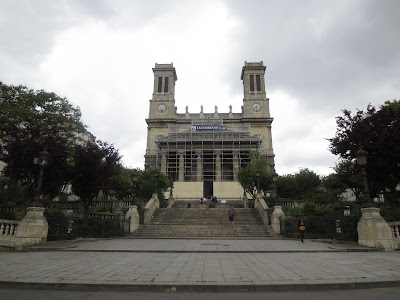
Eglise Saint-Vincent-de-Paul
A church (église) built during 1824 to 1844 on the site of the ancient Saint-Lazare prison enclosure.
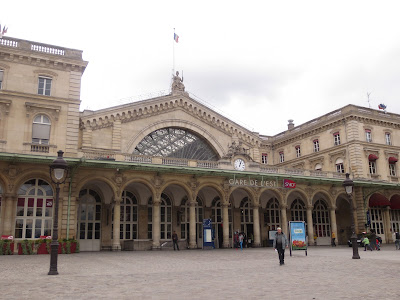
Gare de l'Est
Another of Paris' six main train stations, located close to Gare du Nord, this one caters to several destinations east of Paris, including Reims, Strasbourg, Munich, Frankfurt, Luxembourg.
Jardin Villemin
A garden (jardin) located on the site of a former military hospital of the same name.


Upon entering the garden, I saw a group of 20 or so people having a picnic in a semi-enclosed corner. Some were eating, and others were playing pétanque. The garden being virtually empty of groups at that time of day, I decided to go say hello to the picnickers. This was not without some anxiety.
As soon as I walked into their space, a guy from the group came to greet me as I was about to start my routine. Before I could finish, he stopped me, lashing out a barrage of statements, sometimes in French, sometimes in English, that left me a little lost: "I don't speak English. I speak Japanese, you? Chinese? I speak Chinese. I am Arab. You speak Arab? I don't like English people." He was being totally difficult, or maybe it was simply his nature, but I didn't budge. Even though I came to expect that he would not understand my question, I still had to ask it though, and in English: "Are you from Annapolis, Maryland?" Without a surprise, his response was incoherent. But he created a wonderful opening for me to escape. Facing me, he pulled out his hand inviting me for a handshake and, at the same moment, turned his torso away slightly, as if he was posing for someone taking a picture in front of us. Then he shouted, "Photo!", and amusingly enough, having understood what was going on, I posed. He smiled at me, after which he went to join his group. Suddenly alone, I collected myself and left the area.
The least ‒ and the only thing ‒ that I could say that was my mission had been accomplished.
Canal Saint-Martin
On the border of Jardin Villemin lies this 4.5-kilometer long canal, whose course through the 10th arrondissement is open or visible (as opposed to underground, like its course through the neighboring 11th). Its construction began in 1805 and lasted until 1825, due to difficulties of carrying out such an extensive work in an already very urban city. The canal is home to 9 locks and can be crossed via 2 movable bridges, 2 fixed bridges, and 6 footbridges.


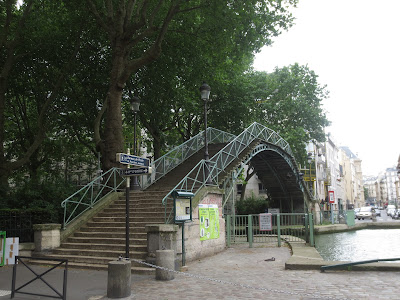
It was here that I first witnessed the mechanism of locks four summers ago. I thought that it was the coolest thing to experience.
During my stroll, I noticed that there were a lot of English speakers around the canal. It was also a Sunday afternoon. In addition, there seemed to be many trendy places to eat and drink in the neighborhood, and the mood appeared to be cheerful, in spite of the visiting rain. I suppose that it all attests to the charm of this popular area. Some people undoubtedly find it romantic.
As far as Operation 50 First States is concerned, I encountered my most serious doubts along the canal. While groups of people were frequent on my path, I just was not sure how to manage the situation. I was asking myself a lot of questions: "Should I approach that family with kids? The pregnant woman with a stroller who's accompanied by her husband? This guy clearly kicking game to the girl walking with him? That group of teenagers? What if those people coming up are Americans? Yes, I was right, they are Americans, good thing that I did not approach them. But it would have been funny if I had, right? This is just too weird. Not to mention daft." Yet all I needed to do was to ask two groups the same question that I had already asked more than a thousand times, and then I could leave the canal for good. It took a decent while and some repeated steps, but I eventually pulled through. Go me!
Hôpital Saint-Louis
A hospital that specializes in dermatology, as well as hematology, oncology, and plastic surgery.
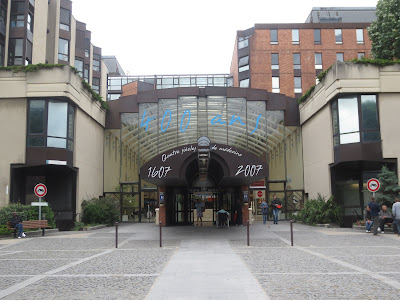
This hospital has one of the aesthetically pleasing grounds that I have ever seen in a Parisian hospital. Then again, I have not been to many hospitals in Paris.
As I walked on a sidewalk across from the hospital, I noticed a young couple headed in my direction. Since it was time to ask a guy the question, I went to the guy of the couple and asked: "Are you from Trenton, New Jersey?" I found him smiling after he heard the question. Still cheerful, he replied: "No. You thought I was from there?" I then conceded, saying: "No. I was just bored." He let out a bigger smile, and the girl who was with him was amused. We went our different ways afterwards. It was the highlight of the my day.
Place de la République
This square (place), which borders the 3rd, 10th, and 11th arrondissements, is one of the largest of Paris at more than 33,000m². It is located at the site occupied in the 14th century by the Porte du Temple stronghold, at the Wall of Charles V, one of the seven former city walls surrounding Paris. Formerly named Place du Château d'Eau, the square became, in 1883, home to a large monument symbolizing values dear to the Republic : liberty, equality, fraternity. Each of these values is represented on the monument by a statue fixed to a central column, on which stands a "Statue de la République" in the form of Marianne, the national emblem of France.
Today, the square is popular meeting place in Paris as well as a top site for demonstrations and protests.
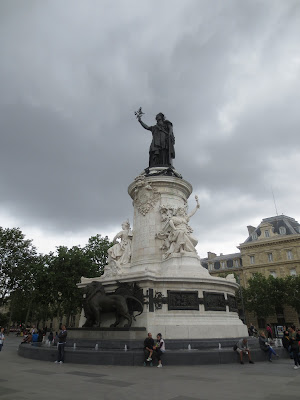


It was only during my stroll that I discovered the new look of Place de la République, which was inaugurated on June 16. The square is now much more pedestrian than it was during my previous visit. I do not remember having seen a grand square in Paris so accessible on foot before. The atmosphere was especially playful, with residents and tourists everywhere. Until the rain revisited and the square suddenly became vacant (see above).
Porte Saint-Martin
A monument commissioned by Louis XIV to commemorate his military victories, this 18-meter high triumphal arch built in limestone and marble was erected on the site of a former gate of the Wall of Charles V.

Passage Brady
This passage, constructed in 1828, is one of two iron-and-glass covered arcades located in the arrondissement. It links Rue du Faubourg-Saint-Denis to Rue du Faubourg-Saint-Martin, and is famous its numerous Indian, Pakistani, and Bangladeshi restaurants.

This may be where I had my first Indian meal in Paris, more than 10 years ago.
One thing that I quickly sensed upon entering this 216-meter long passageway is that the groups of both men and women that I crossed paths with would be rare. And I didn't want to pace the passage back and forth waiting for the right candidates to show up; that would only attract the suspicion of restaurant attendants doing their best to entice visitors to try their food, and I didn't want that. So I had no luxury to let a group pass me by; I had to give it a go without hesitation. I carried out my duties without problems for the two couples that I passed. Concerning the second one, I left the guy of the couple confused after asking the question ("Are you from Charleston, West Virginia?"), causing a nearby restaurant patron to head towards us, as if I was asking for directions. As soon as I saw him coming, I asked the guy hurriedly: "Are you from there or not?" Still looking confused, he nevertheless replied "No" and instantly we went our separate routes. The experience was quite akin to a transaction: I got straight to the point, certainly without trying to lighten up the mood for the few seconds that it lasted.
Porte Saint-Denis
Like its neighbor only 200m south east on Boulevard Saint-Denis, Porte Saint-Denis was built in the 17th century in honor of the victories of Louis XIV and is situated on the old site of the wall of Charles V. Both triumphal arches even bear the same bronze inscription: LUDOVICO MAGNO (To Louis the Great). However, Porte Saint-Denis is taller (25 meters) and was designed by an architect different from the one who designed Porte Saint-Martin.

Below are the "bonus sites" ‒ other interesting things that I saw ‒ that did not make it to the Top 10.
Even though my goal was similar to that accomplished during my visit of the 9th ‒ ask 50 groups comprised of both men and women if they came from the capital of a given American state ‒, I had to deal with certain difficulties that were virtually absent the last time around. First of all, there was the rain, which stopped by on three occasions to disrupt my flow. In addition, I encountered some serious mental obstacles, especially when I doubted myself and consequently hesitated to approach several groups. To get myself to persevere through these trying moments, I sometimes recalled a statement that I had heard last week from Miami Heat forward/center Chris Bosh. He said the following during his press conference after the Heat lost Game 5 of the NBA Finals against San Antonio Spurs: "When you are overthinking too much, you get into your own way". Lovely.
It took me more than three hours ‒ or what seemed like an eternity ‒ but I made it to Cheyenne, Wyoming, otherwise known as State Capital Number 50.
The following are the sites that I discovered along the way.
Gare du Nord
Paris' premier train station (gare) is also one of the busiest in Europe, if not the busiest. It's where you can catch trains to England, Belgium, Germany, the Netherlands, and Northern France.

This is where the afternoon got started. And the kick-off was certainly not smooth. I needed to approach two groups before I left the site, and I ended up hesitating on the first candidate, then the next, then the next, all the while walking around the corner of the train station. I even thought about tanking the operation as I held myself scoreless. I eventually mustered enough courage to push through, and after the first approach, I was good to go.
Eglise Saint-Vincent-de-Paul
A church (église) built during 1824 to 1844 on the site of the ancient Saint-Lazare prison enclosure.

Gare de l'Est
Another of Paris' six main train stations, located close to Gare du Nord, this one caters to several destinations east of Paris, including Reims, Strasbourg, Munich, Frankfurt, Luxembourg.

Jardin Villemin
A garden (jardin) located on the site of a former military hospital of the same name.


Upon entering the garden, I saw a group of 20 or so people having a picnic in a semi-enclosed corner. Some were eating, and others were playing pétanque. The garden being virtually empty of groups at that time of day, I decided to go say hello to the picnickers. This was not without some anxiety.
As soon as I walked into their space, a guy from the group came to greet me as I was about to start my routine. Before I could finish, he stopped me, lashing out a barrage of statements, sometimes in French, sometimes in English, that left me a little lost: "I don't speak English. I speak Japanese, you? Chinese? I speak Chinese. I am Arab. You speak Arab? I don't like English people." He was being totally difficult, or maybe it was simply his nature, but I didn't budge. Even though I came to expect that he would not understand my question, I still had to ask it though, and in English: "Are you from Annapolis, Maryland?" Without a surprise, his response was incoherent. But he created a wonderful opening for me to escape. Facing me, he pulled out his hand inviting me for a handshake and, at the same moment, turned his torso away slightly, as if he was posing for someone taking a picture in front of us. Then he shouted, "Photo!", and amusingly enough, having understood what was going on, I posed. He smiled at me, after which he went to join his group. Suddenly alone, I collected myself and left the area.
The least ‒ and the only thing ‒ that I could say that was my mission had been accomplished.
Canal Saint-Martin
On the border of Jardin Villemin lies this 4.5-kilometer long canal, whose course through the 10th arrondissement is open or visible (as opposed to underground, like its course through the neighboring 11th). Its construction began in 1805 and lasted until 1825, due to difficulties of carrying out such an extensive work in an already very urban city. The canal is home to 9 locks and can be crossed via 2 movable bridges, 2 fixed bridges, and 6 footbridges.


It was here that I first witnessed the mechanism of locks four summers ago. I thought that it was the coolest thing to experience.
During my stroll, I noticed that there were a lot of English speakers around the canal. It was also a Sunday afternoon. In addition, there seemed to be many trendy places to eat and drink in the neighborhood, and the mood appeared to be cheerful, in spite of the visiting rain. I suppose that it all attests to the charm of this popular area. Some people undoubtedly find it romantic.
As far as Operation 50 First States is concerned, I encountered my most serious doubts along the canal. While groups of people were frequent on my path, I just was not sure how to manage the situation. I was asking myself a lot of questions: "Should I approach that family with kids? The pregnant woman with a stroller who's accompanied by her husband? This guy clearly kicking game to the girl walking with him? That group of teenagers? What if those people coming up are Americans? Yes, I was right, they are Americans, good thing that I did not approach them. But it would have been funny if I had, right? This is just too weird. Not to mention daft." Yet all I needed to do was to ask two groups the same question that I had already asked more than a thousand times, and then I could leave the canal for good. It took a decent while and some repeated steps, but I eventually pulled through. Go me!
Hôpital Saint-Louis
A hospital that specializes in dermatology, as well as hematology, oncology, and plastic surgery.

 |
| Quadrilatère Saint-Louis |
 |
| Quadrilatère Saint-Louis |
 |
| Exit to Place du Docteur Alfred Fournier |
This hospital has one of the aesthetically pleasing grounds that I have ever seen in a Parisian hospital. Then again, I have not been to many hospitals in Paris.
As I walked on a sidewalk across from the hospital, I noticed a young couple headed in my direction. Since it was time to ask a guy the question, I went to the guy of the couple and asked: "Are you from Trenton, New Jersey?" I found him smiling after he heard the question. Still cheerful, he replied: "No. You thought I was from there?" I then conceded, saying: "No. I was just bored." He let out a bigger smile, and the girl who was with him was amused. We went our different ways afterwards. It was the highlight of the my day.
Place de la République
This square (place), which borders the 3rd, 10th, and 11th arrondissements, is one of the largest of Paris at more than 33,000m². It is located at the site occupied in the 14th century by the Porte du Temple stronghold, at the Wall of Charles V, one of the seven former city walls surrounding Paris. Formerly named Place du Château d'Eau, the square became, in 1883, home to a large monument symbolizing values dear to the Republic : liberty, equality, fraternity. Each of these values is represented on the monument by a statue fixed to a central column, on which stands a "Statue de la République" in the form of Marianne, the national emblem of France.
Today, the square is popular meeting place in Paris as well as a top site for demonstrations and protests.

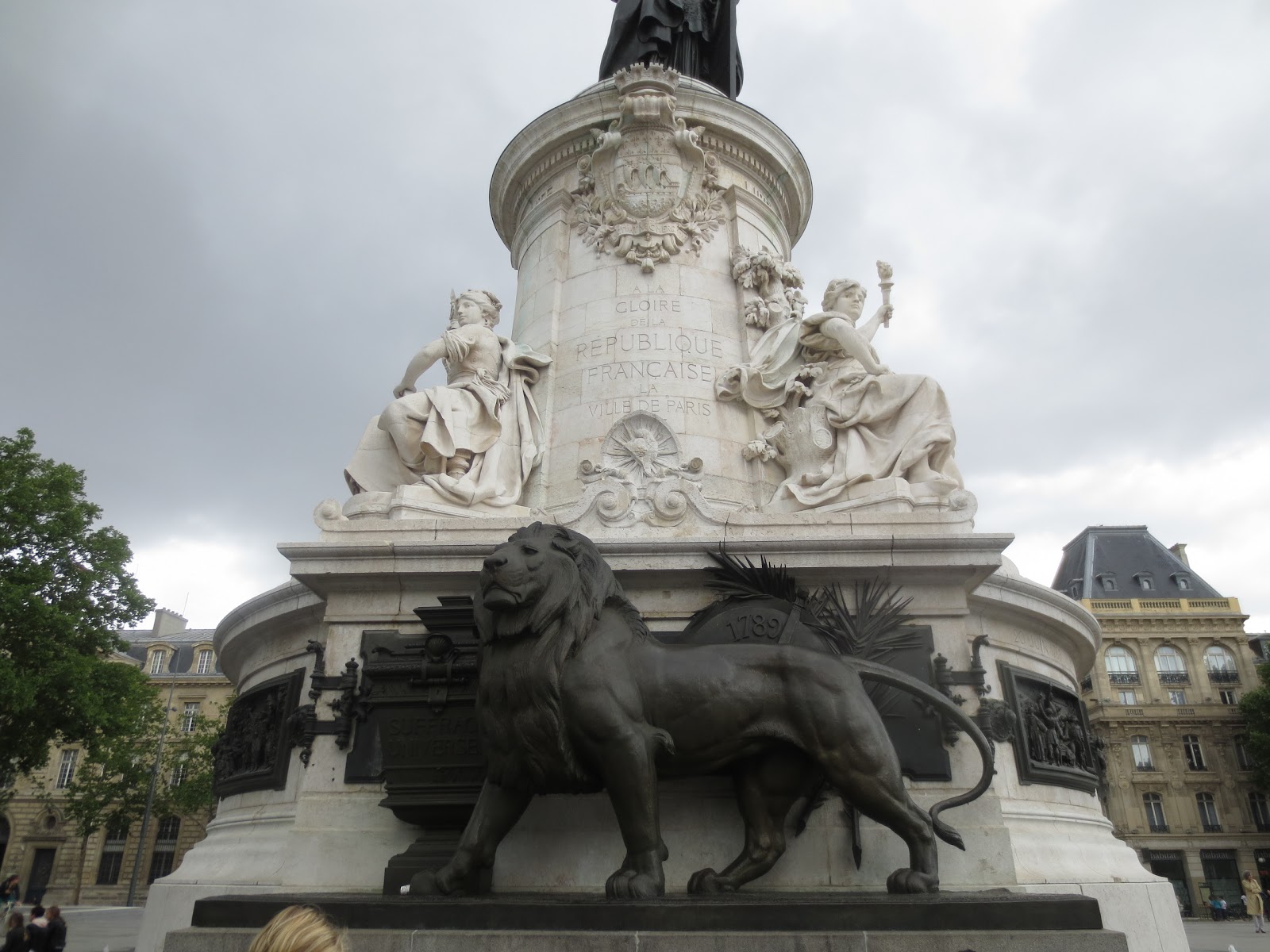

It was only during my stroll that I discovered the new look of Place de la République, which was inaugurated on June 16. The square is now much more pedestrian than it was during my previous visit. I do not remember having seen a grand square in Paris so accessible on foot before. The atmosphere was especially playful, with residents and tourists everywhere. Until the rain revisited and the square suddenly became vacant (see above).
Porte Saint-Martin
A monument commissioned by Louis XIV to commemorate his military victories, this 18-meter high triumphal arch built in limestone and marble was erected on the site of a former gate of the Wall of Charles V.

Passage Brady
This passage, constructed in 1828, is one of two iron-and-glass covered arcades located in the arrondissement. It links Rue du Faubourg-Saint-Denis to Rue du Faubourg-Saint-Martin, and is famous its numerous Indian, Pakistani, and Bangladeshi restaurants.

This may be where I had my first Indian meal in Paris, more than 10 years ago.
One thing that I quickly sensed upon entering this 216-meter long passageway is that the groups of both men and women that I crossed paths with would be rare. And I didn't want to pace the passage back and forth waiting for the right candidates to show up; that would only attract the suspicion of restaurant attendants doing their best to entice visitors to try their food, and I didn't want that. So I had no luxury to let a group pass me by; I had to give it a go without hesitation. I carried out my duties without problems for the two couples that I passed. Concerning the second one, I left the guy of the couple confused after asking the question ("Are you from Charleston, West Virginia?"), causing a nearby restaurant patron to head towards us, as if I was asking for directions. As soon as I saw him coming, I asked the guy hurriedly: "Are you from there or not?" Still looking confused, he nevertheless replied "No" and instantly we went our separate routes. The experience was quite akin to a transaction: I got straight to the point, certainly without trying to lighten up the mood for the few seconds that it lasted.
Porte Saint-Denis
Like its neighbor only 200m south east on Boulevard Saint-Denis, Porte Saint-Denis was built in the 17th century in honor of the victories of Louis XIV and is situated on the old site of the wall of Charles V. Both triumphal arches even bear the same bronze inscription: LUDOVICO MAGNO (To Louis the Great). However, Porte Saint-Denis is taller (25 meters) and was designed by an architect different from the one who designed Porte Saint-Martin.

Below are the "bonus sites" ‒ other interesting things that I saw ‒ that did not make it to the Top 10.
 |
| Eglise Saint-Laurent |
 |
| Building facade on Rue du Faubourg-Saint-Denis |
 |
| Antoine & Lili own this block |
 |
| Théâtre de la Porte Saint-Martin |
Friday, June 21, 2013
changing the world

This is the message that I took away from Color Me Katie, the blog of professional fun maker and Improv Everywhere photographer Katie Soloker.
So yes, we should not fight to change the world itself, but to stop it, from changing us. Have you ever heard anything so simple, so beautiful?
How can we stop the world from changing us? I believe that we can do this by asserting our uniqueness. This requires us to not only recognize our uniqueness ‒ be it a vision, an idea, a business, a method, a technology, a personality or whatever ‒ but to also cultivate it and celebrate it with the world. This is where the fight is. A fight against peer pressure perhaps, but more importantly, a fight for ourselves.
Ironically, this would be how we can change the world for the better. History is replete with examples of people who, in the process of asserting their uniqueness, have changed the world for the better. One of my favorite is Kanye West.
If changing the world seems too big of a challenge to deal with, you can assert your uniqueness instead. Recognize it, cultivate it, and celebrate it with others. Don’t be surprised if you see the world around you changing afterwards.
Sunday, June 16, 2013
advice and examples
When it comes to solving personal problems, like low self-esteem and others related to individual psychology, I like to believe that what people really want is not advice, but examples.
Advice is good and there’s plenty of it to be found out there, whether the source be a book or a friend. Besides, some of us already know the advice we are seeking. By itself though, advice has limited weight. For example, someone who tends to experience loneliness may learn – if he does not already know – that he should try engaging more in social interactions to alleviate his problem. But if this advice comes from a person who he does not perceive as being naturally sociable or determined to become naturally sociable, it becomes easy to neglect the advice. It’s just not compelling enough.
Better than looking for advice, I think, is looking for examples. It is easier to relate to the example set forth by someone, and, because of this, an example is generally more inspiring. An example is like advice personified; a concrete idea of what we want to be that we can see, hear, and point to. This kind of tangible evidence goes a long way in giving us hope that things are possible and, more importantly, in letting us know we are not alone with the problems we are facing.
Even better than looking for examples, I think, is being the example. Looking for examples instead of advice is great, but to solve the personal problem, the one that got things started in the first place, the examples – once discovered and deemed valuable – have to be ultimately integrated with one’s own life. This, to me, is a kind of problem solving that is not only authentic and creative by definition, but that also can serve as an example to others.
I have gotten some advice, I have found some examples, and I will probably keep doing more of both. More than that though, I am going to serve as an example. To myself, at least. It’s just more enjoyable.
Be the change that you wish to see in the world.
– Mahatma Gandhi
Advice is good and there’s plenty of it to be found out there, whether the source be a book or a friend. Besides, some of us already know the advice we are seeking. By itself though, advice has limited weight. For example, someone who tends to experience loneliness may learn – if he does not already know – that he should try engaging more in social interactions to alleviate his problem. But if this advice comes from a person who he does not perceive as being naturally sociable or determined to become naturally sociable, it becomes easy to neglect the advice. It’s just not compelling enough.
Better than looking for advice, I think, is looking for examples. It is easier to relate to the example set forth by someone, and, because of this, an example is generally more inspiring. An example is like advice personified; a concrete idea of what we want to be that we can see, hear, and point to. This kind of tangible evidence goes a long way in giving us hope that things are possible and, more importantly, in letting us know we are not alone with the problems we are facing.
Even better than looking for examples, I think, is being the example. Looking for examples instead of advice is great, but to solve the personal problem, the one that got things started in the first place, the examples – once discovered and deemed valuable – have to be ultimately integrated with one’s own life. This, to me, is a kind of problem solving that is not only authentic and creative by definition, but that also can serve as an example to others.
I have gotten some advice, I have found some examples, and I will probably keep doing more of both. More than that though, I am going to serve as an example. To myself, at least. It’s just more enjoyable.
Be the change that you wish to see in the world.
– Mahatma Gandhi
Subscribe to:
Posts (Atom)